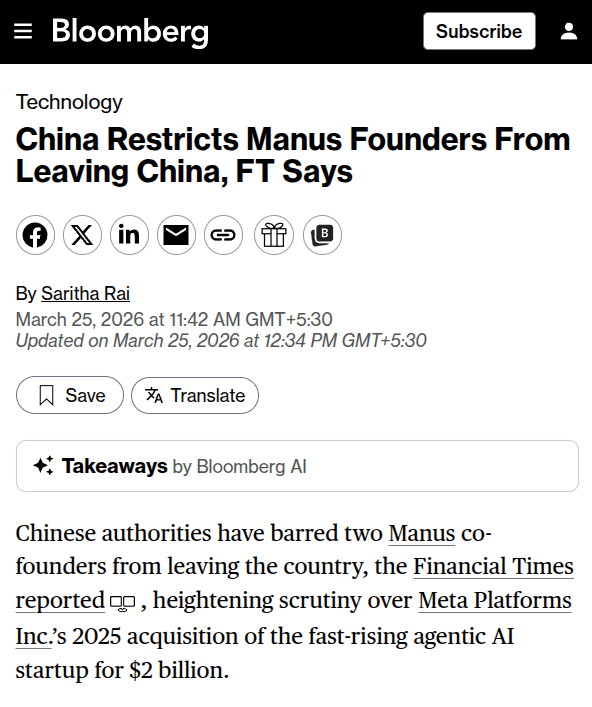
Chinese authorities have taken the significant step of barring the founders of AI startup Manus from leaving the country, according to a Bloomberg report. This travel restriction comes amid heightened regulatory scrutiny of Meta's acquisition of the fast-growing agentic AI company. The investigation centers on whether Manus restructured its operations and moved key assets overseas in a manner that circumvented Chinese regulations on foreign investment, technology transfer, and national security.
The Regulatory Scrutiny
The core of Beijing's concern appears to be the corporate structure and asset transfer preceding the acquisition. Manus, a startup with Chinese roots that reportedly reached roughly $100 million in annualized revenue rapidly, shifted its operational center of gravity to Singapore, accepted foreign funding, and then became a target for acquisition by Meta. This sequence of events—rapid growth, overseas restructuring, foreign investment, and acquisition by a major U.S. tech firm—has triggered a hard look from Chinese regulators.
The fundamental regulatory question is one of corporate identity and control: Was Manus truly an overseas company by the time of the sale to Meta? Or did its China-linked entities, core talent, and underlying technology mean the deal should have been subject to Chinese oversight and controls? Authorities are examining whether the restructuring was a legitimate business move or a mechanism to sidestep rules designed to govern the export of sensitive technology and protect national interests.
Potential Outcomes and Implications
No formal charges have been reported against the founders or the companies involved. However, the imposition of exit bans represents a serious escalation in the probe. According to the report, an extreme potential outcome could involve Chinese authorities forcing changes to the acquisition terms or even unwinding the deal entirely.
Such an action would send a sharp, unambiguous message to the global tech and investment community: AI startups with significant Chinese roots, talent, or technology cannot assume that cross-border corporate restructuring will automatically shield a major sale from state review. It underscores that China's regulatory reach extends to companies and individuals based on their origins and technological assets, not merely their current legal domicile.
This case highlights the increasingly complex intersection of AI innovation, global capital flows, and national security frameworks. For startups operating in sensitive technology sectors like agentic AI, navigating growth, funding, and potential exit strategies now requires careful consideration of multiple, sometimes conflicting, regulatory regimes.
gentic.news Analysis
This development is a concrete escalation in the ongoing friction between U.S. tech expansion and Chinese regulatory sovereignty over its domestic tech ecosystem. It follows a pattern of increasing scrutiny that we've tracked, where Chinese authorities are asserting control over technology deemed strategically important, regardless of where a company is formally headquartered. This isn't about paperwork; it's a substantive challenge to the global venture capital playbook of growing a startup in one market and selling it in another.
The case of Manus is particularly sensitive because it hits several triggers simultaneously: it's in the strategic sector of agentic AI, achieved meteoric revenue growth, and was acquired by Meta, a U.S. tech giant already in a tense geopolitical relationship with China. This aligns with our previous coverage on China's tightening controls over AI model exports and data flows. The move to bar founders from leaving the country is a severe administrative measure typically reserved for investigations where the state perceives a serious risk of asset or technology flight, or non-cooperation.
For practitioners and investors, this signals that the era of assuming "offshore holding company = regulatory safety" for Chinese-linked tech startups is over. Due diligence for any M&A involving AI talent or IP with connections to China must now include a deep analysis of potential PRC regulatory exposure, not just the laws of the incorporation jurisdiction. This will likely chill cross-border M&A in the AI space, pushing more consolidation within China's own ecosystem and potentially creating a more bifurcated global AI development landscape.
Frequently Asked Questions
Why are the Manus founders barred from leaving China?
Chinese authorities have imposed exit bans on the founders as part of an investigation into Meta's acquisition of the AI startup Manus. The probe is examining whether the company's restructuring and move of key assets to Singapore were done to circumvent Chinese rules on foreign investment, technology transfer, and national security related to sensitive AI technology.
What is Manus and why is its acquisition significant?
Manus is a fast-growing agentic AI startup with Chinese roots that reportedly reached about $100 million in annualized revenue. Its acquisition by U.S. tech giant Meta is significant because it represents a rare case of a major U.S. company buying an Asian AI startup at scale. The deal's structure and the origin of Manus's technology have now drawn intense regulatory scrutiny from Chinese authorities.
What could happen to the Meta-Manus acquisition deal?
While no charges have been filed, potential outcomes range from the deal proceeding with modifications to, in an extreme scenario, Chinese authorities forcing an unwinding of the acquisition. The latter would be a drastic measure intended to assert regulatory authority and deter similar attempts to move Chinese-linked AI technology and talent overseas without oversight.
What does this mean for other AI startups with Chinese connections?
This case sets a stark precedent. It signals that AI startups with significant Chinese roots, talent, or technology cannot assume that incorporating or restructuring overseas will protect a future sale from Chinese regulatory review. Investors and founders must now account for PRC national security and technology export controls as a major risk factor in their growth and exit strategies.