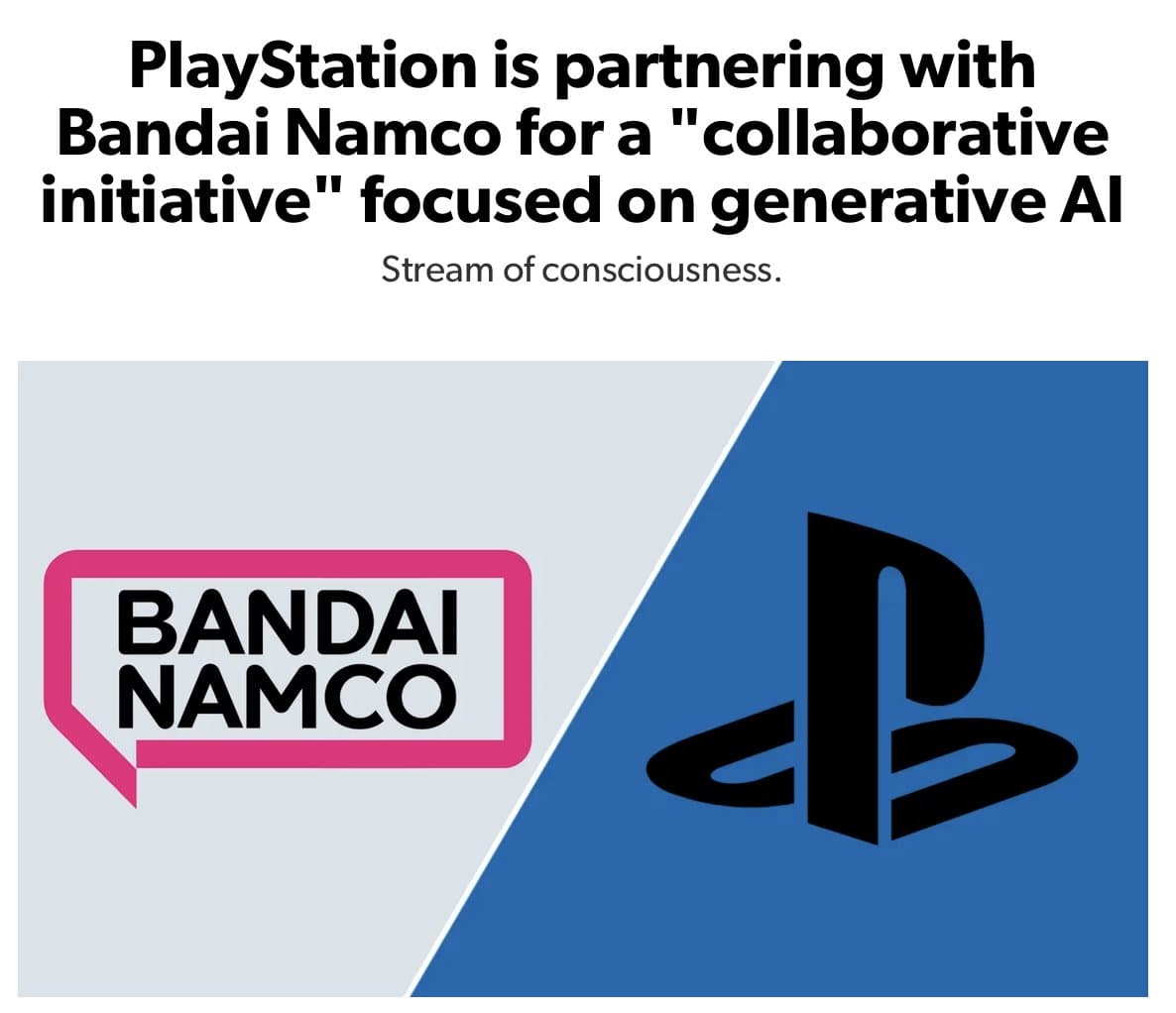
Sony and Bandai Namco launched a collaborative pilot using generative AI to accelerate game development. The initiative targets facial animation, QA, payments, visual fidelity, and future recommendation tools.
Key facts
- Sony and Bandai Namco launched a generative AI pilot for game development.
- AI targets facial animation, QA, payments, and visual fidelity.
- Sony cites DLSS and PSSR as prior AI steps.
- No specific timeline or budget disclosed for the pilot.
- Pilot positions generative AI as a speedup, not replacement.
Sony and Bandai Namco are launching a collaborative pilot around generative AI, positioning the tech as a way to speed up game development. Sony says AI is already helping with facial animation, QA, payments, visual fidelity, and future recommendation tools. With DLSS and PSSR were just the beginning.
Key Takeaways
- Sony and Bandai Namco pilot generative AI for faster game dev.
- AI targets facial animation, QA, payments, and visual fidelity.
Unique take

This pilot is less about replacing artists and more about compressing the iteration loop. Facial animation and QA are notoriously manual, high-friction tasks in AAA pipelines. If generative AI can cut a 3-week animation review cycle to 3 days, the cost savings compound across a studio's entire slate. Sony's reference to DLSS and PSSR—both real-time upscaling techniques—signals they view generative AI as a natural extension of existing GPU-accelerated workflows, not a disruptive new layer.
What's at stake
Bandai Namco, publisher of Elden Ring and Tekken, operates some of the most complex production pipelines in the industry. A successful pilot could set a template for other Japanese publishers, who have been slower to adopt AI tooling than Western studios. Sony, meanwhile, has a dual incentive: its PlayStation division wants faster, cheaper game production, while its imaging and semiconductor businesses sell the hardware that runs these AI workloads.
The competitive landscape

Other game companies are further along. Roblox has shipped generative AI tools for asset creation. Microsoft's Xbox division has invested in AI-driven narrative and QA. Epic Games has integrated AI into Unreal Engine. Sony and Bandai Namco's pilot is notable for its specificity—targeting concrete production pain points rather than vague "efficiency gains"—and for the partnership structure, which could become a blueprint for co-development between platform holders and publishers.
What to watch
Watch for specific metrics from the pilot—reduction in animation iteration time, QA bug detection rates, or cost per title. If Bandai Namco publicly credits the pilot for a ship-date acceleration, expect other Japanese publishers to follow within 6–12 months.