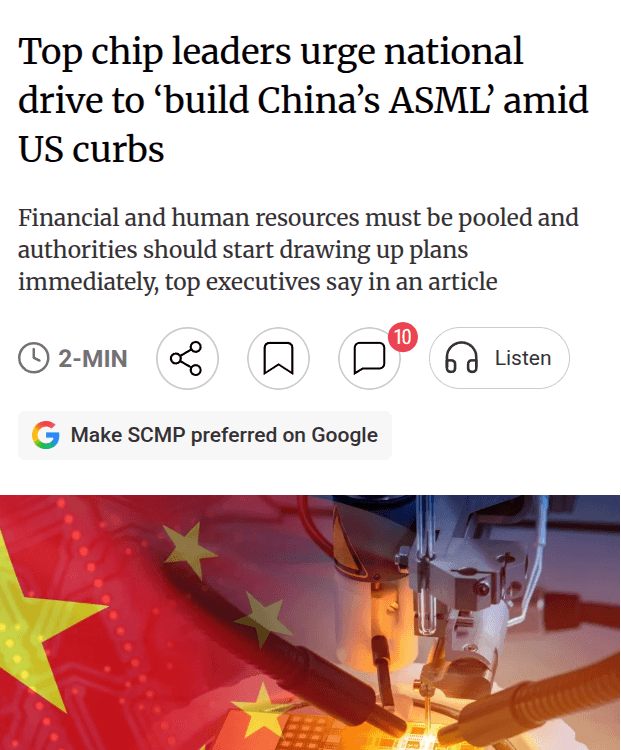
China's semiconductor industry has issued a stark warning and a bold declaration of intent. This week, the country's most senior chip executives publicly called for a consolidated national effort to develop domestic alternatives to the extreme ultraviolet (EUV) lithography machines produced by Dutch giant ASML. This comes alongside the Chinese government's commitment of $47.5 billion through a state fund specifically targeting these advanced tools, signaling a strategic pivot toward technological self-sufficiency in the face of escalating export controls.
The Lithography Chokehold
At the heart of modern computing power lies the semiconductor, and at the heart of cutting-edge semiconductor manufacturing lies lithography. To create the advanced processors that power everything from smartphones to AI data centers, factories use EUV lithography machines to etch billions of microscopic circuits onto silicon wafers. For the most advanced chips at 7-nanometer nodes and below, ASML stands alone. The Dutch company is the sole global manufacturer of the EUV scanners required for this production, making it a linchpin in the entire global tech supply chain.
For China, this represents a critical vulnerability. Stringent export controls, led by the United States and adhered to by the Netherlands, prevent Chinese companies from purchasing these state-of-the-art machines. This blockade effectively caps China's ability to produce the most advanced logic chips domestically, a direct impediment to its ambitions in artificial intelligence, supercomputing, and high-tech manufacturing.
A Fragmented Foundation
The public call to action, as reported by the South China Morning Post and highlighted by industry observers, underscores a painful self-assessment. China's chip equipment industry is currently described by its own leaders as too "small, fragmented, and weak." This fragmentation means resources, talent, and research are dispersed across multiple competing entities without the cohesive scale needed to tackle a challenge as monumental as replicating ASML's ecosystem.
The technological gap is vast. The most advanced lithography machine China has produced domestically is reported to only match the capabilities of an ASML model from 2008—a tool designed for older deep ultraviolet (DUV) lithography, not the cutting-edge EUV process. Bridging this 15-year gap in a domain where progress is measured in atomic-scale precision is a herculean task.
The $47.5 Billion National Project
The government's response is a massive financial injection. The 344 billion yuan ($47.5 billion) state fund represents the third phase of China's National Integrated Circuit Industry Investment Fund, often called the "Big Fund." Its clear directive is to de-bottleneck the equipment sector, with a laser focus on lithography.
This capital is not just for a single company but is intended to foster an entire ecosystem. Building an EUV scanner is arguably one of the most complex engineering feats in the world. A single machine contains hundreds of thousands of components, relies on parts from over 5,000 specialized global suppliers, and involves groundbreaking innovations in optics, precision mechanics, and laser-produced plasma. China's strategy appears to be one of vertical integration, aiming to cultivate or substitute for every link in this immense supply chain.
Implications for the Global Tech Landscape
This move has profound implications. First, it marks a definitive shift from China's previous strategy of acquiring technology through partnerships and purchases to one of forced indigenous innovation. Success is not guaranteed, but the concentration of political will and capital is unprecedented.
Second, it accelerates the bifurcation of the global tech ecosystem. The world is moving toward parallel, decoupled supply chains: one centered on the US and its allies with access to ASML tools, and another led by China, striving to create its own. This could lead to competing standards, reduced interoperability, and increased costs industry-wide.
Finally, it places immense pressure on ASML's monopoly. While the Dutch firm's technological lead is secure for the foreseeable decade, the emergence of a determined, well-funded national competitor could reshape the long-term market dynamics. It also raises questions about intellectual property and the potential for reverse-engineering from older, legally acquired DUV machines.
The Long Road Ahead
The challenges are monumental. Beyond the sheer physics and engineering, China must solve acute talent shortages in hyper-specialized fields like computational lithography and EUV source design. It must also develop advanced optics and metrology tools that are themselves subject to export restrictions.
The call for consolidation suggests that Beijing may push for mergers or state-coordinated consortiums to pool resources, reducing redundant competition. The model may resemble historic "moonshot" projects, where national objectives override commercial market logic.
For the global AI race, the stakes are clear. Advanced AI training clusters depend on the most advanced chips, which depend on EUV lithography. China's drive to build its own ASML is, fundamentally, a drive to secure the foundational technology for its AI future, independent of Western policy shifts. The success or failure of this $47.5 billion national project will be a defining story for the next decade of technological geopolitics.
Source: South China Morning Post, "Top chip leaders urge national drive to build China's ASML amid US curbs" (SCMP.com).