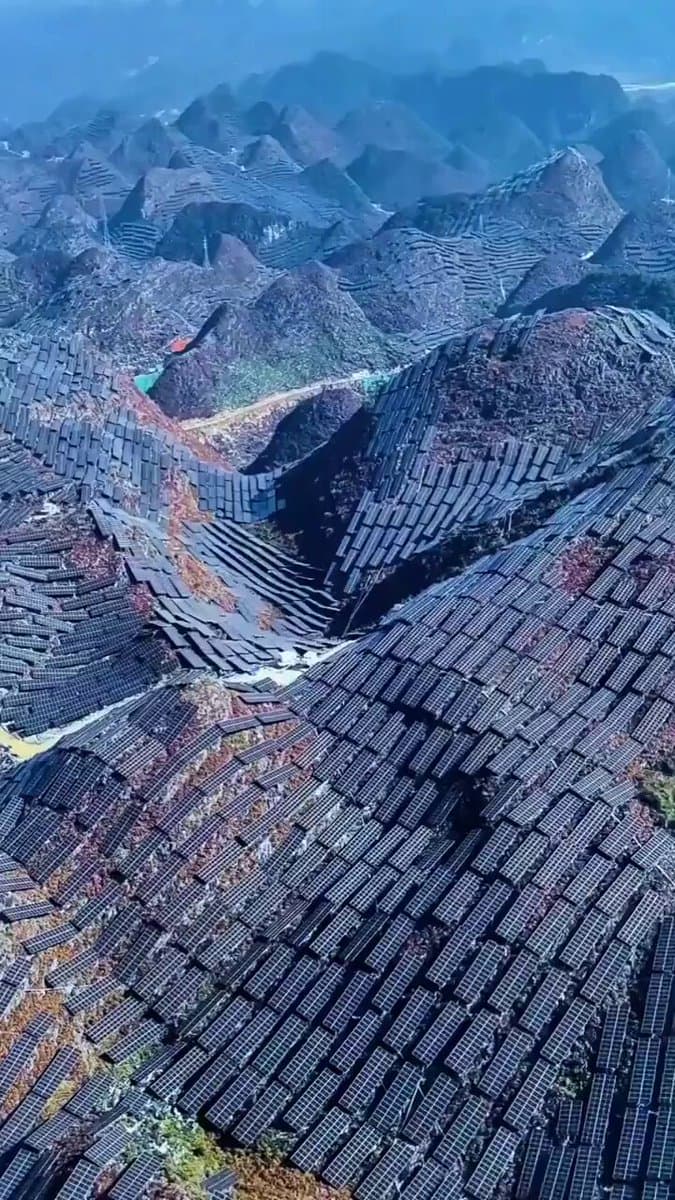
A remarkable transformation is underway in rural Guizhou province, where entire hillsides have been converted into vast solar energy farms. Thousands of solar panels now stretch across mountain ridges to the horizon, turning previously barren rock formations into significant electricity generators capable of producing terawatt-hours of power. This development represents more than just another renewable energy project—it showcases China's distinctive approach to infrastructure development at a scale that challenges conventional Western perceptions of solar implementation.
The Guizhou Solar Transformation
The specific installation referenced in Guizhou province demonstrates several innovative approaches to renewable energy deployment. Rather than utilizing flat, easily accessible land—a common constraint for solar projects in many countries—Chinese engineers have adapted solar technology to challenging mountainous terrain. This approach solves multiple problems simultaneously: it utilizes land with limited agricultural or residential value, takes advantage of higher altitude locations that often receive stronger sunlight with less atmospheric interference, and creates energy infrastructure in regions that might otherwise lack substantial economic development opportunities.
What makes this project particularly noteworthy is its sheer physical scale. The description of panels stretching "across mountain ridges to the horizon" suggests an installation covering multiple peaks and valleys, potentially spanning several square kilometers. Such topography-agnostic deployment represents a significant engineering achievement, requiring specialized mounting systems, transmission infrastructure, and maintenance protocols adapted to steep slopes and remote locations.
China's Distinctive Scale Advantage
China's ability to execute projects of this magnitude stems from several structural advantages. The country's centralized planning system allows for coordinated land use decisions that would be difficult in more decentralized governance models. Additionally, China's manufacturing dominance in solar panel production creates cost advantages that make massive deployments economically feasible. The scale of these installations likely benefits from economies that smaller projects cannot achieve, potentially lowering per-watt costs despite the challenging terrain.
This approach to renewable energy reflects China's broader infrastructure philosophy: thinking in terms of systemic transformation rather than incremental additions. Where other countries might build solar farms measured in acres or hectares, China conceptualizes energy projects at the landscape level, considering how entire regions can be repurposed for energy generation. This mindset has previously been demonstrated in China's massive hydroelectric projects, high-speed rail network, and urban development patterns, and is now being applied to renewable energy with similar ambition.
Technical and Logistical Innovations
Implementing solar installations across mountainous terrain requires solving several technical challenges. Panel mounting systems must accommodate varying slopes and orientations while maintaining structural integrity. Electrical collection systems need to manage the distributed nature of generation across complex topography. Maintenance access in remote, rugged locations presents additional logistical hurdles that have presumably been addressed through innovative service approaches.
The choice of Guizhou province is particularly strategic. Located in southwestern China, the region receives substantial sunlight while offering the mountainous terrain that characterizes much of inland China. By demonstrating that such landscapes can be productively utilized for energy generation, China creates a template that could be applied across other mountainous regions, both domestically and potentially internationally.
Implications for Global Energy Transition
China's mountain-scale solar projects carry significant implications for the global transition to renewable energy. First, they demonstrate that previously considered "marginal" or "unsuitable" land can be productively harnessed for clean energy generation. This expands the potential geographical footprint for solar power beyond the desert and flatland installations that dominate current thinking.
Second, the scale of these projects suggests that China is rapidly accelerating its renewable energy capacity in ways that may not be fully captured by conventional metrics. While many analyses focus on China's continued coal plant construction, these massive solar installations represent a parallel track of clean energy development that could eventually displace fossil fuel generation.
Third, the visual impact of these installations—thousands of panels covering hillsides—serves as a powerful symbol of energy transition. Unlike rooftop solar or even ground-mounted farms that blend into flat landscapes, these mountain-scale projects make renewable energy visible at a geographical scale, potentially influencing public perception and political will regarding energy transformation.
Environmental and Social Considerations
While the renewable energy benefits are clear, projects of this scale inevitably raise environmental and social questions. The transformation of natural hillsides into industrial energy landscapes affects local ecosystems, potentially disrupting habitats and altering hydrological patterns. The social impact on rural communities—both positive in terms of economic development and potentially negative in terms of landscape alteration—warrants consideration in any comprehensive assessment.
China's approach to these considerations will likely influence how other nations view similar large-scale renewable projects. The balance between rapid decarbonization and environmental stewardship represents one of the central tensions in climate response strategies worldwide, and China's mountain solar projects provide a concrete case study in how these competing priorities are being navigated.
The Future of Landscape-Scale Renewables
The Guizhou installation points toward a future where renewable energy infrastructure becomes integrated into landscapes at a geographical rather than merely architectural scale. This represents a paradigm shift from thinking of solar panels as additions to existing structures or uses of vacant land, toward conceptualizing entire regions as potential energy-generating territories.
As solar technology continues to improve in efficiency and decrease in cost, the economic rationale for such landscape-scale deployments will strengthen. China's early experimentation with this approach positions the country to potentially export both the technology and the implementation models for similar projects elsewhere, particularly in developing nations with challenging topography and growing energy needs.
Source: Rohan Paul (@rohanpaul_ai) on X/Twitter, highlighting solar installations in rural Guizhou, China