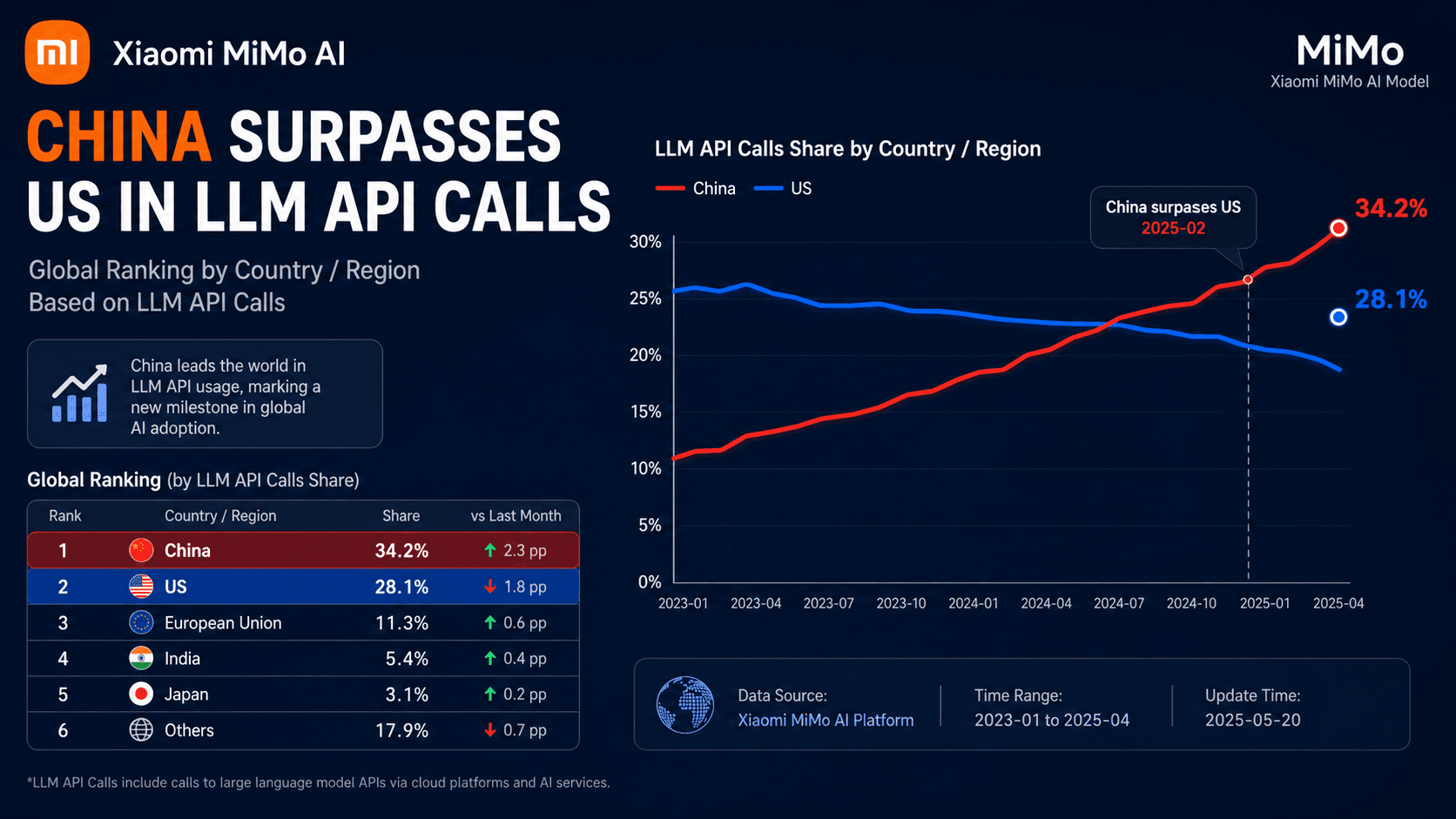
A recent analysis from AI researcher Kimmo Kärkkäinen suggests Chinese open-source AI development is rapidly closing the performance gap with leading US proprietary models. According to projections shared on social media platform X, developers in China are approximately five months behind models like Anthropic's Claude Sonnet 4.5, with open-source alternatives expected to reach comparable performance to Sonnet 4.6 or OpenAI's GPT-4o/Opus level by early 2025.
The Accelerating Open-Source Timeline
The timeline presented indicates a remarkable acceleration in China's AI capabilities. While US companies like Anthropic, OpenAI, and Google have maintained leadership in frontier model development, the open-source community—particularly in China—has demonstrated an ability to replicate and sometimes surpass proprietary architectures with smaller, more efficient models.
What makes this development particularly noteworthy is the "significantly smaller" size mentioned in the original analysis. Chinese researchers appear to be achieving Sonnet-level performance with more compact models, suggesting advances in model architecture, training efficiency, or knowledge distillation techniques that could have broader implications for AI deployment across resource-constrained environments.
Technical and Strategic Implications
This acceleration carries several important implications for the global AI landscape. First, it challenges the assumption that US companies maintain an insurmountable lead in AI capabilities. While frontier models from US labs may still push the boundaries of what's possible, the practical gap for most commercial applications appears to be narrowing rapidly.
Second, the focus on smaller, more efficient models suggests Chinese developers may be prioritizing different optimization targets than their US counterparts. Where US labs often emphasize raw capability at the expense of size and efficiency, Chinese approaches appear to balance performance with practical deployment considerations—a strategy that could prove advantageous in real-world applications.
The Open-Source Advantage
The open-source nature of these developments represents perhaps the most significant aspect of this trend. Unlike proprietary models from US companies, open-source alternatives from China would be freely available for inspection, modification, and deployment without restrictive licensing or usage fees. This could dramatically accelerate AI adoption globally, particularly in regions and industries where cost or regulatory concerns have limited access to cutting-edge AI.
Open-source models also enable greater transparency and auditability—critical factors as AI systems become more integrated into sensitive applications. While Chinese open-source models would still raise questions about training data, potential biases, and alignment approaches, their availability for independent evaluation represents a different paradigm than the "black box" nature of many proprietary systems.
Geopolitical Context and AI Competition
This development occurs against a backdrop of intensifying US-China technological competition, with AI widely recognized as a strategic domain. The US has maintained export controls on advanced AI chips and related technologies, aiming to limit China's access to cutting-edge hardware. However, the reported progress suggests Chinese researchers are finding ways to achieve competitive results despite these constraints.
The emergence of high-quality open-source alternatives from China could also complicate US efforts to maintain AI leadership through proprietary systems. If organizations worldwide can access Sonnet/Opus-level capabilities without relying on US companies, the strategic value of maintaining a closed development model may diminish.
Challenges and Considerations
Despite the optimistic projections, several challenges remain. First, benchmark performance comparisons can be misleading, as real-world capability depends on numerous factors beyond standardized tests—including safety alignment, reasoning capabilities, and specialized domain knowledge.
Second, questions about training data provenance and potential intellectual property issues will likely accompany any high-performance open-source release. The AI community will need to carefully evaluate these models for compliance with international norms and regulations.
Finally, the actual timeline remains speculative. While the five-month projection suggests rapid progress, unforeseen technical hurdles or resource constraints could alter the trajectory. The AI field has seen numerous predictions of imminent breakthroughs that failed to materialize as expected.
Looking Ahead: A More Diverse AI Ecosystem
If these projections prove accurate, the global AI landscape in 2025 could look substantially different than today. Rather than a clear hierarchy with US proprietary models at the top, we might see a more diverse ecosystem with multiple competitive options across the performance spectrum.
This diversification could benefit end-users through increased choice, lower costs, and specialized optimizations for different use cases. It could also accelerate innovation as different development approaches compete and cross-pollinate.
The coming months will provide crucial evidence about whether Chinese open-source development can indeed deliver on these projections. Regardless of the exact timeline, the trend appears clear: the gap between proprietary and open-source AI, and between US and Chinese capabilities, is narrowing faster than many anticipated.
Source: Analysis shared by Kimmo Kärkkäinen (@kimmonismus) on X/Twitter, November 2024