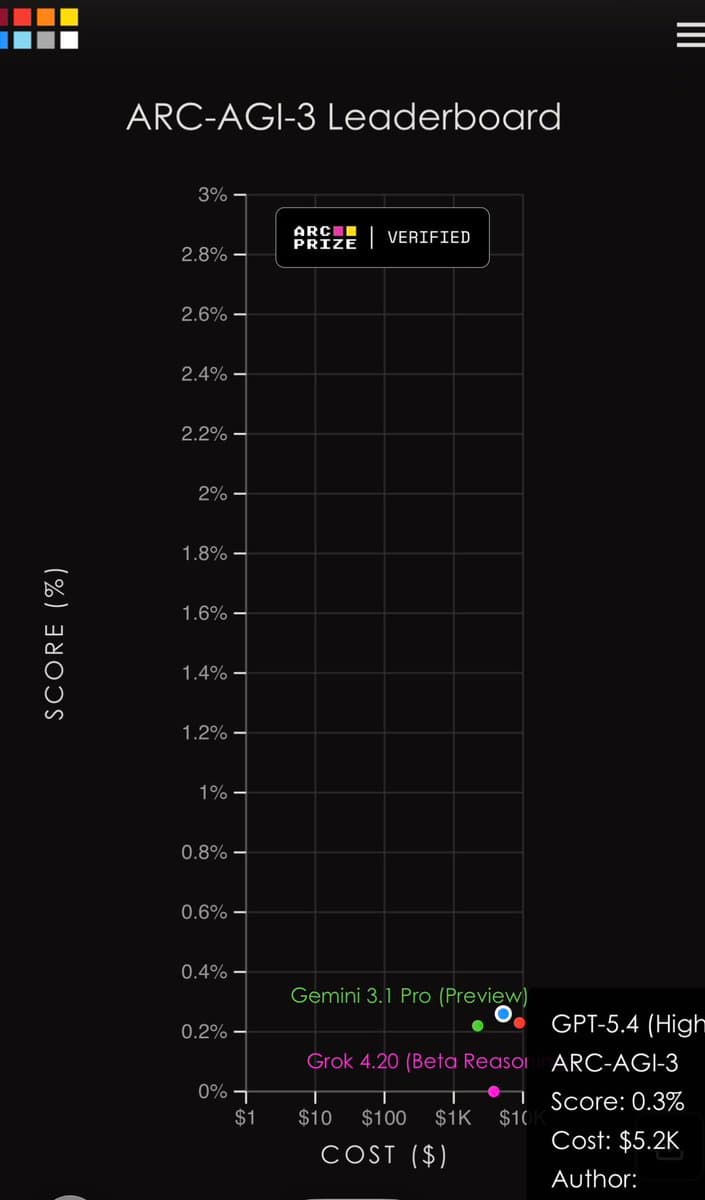
A brief social media post from an account associated with AI researcher Kimmo Kärkkäinen (@kimmonismus) has sparked discussion within the technical community. The post states: "Back to work friends. Frontier models achieve below 1% on Arc agi 3. Let’s see if this will be saturated by end of year."
What Happened
The post claims that current "frontier models"—presumably referring to the most capable large language models from labs like OpenAI, Anthropic, Google DeepMind, and others—are scoring below 1% on the ARC-AGI v3 benchmark. The ARC-AGI (Abstraction and Reasoning Corpus for Artificial General Intelligence) benchmark, created by François Chollet, is designed to measure an AI system's ability to solve novel, abstract reasoning problems from minimal examples—a capability considered core to human-like general intelligence.
The post suggests this extremely low performance may indicate a saturation point for current model architectures and training paradigms, questioning whether further scaling will yield significant improvements on this specific measure of reasoning by the end of 2025.
Context: The ARC-AGI Benchmark
ARC-AGI is notoriously difficult for current AI systems. Unlike benchmarks that test knowledge recall or pattern recognition within trained distributions, ARC-AGI presents entirely new visual reasoning puzzles. Solving them requires forming abstract concepts, inferring underlying rules from just a few examples, and applying these rules to new instances—a process known as few-shot abstraction.
Performance is typically measured as a percentage of correctly solved tasks. Prior public results have been low. For example, in 2023, the top-performing public submission on the original ARC (v1) achieved around 34%. The "v3" version referenced is likely an updated, more challenging iteration. A score below 1% for frontier models, if accurate, underscores the fundamental gap between current pattern-matching LLMs and systems capable of human-like abstract reasoning.
The Implication of "Saturation"
The mention of "saturation" points to a critical debate in AI research: the limits of scaling. The dominant paradigm for advancing AI capabilities in recent years has been scaling up model size, compute budget, and dataset size. This has produced consistent gains on many benchmarks (MMLU, GPQA, MATH). However, ARC-AGI is explicitly designed to be immune to such scaling—it cannot be solved by memorizing internet-scale data. If frontier models are truly plateauing near 0% on ARC-AGI v3, it provides empirical evidence that scaling alone may not lead to certain forms of general reasoning, potentially necessitating architectural or algorithmic breakthroughs.
gentic.news Analysis
This report, while unverified, aligns with a growing body of evidence and expert commentary we've covered at gentic.news. The performance cliff on reasoning-heavy benchmarks like ARC-AGI has been a consistent theme. In our analysis of Google's Gemini 1.5 Pro launch, we noted its impressive multimodal capabilities but also highlighted that its performance on tasks requiring deep, novel reasoning remained a distinct challenge separate from its massive context window.
The mention of potential "saturation by end of year" connects directly to the ongoing discourse about diminishing returns from scale. This follows a pattern observed in our tracking of benchmark leaderboards: while scores on knowledge-based tests continue to creep up, progress on tests of abstraction and reasoning (like ARC, BIG-Bench Hard, and certain coding puzzles) has been slower and less linear. If the sub-1% claim is accurate for the latest v3 benchmark, it represents a stark quantification of that plateau.
Furthermore, this development sits in contrast to the rapid progress seen in other areas, such as agentic coding, where models like DeepSeek-Coder-V2 and Claude 3.5 Sonnet have shown remarkable proficiency. This dichotomy reinforces the hypothesis that current transformer-based LLMs are exceptionally good at interpolation within their training distribution but struggle with the type of out-of-distribution, compositional reasoning that ARC demands. The race is now bifurcating: one track continues to push the limits of scale and efficiency on known tasks, while another, arguably more fundamental track, seeks the architectural innovations needed to conquer benchmarks like ARC-AGI.
Frequently Asked Questions
What is the ARC-AGI benchmark?
The ARC-AGI (Abstraction and Reasoning Corpus for Artificial General Intelligence) benchmark is a set of visual reasoning puzzles created by AI researcher François Chollet. It is designed to measure an AI system's ability to solve completely novel tasks by inferring abstract rules from just a few examples. Success requires strong few-shot learning and abstract reasoning, not memorization of prior data, making it a tough test for current large language models.
What does a score below 1% mean?
A score below 1% on ARC-AGI suggests that even the most advanced "frontier" AI models can correctly solve fewer than 1 out of every 100 tasks in the benchmark. This extremely low score highlights a significant gap between current AI capabilities—which excel at pattern recognition and information retrieval—and the kind of fluid, human-like abstract reasoning the benchmark is designed to measure.
Why is the ARC-AGI benchmark considered so important?
ARC-AGI is important because it targets a core component of general intelligence: the ability to handle novelty and reason abstractly. Most AI benchmarks can be gamed through scale, data, and clever fine-tuning. ARC-AGI is explicitly designed to resist these approaches, aiming to measure a model's reasoning skill directly. Persistent low scores indicate a fundamental limitation in today's dominant AI architectures.
What would it take for AI models to improve on ARC-AGI?
Substantial improvement on ARC-AGI likely requires moving beyond simply scaling up existing transformer models. Researchers are exploring avenues like hybrid neuro-symbolic architectures, improved planning algorithms, models that build internal world models, or new training paradigms that explicitly teach abstraction and rule-formation. A breakthrough here would signal a major step toward more general and robust AI.