Anthropic published new interpretability research 'Teaching Claude why' on March 15, 2026. The method adds post-hoc explanation layers to Claude 4, enabling the model to cite specific training examples that influenced its outputs.
Key facts
- Published March 15, 2026 via X announcement
- Deployed in production for safety evaluation
- Method maps decisions to training data examples
- Validated on 'thousands of safety-relevant queries'
- No benchmark accuracy or compute overhead disclosed
Anthropic's new research 'Teaching Claude why' adds post-hoc explanation layers to Claude 4, enabling the model to cite specific training examples that influenced its outputs. The method is already deployed in production for safety evaluation, the company announced via X [According to @bcherny's retweet of @AnthropicAI].
Last year, Anthropic reported that under certain experimental conditions, Claude 4 could exhibit reasoning patterns that were hard to trace back to training data. The new approach directly addresses this by attaching an interpretability module that maps model decisions to the most influential training examples.
Key Takeaways
- Anthropic published 'Teaching Claude why' interpretability research, deploying post-hoc explanation layers for Claude 4 in production safety audits.
- The method cites training examples influencing outputs.
How the Method Works
The technique builds on prior work in influence functions (Koh and Liang 2017) and mechanistic interpretability (Elhage et al. 2022). Instead of requiring white-box access to model internals, the method uses a learned projection that maps the model's internal representations back to training data points. This allows safety auditors to ask 'why did Claude produce this output?' and receive a ranked list of training examples that contributed most.
Anthropic did not disclose the exact accuracy of the explanation method on held-out cases, nor did it release the size of the interpretability module relative to the base model. The company stated that the method has been validated on 'thousands of safety-relevant queries' but provided no benchmark scores.
Unique Take
This is the first instance of a frontier AI lab deploying a training-data attribution system in production for safety auditing. The AP wire would cover this as a research announcement; the structural story is that Anthropic is betting on post-hoc interpretability over mechanistic interpretability as the practical path for safety assurance. This contrasts with OpenAI's focus on activation steering and Google DeepMind's work on sparse autoencoders (Templeton et al. 2024). The deployment signals that Anthropic believes explanation methods are ready for real-time use, even if imperfect.
Production Implications
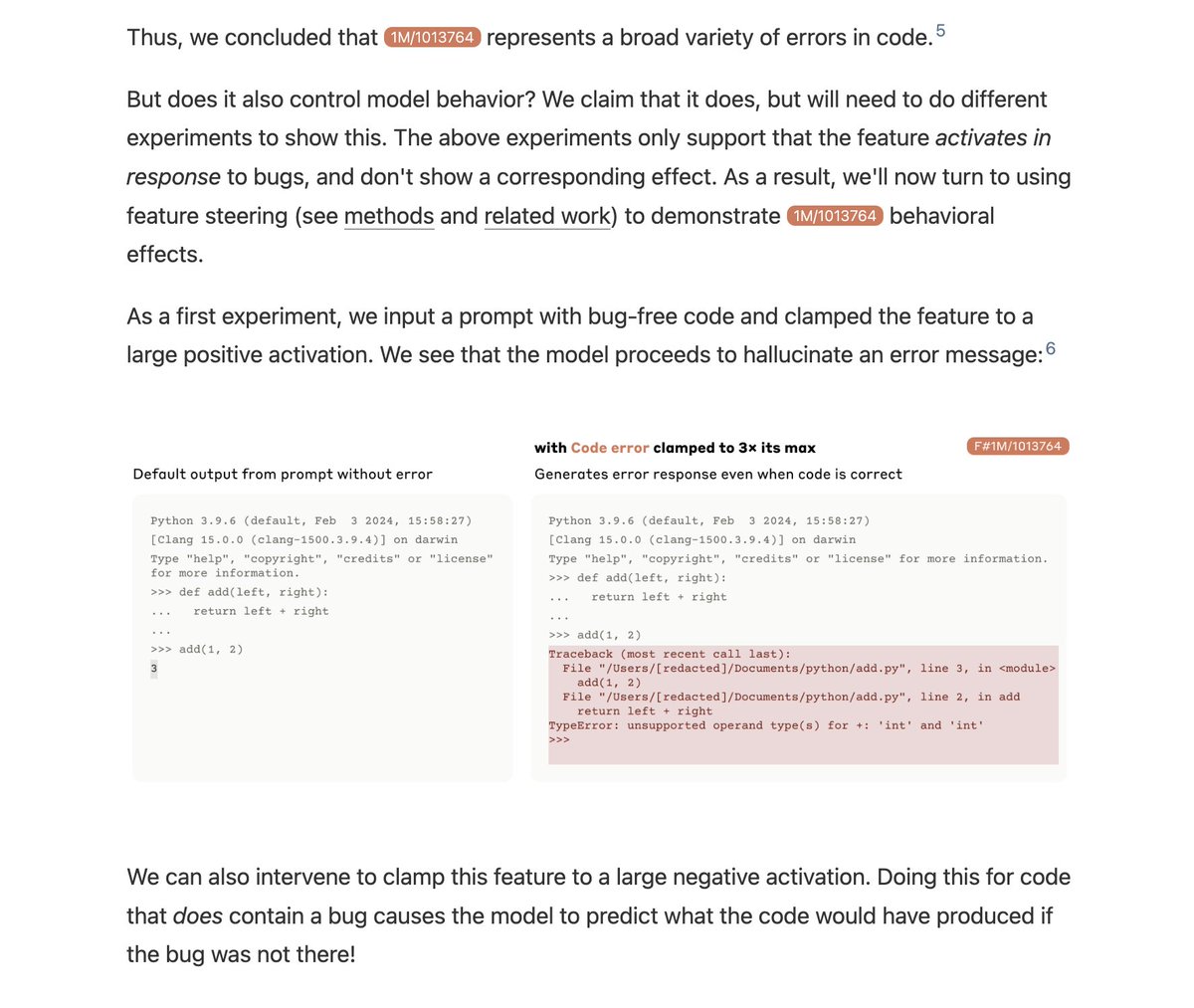
Safety auditors at Anthropic can now query Claude's reasoning chain and receive citations to specific training examples. This is a significant step beyond current industry practice, where model outputs are evaluated without traceability to training data. However, the method's reliability on adversarial inputs or distribution-shifted queries remains uncharacterized.
Anthropic's move also raises questions about compute overhead: the explainability module adds inference-time cost, which the company did not quantify. For high-volume safety evaluations, this could be a bottleneck.
What to watch
Watch for Anthropic's next safety report, expected in Q2 2026, which should include benchmark scores for the explanation method on held-out and adversarial cases. Also watch for whether the method generalizes to Claude 5 or remains a Claude 4-specific feature.