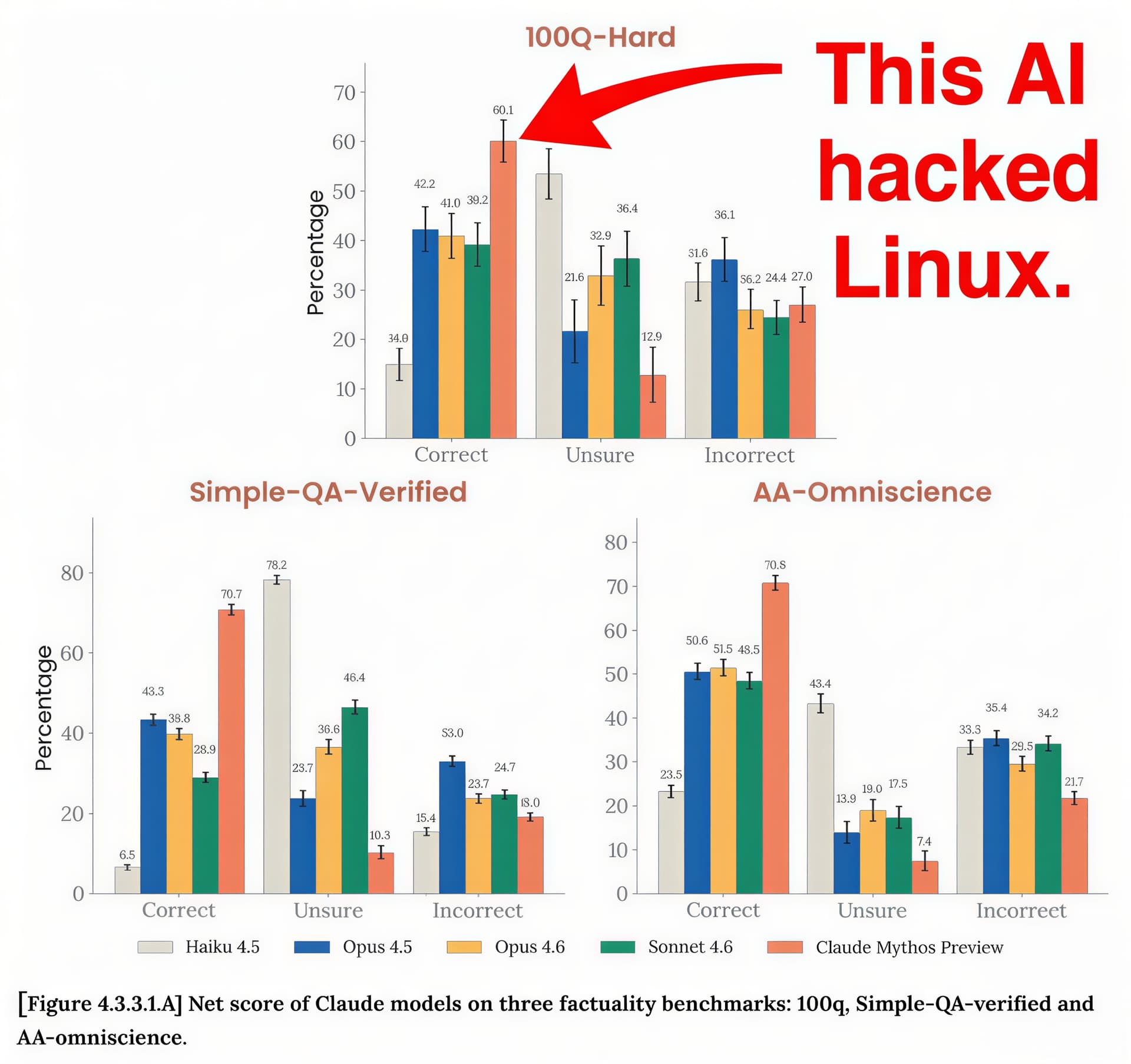
Anthropic has set pricing for its upcoming Claude Mythos model, placing it at $25 per million input tokens and $125 per million output tokens during its private preview phase. The model remains in limited access, available only to approved participants.
What Happened
The pricing was revealed via a social media post from AI commentator Rohan Pandey (@rohanpaul_ai), who noted the rates apply "while it is still in private preview." This confirms earlier speculation about Anthropic preparing a new, high-tier model to compete directly with OpenAI's GPT-4o and Google's Gemini Ultra.
The $25/$125 pricing structure follows the now-standard industry practice of charging more for generated (output) tokens than processed (input) tokens, reflecting the higher computational cost of generation.
Context
Claude Mythos represents Anthropic's next-generation model, expected to surpass the capabilities of the current Claude 3.5 Sonnet. While full technical specifications and benchmark results haven't been publicly released, the pricing alone signals its positioning as a premium offering.
For comparison:
- OpenAI's GPT-4o costs approximately $5/$15 per million tokens (input/output)
- Anthropic's Claude 3.5 Sonnet costs $3/$15 per million tokens
- Google's Gemini 1.5 Pro costs $3.50/$10.50 per million tokens
Mythos's pricing is significantly higher than these mainstream offerings, suggesting Anthropic is targeting it at enterprise and research applications where maximum performance justifies the cost premium.
What This Means in Practice
At $125 per million output tokens, generating 1,000 pages of text (approximately 2 million tokens) would cost $250. This makes Mythos substantially more expensive than current alternatives for generation-heavy workloads, but potentially competitive for complex analysis tasks where input context dominates costs.
The private preview status means access is currently restricted, likely to select enterprise partners and researchers who can provide feedback before a broader launch.
gentic.news Analysis
This pricing reveal is strategically timed amid intensifying competition in the frontier model space. Following our coverage of Google's Gemini 2.0 launch last month, which emphasized multimodal capabilities, and OpenAI's rumored GPT-5 development timeline, Anthropic is signaling it won't cede the high-end market. The $125 output token price is particularly aggressive—nearly 8x higher than GPT-4o's—suggesting Anthropic believes Mythos delivers disproportionate value for certain generation tasks.
Historically, Anthropic has prioritized safety and constitutional AI principles, often at the expense of raw performance metrics. The premium pricing for Mythos suggests the company may be positioning this model as both the safest AND most capable option, attempting to capture customers who prioritize both attributes. This follows their pattern of premium positioning, as seen when Claude 3 Opus launched at higher prices than comparable models.
Looking at the broader competitive landscape, this move pressures both OpenAI and Google to justify their pricing strategies. If Mythos demonstrates significant performance advantages in private preview benchmarks, we could see a new pricing tier emerge for "ultra-capable" models, distinct from the current high-end offerings. However, the success of this strategy depends entirely on Mythos's actual capabilities relative to GPT-4o and Gemini Ultra—numbers we haven't seen yet.
Frequently Asked Questions
What is Claude Mythos?
Claude Mythos is Anthropic's upcoming next-generation AI model, currently in private preview. It's expected to be more capable than the current Claude 3.5 Sonnet and is positioned as a premium offering for enterprise and research applications.
How does Claude Mythos pricing compare to other models?
At $25/$125 per million tokens (input/output), Mythos is significantly more expensive than mainstream alternatives. GPT-4o costs approximately $5/$15, Claude 3.5 Sonnet costs $3/$15, and Gemini 1.5 Pro costs $3.50/$10.50. Mythos's premium pricing suggests Anthropic believes it offers superior performance for certain use cases.
When will Claude Mythos be publicly available?
There's no official public release date. The model is currently in private preview available only to approved participants. Based on typical development cycles, a broader beta or general availability might occur in the coming months, but this is speculative.
What applications justify Mythos's higher cost?
The high output token cost ($125/million) suggests Mythos is optimized for applications where generation quality is paramount and cost is secondary. This could include complex creative writing, advanced code generation, scientific research assistance, or enterprise applications where error reduction justifies premium pricing. The lower input cost relative to output cost makes it more economical for analysis-heavy tasks.