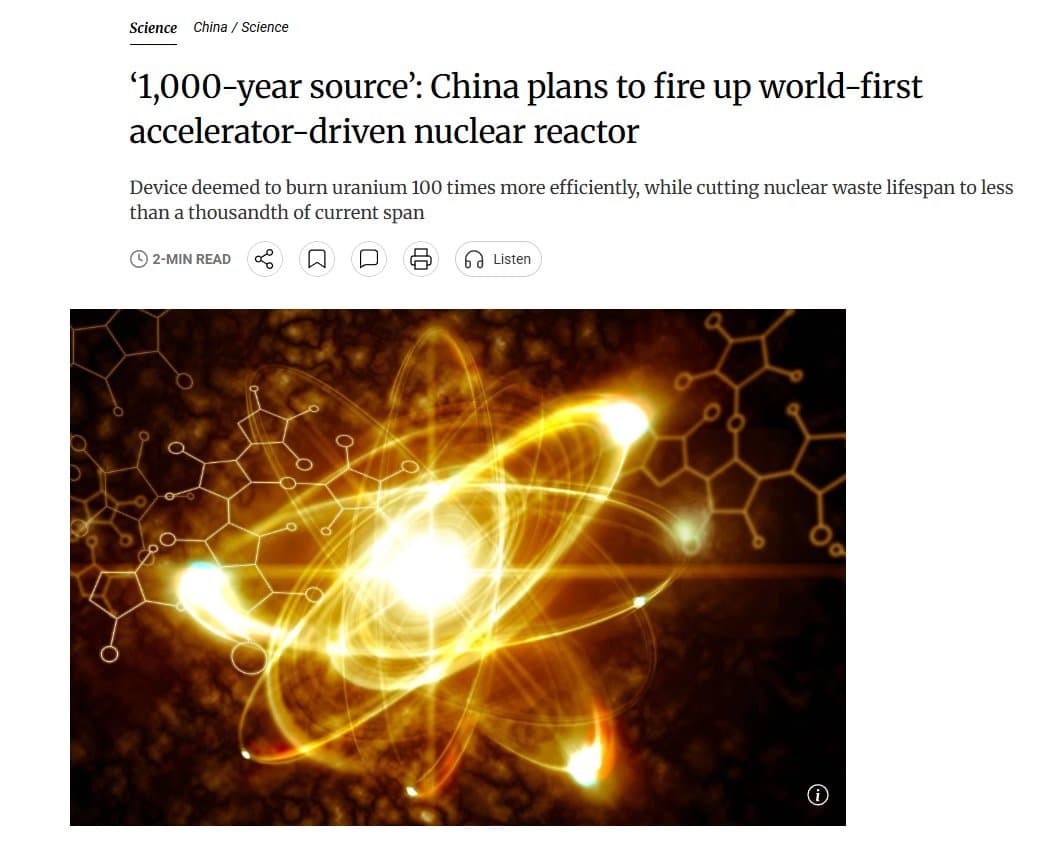
China has embarked on an ambitious project that could fundamentally reshape the future of nuclear energy. In Guangdong province, engineers are constructing the world's first megawatt-level accelerator-driven nuclear reactor—a sophisticated system designed not only to generate electricity but to transform long-lived nuclear waste into safer, short-lived materials. This technological leap represents what many experts consider the most promising path forward for sustainable nuclear power.
How the Accelerator-Driven System Works
The reactor employs particle accelerators that fire proton beams at approximately 0.8 times the speed of light. These high-energy protons strike a target material, producing neutrons through a process called spallation. These neutrons are then directed into a subcritical nuclear core containing nuclear waste, primarily uranium-238 and other transuranic elements.
Unlike conventional reactors that require a self-sustaining chain reaction, this system operates in a subcritical state, meaning it cannot sustain a chain reaction without the external neutron source from the accelerator. This fundamental difference provides inherent safety advantages—if the accelerator stops, the nuclear reactions cease almost immediately.
The neutrons convert uranium-238 into plutonium-239 and other fissile materials while simultaneously breaking down long-lived radioactive isotopes into shorter-lived elements. This dual capability—energy generation while consuming nuclear waste—addresses two of nuclear power's most significant challenges simultaneously.
The Potential Impact on Nuclear Waste Management
Current nuclear reactors produce waste that remains dangerously radioactive for hundreds of thousands of years, creating complex storage and security challenges. China's accelerator-driven system could reduce this radioactive lifespan to less than 0.1% of current levels—potentially cutting it from geological timescales to manageable centuries.
According to the project specifications, the technology could make uranium utilization approximately 100 times more efficient than in conventional reactors. This efficiency gain stems from the system's ability to "burn" uranium-238, which constitutes about 99.3% of natural uranium but is largely unused in current reactor designs.
Timeline and Development Context
The reactor is scheduled to go online around 2027, placing China at the forefront of advanced nuclear technology development. This project builds upon decades of international research into accelerator-driven systems, including work at CERN, Los Alamos National Laboratory, and various European research institutions.
China's commitment to this technology aligns with its broader energy strategy, which includes substantial investment in both renewable energy and advanced nuclear systems. The country currently operates the world's largest nuclear power expansion program, with dozens of reactors under construction.
Safety Advantages and Technical Challenges
The subcritical design offers several safety benefits beyond waste reduction. Since the system cannot sustain a chain reaction without the external neutron source, risks associated with criticality accidents—like those at Chernobyl or Fukushima—are virtually eliminated. The reactor also operates at lower temperatures and pressures than conventional designs, reducing the potential for catastrophic failure.
However, significant technical challenges remain. The particle accelerators must operate with exceptional reliability—any interruption stops energy production. The system also requires sophisticated control mechanisms to manage the complex nuclear transformations occurring within the reactor core. Materials science presents another hurdle, as components must withstand intense radiation while maintaining structural integrity.
Global Implications for Energy Security
If successful, this technology could provide a stable, safer nuclear energy source for up to 1,000 years using existing uranium reserves. This timeline extends far beyond current projections for conventional nuclear power and could bridge the gap until fusion power becomes commercially viable.
The development has significant geopolitical implications. China's leadership in this advanced nuclear technology could reshape global energy dynamics, particularly as nations seek carbon-free baseload power to complement intermittent renewable sources like solar and wind.
Environmental and Economic Considerations
Beyond waste reduction, the accelerator-driven system offers environmental advantages through more complete fuel utilization. By consuming nearly all uranium atoms rather than just the fissile U-235, the technology reduces mining requirements and associated environmental impacts.
Economically, the system could potentially lower long-term nuclear energy costs by eliminating the need for permanent waste repositories—a multibillion-dollar expense for nuclear-powered nations. The technology might also enable the use of existing nuclear waste stockpiles as fuel, turning a liability into an energy asset.
The Road Ahead for Advanced Nuclear Technology
China's accelerator-driven reactor represents just one approach to Generation IV nuclear technology, which includes several advanced designs promising improved safety, efficiency, and waste characteristics. International collaboration will likely be essential for optimizing these systems, as no single nation possesses all the necessary expertise.
The success of China's project could accelerate global investment in accelerator-driven systems and related technologies. Research institutions worldwide are watching closely, as breakthroughs in this field could validate concepts that have been theoretical for decades.
Source: Based on reporting from @kimmonismus/X regarding China's accelerator-driven nuclear reactor development in Guangdong province.