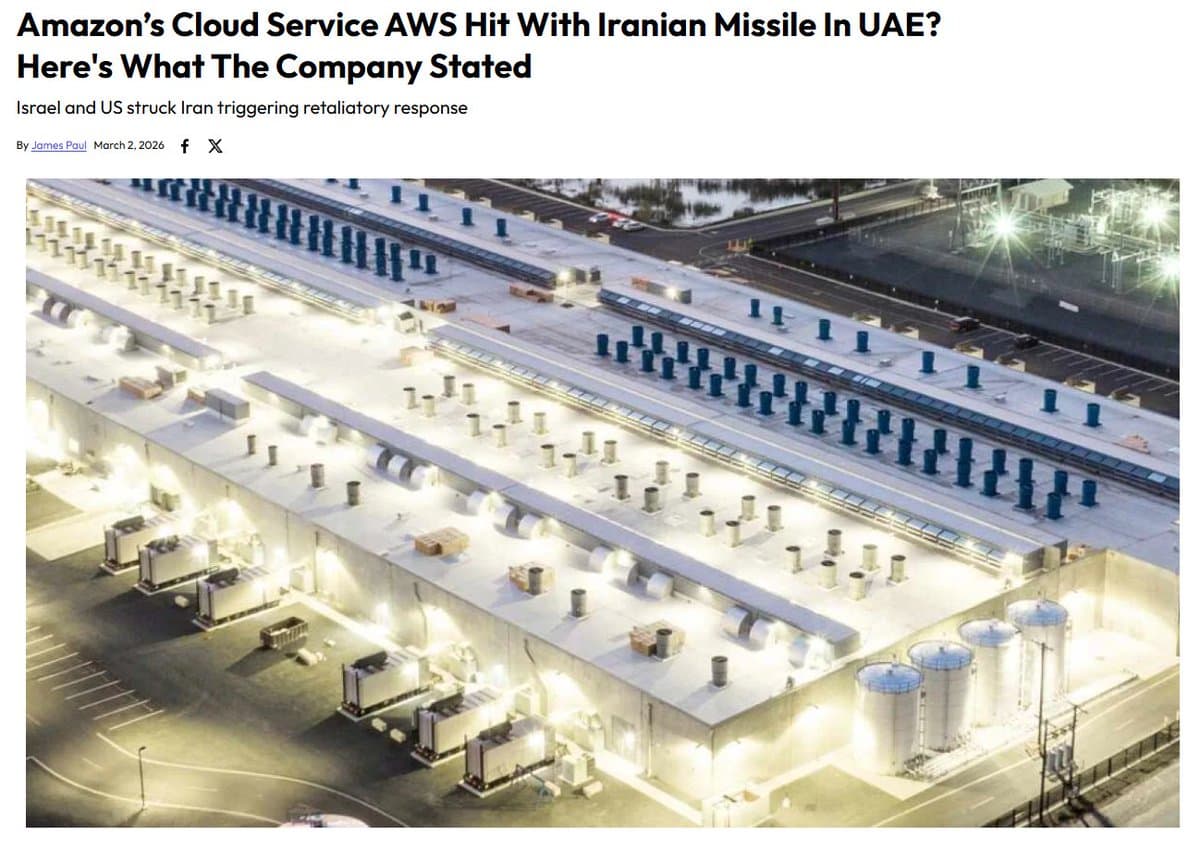
In a stark reminder that artificial intelligence systems exist in the physical world, a missile strike reportedly targeted an Amazon Web Services data center in the United Arab Emirates this week, sparking a fire and causing temporary power shutdowns in one availability zone. The incident occurred against the backdrop of escalating tensions between Israel, Iran, and the United States, raising urgent questions about the security of cloud infrastructure that powers critical AI applications worldwide.
The Attack and Immediate Impact
According to reports circulating on social media and confirmed by AWS, "objects" struck the company's ME-CENTRAL-1 region in the UAE. The attack caused physical damage to the facility, resulting in a fire and temporary power disruption affecting one availability zone within the region. AWS engineers responded quickly to contain the damage and restore services, leveraging the company's redundant infrastructure design.
In a statement addressing the incident, AWS emphasized that their redundancy systems protected customers who had designed their applications to operate across multiple availability zones. However, services and applications relying solely on the affected zone experienced disruptions. The company did not specify the exact nature of the "objects" that struck the facility or attribute responsibility for the attack.
The ME-CENTRAL-1 Region: Strategic Importance
The targeted AWS region, ME-CENTRAL-1 located in the UAE, represents a critical piece of global cloud infrastructure. Launched in 2022, this region serves as Amazon's primary cloud hub for the Middle East, hosting data for multinational corporations, regional businesses, and government entities. The region's strategic importance has grown significantly as digital transformation accelerates across Middle Eastern economies.
For AI development specifically, this region hosts training data, machine learning models, and inference services for applications ranging from financial technology to healthcare diagnostics. The attack demonstrates how geopolitical conflicts can directly impact the physical infrastructure supporting the global AI ecosystem.
Redundancy Tested: Cloud Architecture Under Fire
The incident served as an unplanned stress test for cloud redundancy systems. AWS and other major cloud providers design their data centers with multiple availability zones—physically separate facilities with independent power, cooling, and networking—precisely to withstand localized disruptions. Customers who architect their applications across multiple zones experienced minimal disruption, while those with single-zone deployments faced service interruptions.
This event highlights a critical consideration for AI developers: while cloud providers offer robust redundancy options, implementation decisions made during application design directly determine resilience during infrastructure disruptions. The attack underscores the importance of distributed architecture for mission-critical AI systems, particularly those operating in geopolitically sensitive regions.
Broader Implications for AI Infrastructure Security
The targeting of cloud infrastructure represents a significant escalation in how physical conflicts impact digital ecosystems. As AI systems become increasingly embedded in critical infrastructure—from financial markets to healthcare to transportation—their physical vulnerabilities become national security concerns.
Several implications emerge from this incident:
Geopolitical Risk Assessment: Companies deploying AI systems must now consider physical infrastructure risks in their threat models, particularly for applications in or dependent on regions experiencing geopolitical tensions.
Supply Chain Vulnerabilities: The attack reveals vulnerabilities in the physical supply chain of AI computation, reminding developers that models and data don't exist purely in abstraction but reside in physical locations subject to conventional threats.
Regulatory Response: Governments may increase scrutiny and regulation of cloud infrastructure location and redundancy requirements for AI systems deemed critical to national interests.
Historical Context and Precedents
While unprecedented in its direct targeting of major cloud infrastructure, this incident follows a pattern of increasing physical attacks on digital infrastructure during conflicts. Previous incidents include cyber-physical attacks on Ukrainian data centers during the Russian invasion and various attacks on telecommunications infrastructure in conflict zones worldwide.
What distinguishes this event is the targeting of a hyperscale cloud provider's infrastructure—the backbone of modern AI development and deployment. The attack suggests that adversaries now recognize cloud data centers as high-value targets whose disruption can have cascading effects across multiple industries and national economies.
Technical Response and Mitigation Strategies
In response to the incident, cloud providers and their customers are likely to reevaluate several aspects of their infrastructure strategy:
- Geographic Distribution: Increased emphasis on distributing AI workloads across geographically dispersed regions, even when this introduces latency trade-offs
- Multi-Cloud Considerations: Organizations may accelerate multi-cloud strategies to avoid dependency on a single provider's infrastructure in any given region
- Edge Computing: The incident may accelerate adoption of edge computing for AI applications, distributing computation closer to end-users and reducing centralization risks
- Physical Security Enhancements: Cloud providers will likely reassess physical security measures at data centers in geopolitically sensitive regions
The Future of AI Infrastructure in Conflict Zones
This attack raises fundamental questions about the future deployment of AI infrastructure in regions experiencing geopolitical tensions. Several scenarios could emerge:
Infrastructure Hardening: Cloud providers may invest in more robust physical protection for data centers in sensitive regions, potentially including underground facilities or military-grade protection.
Sovereign Cloud Solutions: Nations may accelerate development of sovereign cloud infrastructure with enhanced physical security and geographic isolation.
Decentralized Alternatives: The incident may boost interest in truly decentralized computing platforms that lack centralized physical points of failure.
Diplomatic Protections: Governments may begin negotiating protections for digital infrastructure as part of diplomatic agreements, similar to protections for diplomatic facilities or cultural heritage sites.
Conclusion: A Wake-Up Call for AI Infrastructure Resilience
The missile strike on AWS infrastructure in the UAE serves as a wake-up call for the AI industry. It demonstrates that the physical vulnerabilities of cloud infrastructure represent a tangible risk to AI systems, particularly as these systems become more integrated into critical societal functions.
For AI developers and organizations deploying AI solutions, this incident underscores the importance of resilience planning that considers both cyber and physical threats. Redundancy must be designed not just across availability zones but potentially across regions, providers, and even deployment modalities.
As geopolitical tensions increasingly manifest in the digital realm, the security of AI infrastructure will become inseparable from broader national and international security considerations. The attack on AWS ME-CENTRAL-1 may be remembered as the moment the industry recognized that AI doesn't exist in the cloud alone—it exists in buildings that can be hit by missiles.
Source: Initial report from @kimmonismus on X/Twitter, with AWS confirmation of incident at ME-CENTRAL-1 region.