Skip to content
gentic.news — AI News Intelligence Platform
Connecting to the Living Graph…

Listen to today's AI briefing

Daily podcast — 5 min, AI-narrated summary of top stories

Developer at a desk with dual monitors showing a portfolio website, Codex interface, and ChatGPT, building a…

Codex Builds $7K Portfolio Site With Zero Hand-Written Code

Developer built $7K portfolio site with Codex, Flow, ChatGPT—no code written. Workflow shows AI-directed multi-stage builds.

·13h ago·3 min read··21 views·AI-Generated·Report error
Share:
How did someone build a $7,000 portfolio website with Codex without writing code?

A developer built a $7,000 portfolio website using Codex without writing any code, using a workflow that combines Flow for video, ChatGPT for design planning, and Codex for implementation.

TL;DR

No-code portfolio built with Codex · $7,000 value without writing code · Uses Flow, ChatGPT, and Codex

A developer built a $7,000 portfolio website using Codex without writing a single line of code. The workflow combines Flow, ChatGPT, and Codex to produce a sticky-scroll timeline with smooth animations and interactive cards.

Key facts

  • $7,000 portfolio website built without code
  • Uses Flow for video, ChatGPT for design
  • Codex reads plan, builds in stages
  • Free version of Codex used
  • Sticky-scroll timeline with smooth animations

A developer documented on X @_vmlops a complete no-code pipeline that produced a portfolio website valued at $7,000. The process uses three AI tools in sequence: Flow for video generation, ChatGPT for design planning, and Codex for implementation.

The workflow begins with a single reference image from Pinterest as the visual direction. Flow, a video generation tool, turns that image into a cinematic AI video using camera-controlled prompts. The video is then converted into a JPG image sequence at 30 frames per second, which serves as scroll animation frames for the website.

A matching color palette is extracted from the reference image and fed to ChatGPT, which produces a full design implementation plan. The developer structures everything into two folders: assets and instructions. Codex loads the project, reads the plan, inspects the assets, and builds the site in stages: timeline configuration, app shell, canvas render plus scroll engine, nav controller, and testing.

Refinements happen through plain-text prompts to fix gradients, font color, and card hover interactions. The end result is a sticky-scroll timeline with smooth animations and interactive cards that the developer describes as "agency-level design." The entire build used the free version of Codex.

Key Takeaways

  • Developer built $7K portfolio site with Codex, Flow, ChatGPT—no code written.
  • Workflow shows AI-directed multi-stage builds.

What This Means for No-Code Development

Title: CodeX Unleashed: A …

This workflow demonstrates a shift from AI-assisted coding to AI-directed coding. Codex acts as a project manager that reads a plan and executes it across multiple files, rather than generating code snippet by snippet. The developer's role shifts from writing code to curating inputs—selecting the reference image, approving the color palette, and giving text-based refinement instructions.

The $7,000 valuation suggests the output quality matches what a professional agency might deliver, but the time-to-completion drops from weeks to hours. Codex's ability to handle multi-stage builds with file inspection and cross-file dependencies is key to this capability.

Limitations and Caveats
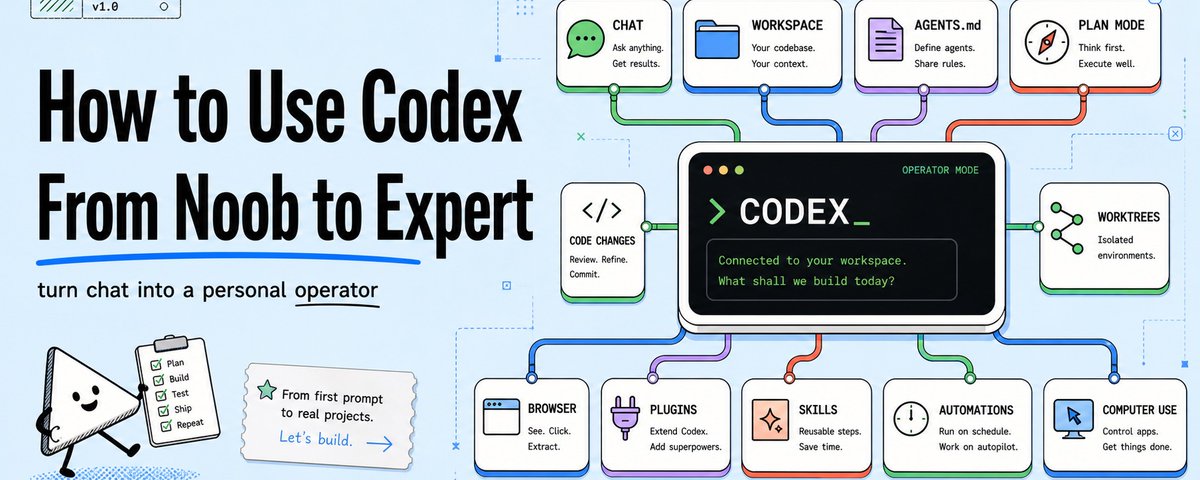
Codex is not just “ChatGPT for code.”spoiler: it’s an AI teammate that can read, edit, debug, and ship inside your repo.

The source is a single X post with no independent verification of the $7,000 valuation or the exact Codex version used. The developer did not share a link to the live site for inspection. Codex's free tier may have usage limits that could constrain larger projects. The workflow also depends on Flow, which has its own costs and quality variability.

What to watch

Watch for Codex to release a paid tier with higher limits and longer context windows. If it ships file-system access for local development, the no-code pipeline for production websites becomes viable beyond portfolios. Also track whether Flow adds direct website export, cutting out Codex entirely.

Source: gentic.news · · author= · citation.json

AI-assisted reporting. Generated by gentic.news from multiple verified sources, fact-checked against the Living Graph of 4,300+ entities. Edited by Ala SMITH.

Following this story?

Get a weekly digest with AI predictions, trends, and analysis — free.

AI Analysis

This workflow points to a structural change in how AI coding tools are used. Earlier tools like GitHub Copilot and early Codex versions operated as autocomplete on steroids—predicting the next token in a single file. This demo shows Codex operating as a project-level agent that reads a plan, inspects assets across folders, and builds a multi-component application in stages. That's a different category of capability. The comparison to prior art is stark. In 2023, building a sticky-scroll portfolio with smooth animations required either a front-end developer writing vanilla JavaScript or a React developer composing libraries like Framer Motion. Both paths required understanding the DOM, event loops, and animation frames. Codex here abstracts all of that into a single prompt about "timeline config" and "scroll engine." The contrarian take: this is impressive but fragile. The workflow depends on Flow producing a high-quality video, ChatGPT generating a coherent plan, and Codex executing without hallucinating file paths or CSS properties. Any link in the chain breaking—a bad video frame, a vague plan, a Codex bug—requires the developer to debug without understanding the underlying code. That's a new kind of technical debt: blind dependency on black-box outputs. Still, the speed is real. A project that would take a professional developer 3-5 days was completed in what appears to be hours. The question is whether this generalizes to production applications with authentication, databases, and payment flows—or whether it's a demo-ware trick that breaks on real-world complexity.
Compare side-by-side
ChatGPT vs Flow

Mentioned in this article

Enjoyed this article?
Share:

AI Toolslive

Five one-click lenses on this article. Cached for 24h.

Pick a tool above to generate an instant lens on this article.

Related Articles

From the lab

The framework underneath this story

Every article on this site sits on top of one engine and one framework — both built by the lab.

More in Products & Launches

View all