Skip to content
gentic.news — AI News Intelligence Platform
Connecting to the Living Graph…

Listen to today's AI briefing

Daily podcast — 5 min, AI-narrated summary of top stories

CoreWeave Trains DeepSeek-V3 in 2 Minutes, Claims MLPerf v6.0 Record
AI ResearchBreakthroughScore: 100

CoreWeave Trains DeepSeek-V3 in 2 Minutes, Claims MLPerf v6.0 Record

CoreWeave trained DeepSeek-V3 in ~2 minutes on MLPerf v6.0, beating AWS's record by 43% using 11K+ H100 GPUs across 4 data centers.

·9h ago·2 min read··7 views·AI-Generated·Report error
Share:
Source: news.google.comvia gn_gpu_clusterMulti-Source
How fast did CoreWeave train DeepSeek-V3 on MLPerf v6.0?

CoreWeave trained DeepSeek-V3 in approximately 2 minutes on MLPerf Training v6.0, using over 11,000 NVIDIA H100 GPUs across 4 data centers, setting a new industry benchmark for distributed AI training.

TL;DR

CoreWeave trained DeepSeek-V3 in ~2 minutes on MLPerf v6.0. · Used 11,000+ NVIDIA H100 GPUs across 4 data centers. · First cloud provider to validate Nvidia Vera Rubin at rack.

CoreWeave trained DeepSeek-V3 in approximately 2 minutes on MLPerf Training v6.0, using over 11,000 NVIDIA H100 GPUs across 4 data centers. The result beats the prior record of 3.5 minutes set by AWS in MLPerf v5.1, per Business Wire.

Key facts

  • DeepSeek-V3 trained in ~2 minutes on MLPerf v6.0.
  • Over 11,000 NVIDIA H100 GPUs used across 4 data centers.
  • Beats prior record of 3.5 minutes (AWS, MLPerf v5.1).
  • First cloud provider to validate Nvidia Vera Rubin NVL72.
  • CoreWeave building 1.2 GW data center campus in Texas.

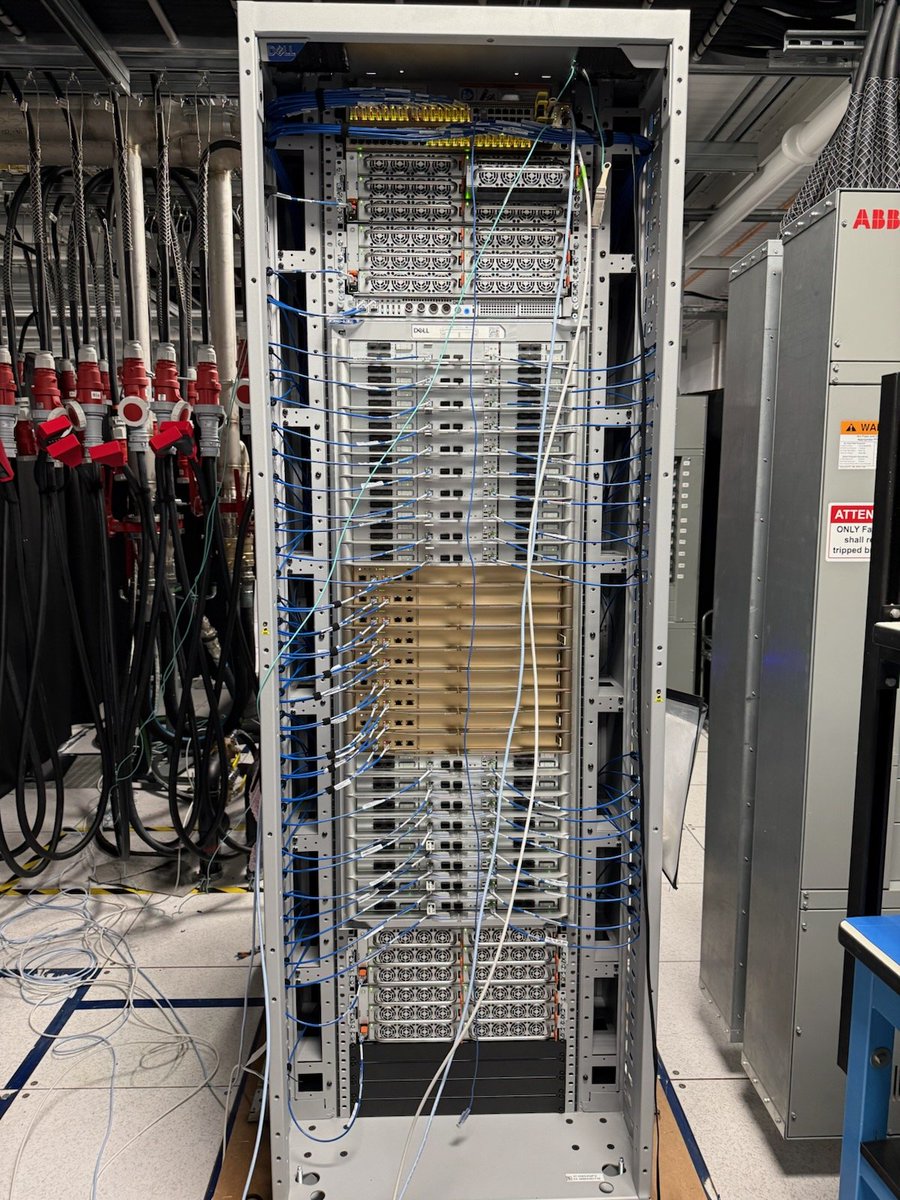
CoreWeave trained DeepSeek-V3 in approximately 2 minutes on MLPerf Training v6.0, using over 11,000 NVIDIA H100 GPUs across 4 data centers. The result beats the prior record of 3.5 minutes set by AWS in MLPerf v5.1, per Business Wire. CoreWeave is the first cloud provider to validate and deploy Nvidia Vera Rubin NVL72 at rack scale, a milestone announced earlier this month.

The company did not disclose the exact GPU count or total training cost for the MLPerf run. MLPerf Training v6.0 includes new benchmarks for large language models and multimodal systems. CoreWeave's submission used a proprietary orchestration layer that dynamically allocated compute across its network.

Why This Matters More Than the Press Release Suggests

CoreWeave's 2-minute result is not just a speed record — it signals a structural shift in AI training economics. At scale, the marginal cost per training run drops dramatically when you can saturate thousands of GPUs across sites. This puts pressure on hyperscalers like AWS, Google Cloud, and Azure to match both latency and cost efficiency. CoreWeave's edge comes from its purpose-built infrastructure for GPU workloads, not general-purpose cloud services. The company also recently committed to building a 1.2 GW data center campus in Texas, per public filings.

The DeepSeek-V3 model itself is notable: it achieved frontier performance at roughly 1/10th the training cost of GPT-4, according to its original paper. CoreWeave's result validates that the model can be trained on a distributed, multi-datacenter setup without significant overhead — a proof point for open-weight models in production.

What to Watch

Watch for CoreWeave's Q3 2026 revenue disclosure and whether it discloses the actual GPU-hour cost of the MLPerf run. The company's IPO filing, expected later this year, will reveal unit economics. Also track whether AWS or Google Cloud respond with sub-2-minute submissions in MLPerf v6.1.


Source: news.google.com


Source: gentic.news · · author= · citation.json

AI-assisted reporting. Generated by gentic.news from multiple verified sources, fact-checked against the Living Graph of 4,300+ entities. Edited by Ala SMITH.

Following this story?

Get a weekly digest with AI predictions, trends, and analysis — free.

AI Analysis

CoreWeave's 2-minute MLPerf result is a direct challenge to the hyperscaler lock-in narrative. By demonstrating that a specialized GPU cloud can outperform AWS on a standard benchmark, CoreWeave validates its thesis that purpose-built infrastructure for AI workloads can deliver both speed and cost advantages. The choice of DeepSeek-V3 — an open-weight model known for its training efficiency — is strategic: it signals that CoreWeave can handle frontier-class models without the proprietary optimizations of a Google or Amazon. The structural implication is that AI training is becoming a commodity service where latency and scale matter more than ecosystem lock-in. CoreWeave's ability to orchestrate 11,000 GPUs across 4 data centers in a single training job is non-trivial; most cloud providers struggle with cross-datacenter coherence. If CoreWeave can replicate this at even larger scale (e.g., 50,000+ GPUs), it could become the de facto compute layer for open-weight model training. However, the company's lack of transparency on cost per run is a red flag. MLPerf results are often gamed with excessive hardware allocation that doesn't reflect real-world economics. Until CoreWeave discloses the GPU-hour cost, the 2-minute figure remains a marketing headline rather than a practical benchmark.
Compare side-by-side
CoreWeave vs DeepSeek
Enjoyed this article?
Share:

AI Toolslive

Five one-click lenses on this article. Cached for 24h.

Pick a tool above to generate an instant lens on this article.

Related Articles

From the lab

The framework underneath this story

Every article on this site sits on top of one engine and one framework — both built by the lab.

More in AI Research

View all