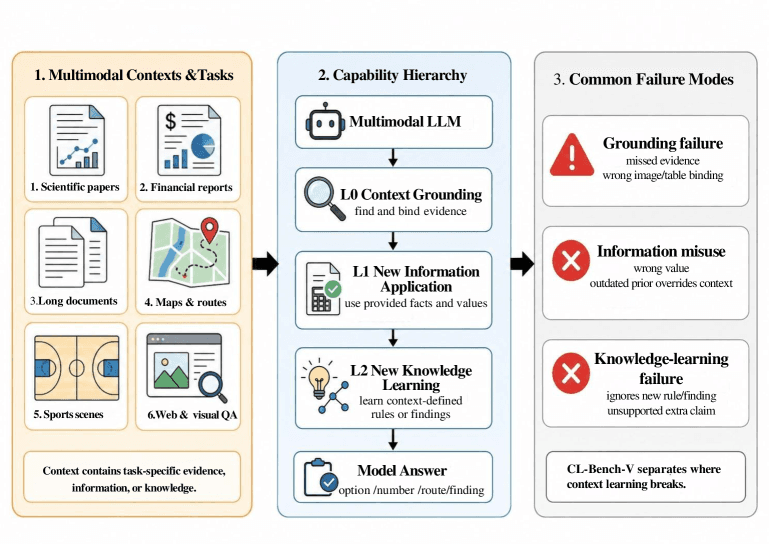
ClBench-V, a benchmark from @HuggingPapers, evaluates multimodal contextual learning across three dimensions. It tests context grounding, new information application, and new knowledge learning for vision-language models.
Key facts
- ClBench-V evaluates three dimensions of contextual learning.
- Dimensions: context grounding, new info application, new knowledge.
- Targets vision-language models (VLMs).
- No model results or dataset sizes disclosed.
- Fills gap in multimodal contextual learning evaluation.
Researchers have introduced ClBench-V, a benchmark designed to assess how well multimodal models can perform contextual learning According to @HuggingPapers. The benchmark evaluates three specific dimensions: context grounding—the ability to anchor responses to provided visual and textual context; new information application—integrating novel facts into reasoning; and new knowledge learning—generalizing from few examples to new tasks.
ClBench-V targets vision-language models (VLMs), which combine image and text inputs. The benchmark's structure is reminiscent of prior contextual learning tests like MMLU and BIG-bench, but tailored for multimodal settings where models must process both images and text simultaneously. The announcement did not disclose specific model results, dataset sizes, or baseline scores, making it difficult to gauge difficulty or compare against existing benchmarks.
Why ClBench-V Matters
Existing benchmarks for VLMs, such as VQA and COCO Captions, test recognition or generation but rarely isolate contextual learning—the ability to apply in-context examples to new inputs without fine-tuning. ClBench-V fills this gap by explicitly measuring how models adapt to contextual cues, a key capability for applications like few-shot image classification, visual question answering with custom contexts, and interactive AI assistants.
The three dimensions align with emerging research on in-context learning in LLMs, now extended to vision. For instance, models like GPT-4V and Gemini have shown some ability to use visual examples, but systematic evaluation has been lacking. ClBench-V could become a standard test for this capability, though its utility depends on public release of tasks, scoring methodology, and leaderboard.
Limitations and Open Questions
The announcement lacks detail on task composition, evaluation metrics, and whether the benchmark is open-source. Without baseline results from current VLMs, it's unclear if ClBench-V is sufficiently challenging or if it merely replicates existing tests. Researchers should watch for a full paper with ablation studies and human baselines.
No specific model results or dataset sizes were disclosed in the announcement. The benchmark's design suggests a focus on few-shot adaptation in multimodal settings.
Key Takeaways
- ClBench-V benchmark from @HuggingPapers tests multimodal contextual learning across three dimensions: grounding, application, and knowledge learning.
- No results disclosed yet.
What to watch
Watch for the full ClBench-V paper release, including task descriptions, baseline scores on current VLMs (e.g., GPT-4V, Gemini, Claude 3), and whether a public leaderboard is established. The first benchmark results will reveal if models genuinely learn from context or rely on memorization.