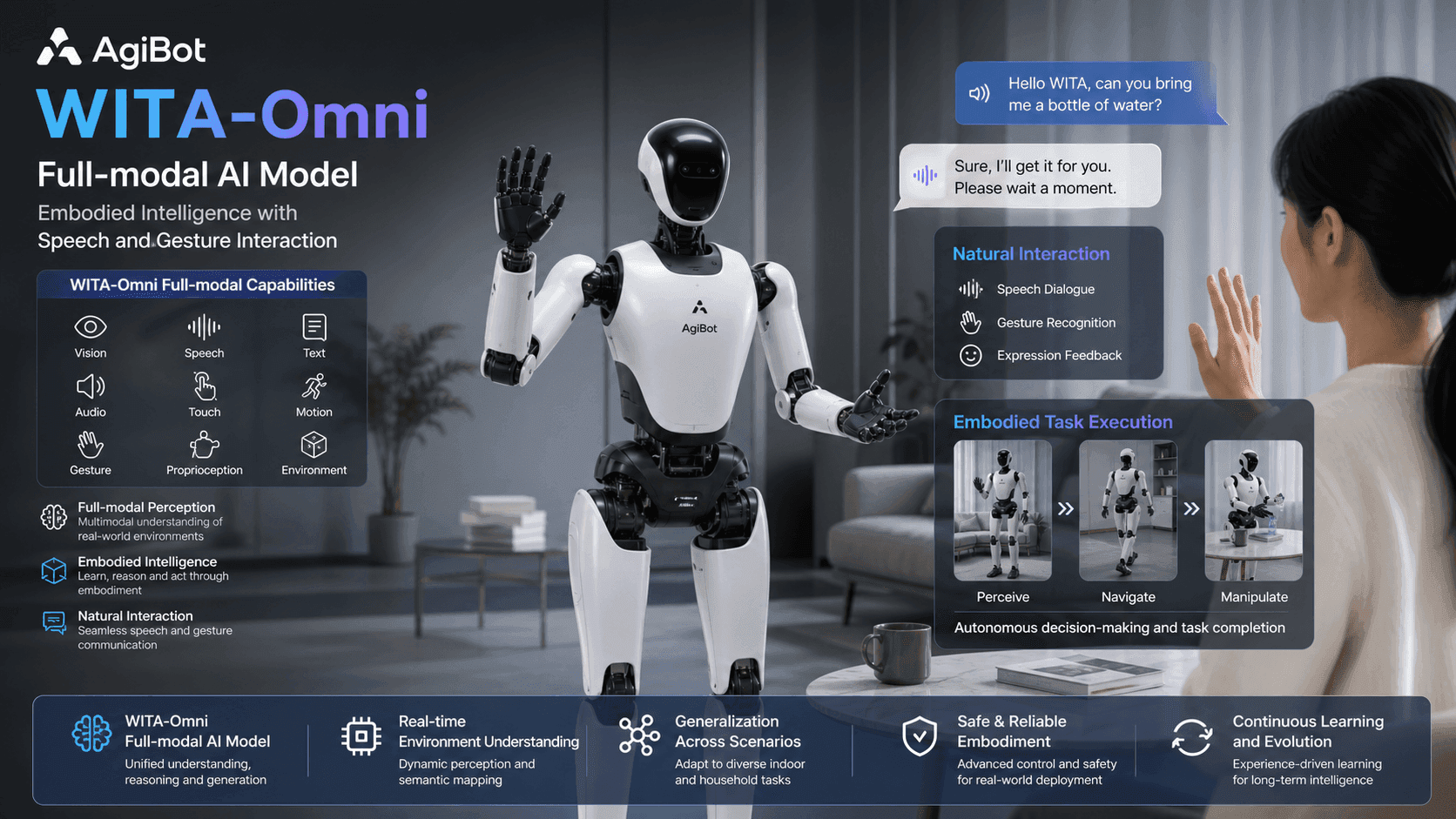
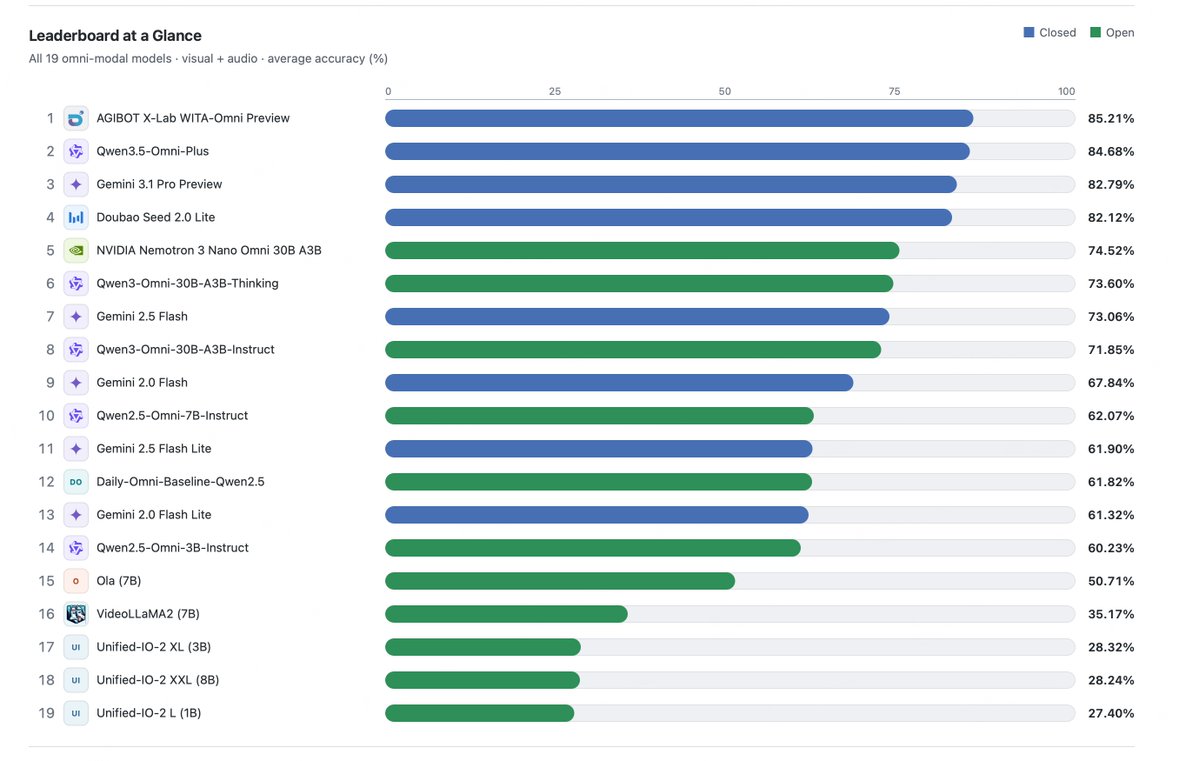
AgiBot WITA-Omni scored 85.21 on the DailyOmni benchmark, beating Google Gemini and ByteDance Doubao. The model uses a Thinker-Talker-Actor architecture synchronizing speech, action, and facial expression on a single timeline.
Key facts
- WITA-Omni scored 85.21 on DailyOmni benchmark.
- First place in 6 of 8 benchmark indicators.
- Beats Google Gemini, ByteDance Doubao, Alibaba Qwen.
- Uses Thinker-Talker-Actor architecture for temporal sync.
- No model size, training compute, or weights disclosed.
AgiBot's WITA-Omni scored 85.21 on the DailyOmni benchmark, placing first in 6 of 8 indicators and beating Google Gemini, ByteDance Doubao, and Alibaba Qwen According to AgiBot WITA-Omni Full-Modal Mo. The benchmark tests full-modal understanding across vision, language, audio, and action, a domain increasingly critical for embodied AI systems that must coordinate perception, speech, and physical movement.
The model uses a Thinker-Talker-Actor architecture that synchronizes speech, action, and facial expression on a single timeline. Unlike prior multimodal models that treat modalities as separate channels merged at inference, WITA-Omni generates a unified temporal representation across all outputs. AgiBot claims the architecture enables real-time coordination between verbal output and physical movement, a requirement for humanoid robots and interactive agents.
Why the architecture matters
The Thinker-Talker-Actor design addresses a fundamental limitation in existing full-modal models: temporal misalignment between speech and action. Google's Gemini and ByteDance's Doubao, while strong on static multimodal understanding, do not natively synchronize generated speech with physical actions on a shared clock. AgiBot's approach, by contrast, binds the token-level generation of text, audio, and motor commands to a common timeline, reducing latency between thinking and doing.
AgiBot did not disclose the model size, training compute, or dataset composition. The company also did not release weights or a technical paper as of the announcement. Without open benchmarks or ablation studies, it is impossible to verify whether the DailyOmni score reflects genuine architectural advantage or benchmark-specific tuning.
Competitive landscape
The result places AgiBot ahead of three major rivals in the embodied AI race. Google has invested heavily in Gemini's multimodal capabilities and, per our knowledge graph, competes with AgiBot across AI agents and robotics. ByteDance and Alibaba also maintain active full-modal research programs. Alibaba's RynnBrain 1.1, released July 25, 2026, targets robot manipulation with 2B, 9B, and 122B MoE models.
AgiBot's win is notable given that Google shipped three Gemini Flash models just days ago, on July 28, 2026, and added background execution and MCP support to Gemini API Managed Agents. The timing suggests AgiBot is positioning WITA-Omni as the embodied alternative to cloud-centric multimodal systems.
Open questions
AgiBot has not published the inference latency or hardware requirements for WITA-Omni. The DailyOmni benchmark does not measure real-time performance on physical robots, only offline comprehension. Whether the Thinker-Talker-Actor architecture degrades under latency constraints common in robotics remains unknown.
The company also did not disclose whether WITA-Omni is deployed on any of AgiBot's own humanoid robots or is purely a research model.
What to watch
Watch for AgiBot to release a technical paper or model weights. If the Thinker-Talker-Actor architecture generalizes to physical robot deployment with sub-100ms latency, it could set a new standard for embodied AI. Also watch whether Google or ByteDance respond with their own temporal-sync architectures.
Source: pandaily.com