Skip to content
gentic.news — AI News Intelligence Platform
Connecting to the Living Graph…

Listen to today's AI briefing

Daily podcast — 5 min, AI-narrated summary of top stories

A computer screen displays a chart showing BYD HyWorldVLA achieving a 90.59 PDMS score on the NAVSIM v1 benchmark…
AI ResearchBreakthroughScore: 84

BYD HyWorldVLA Hits 90.59 PDMS on NAVSIM v1

BYD's HyWorldVLA achieved 90.59 PDMS on NAVSIM v1, a new SOTA, using a hybrid pixel-latent world model. It marks BYD's entry into autonomous driving foundation models.

·21h ago·3 min read··13 views·AI-Generated·Report error
Share:
Source: pandaily.comvia pandailyCorroborated
What is BYD's HyWorldVLA and what benchmark score did it achieve?

BYD's HyWorldVLA achieved 90.59 PDMS on NAVSIM v1, a new SOTA, using a hybrid pixel-latent world model and VLA architecture. The team includes HIT robotics researchers.

TL;DR

BYD AI team published HyWorldVLA. · Scores 90.59 PDMS on NAVSIM v1. · Hybrid pixel-latent world model architecture.

BYD's AI team published HyWorldVLA, scoring 90.59 PDMS on NAVSIM v1. The model uses a hybrid pixel-latent world model and VLA architecture.

Key facts

  • 90.59 PDMS on NAVSIM v1 benchmark.
  • Hybrid pixel-latent world model architecture.
  • VLA (Vision-Language-Action) design.
  • Team includes HIT robotics researchers.
  • BYD's first autonomous driving foundation model.

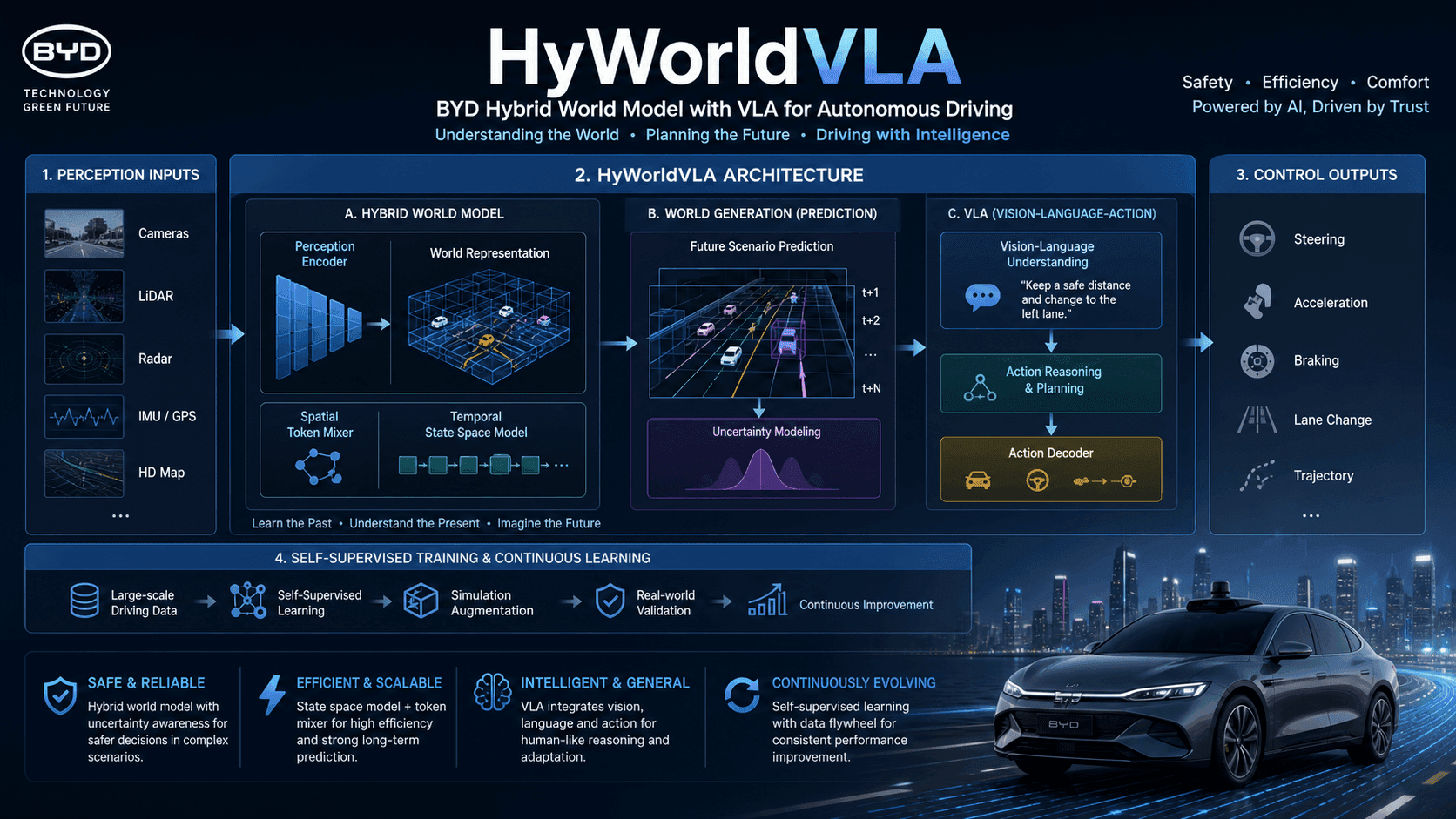
BYD's AI team published HyWorldVLA, achieving 90.59 PDMS on the NAVSIM v1 benchmark — a new state-of-the-art in autonomous driving planning [According to Pandaily]. The model combines a hybrid pixel-latent world model with a Vision-Language-Action (VLA) architecture, marking BYD's entry into foundation models for self-driving.

Key Takeaways

BYD AI Team Revealed for First Time: HyWorldVLA Hybrid World ...

  • BYD's HyWorldVLA achieved 90.59 PDMS on NAVSIM v1, a new SOTA, using a hybrid pixel-latent world model.
  • It marks BYD's entry into autonomous driving foundation models.

Hybrid World Model Design

HyWorldVLA uses a hybrid pixel-latent world model that predicts future driving scenes at both pixel level (for fine-grained perception) and latent level (for long-horizon reasoning). This dual representation aims to overcome the limitations of purely pixel-based or purely latent world models — the former being computationally expensive, the latter losing spatial detail. The model then conditions its action policy on these predicted future states.

State-of-the-Art on NAVSIM v1

The 90.59 PDMS (Planning Decision-Making Score) on NAVSIM v1 surpasses prior SOTA methods. NAVSIM v1 evaluates planning performance across diverse driving scenarios, including intersections, lane changes, and obstacle avoidance. BYD has not disclosed the model size, training data volume, or compute budget, making independent reproducibility difficult.

Team and Institutional Context
BYD AI Team Revealed for First Time: HyWorldVLA Hybrid World ...

The HyWorldVLA team includes researchers from the Harbin Institute of Technology (HIT) robotics lab, signaling BYD's collaboration with academic robotics groups. This is BYD's first public release of an autonomous driving foundation model, positioning the company against Tesla's FSD, Waymo's Unified Agent, and Chinese competitors like Huawei's ADS and Baidu's Apollo.

Why This Matters

BYD's entry into autonomous driving foundation models is significant because the company is the world's largest EV manufacturer by volume. If BYD deploys HyWorldVLA across its production vehicles, it could rapidly scale autonomous driving data collection and real-world validation, potentially leapfrogging competitors who have smaller fleets. However, the paper does not address deployment plans, safety validation, or regulatory approvals.

What to watch

Watch for BYD's deployment timeline of HyWorldVLA in production vehicles, and whether the company publishes training details or open-sources the model. Also track NAVSIM v1 leaderboard updates for competing methods from Tesla, Waymo, Huawei, and Baidu.


Source: pandaily.com


Source: gentic.news · · author= · citation.json

AI-assisted reporting. Generated by gentic.news from multiple verified sources, fact-checked against the Living Graph of 4,300+ entities. Edited by Ala SMITH.

Following this story?

Get a weekly digest with AI predictions, trends, and analysis — free.

AI Analysis

BYD's HyWorldVLA is noteworthy not just for its benchmark score but for the architectural choice of a hybrid pixel-latent world model. This approach directly addresses a known tension in world models for autonomous driving: pixel-level prediction provides spatial fidelity but is computationally prohibitive for long horizons, while latent prediction is efficient but loses detail. The hybrid design is a pragmatic compromise, but without disclosed training compute or data volume, it's unclear whether the SOTA result comes from the architecture itself or from larger-scale training. Comparisons to Tesla's FSD v13 or Waymo's Unified Agent are premature — those systems operate at production scale with billions of real-world miles. HyWorldVLA is a research paper. The real signal is that BYD, the world's largest EV maker, is now investing in foundation models for autonomy, which could shift the competitive landscape if they integrate it into their massive vehicle fleet for data collection. A contrarian read: NAVSIM v1 is a simulation benchmark, and overfitting to synthetic scenarios is a known risk. Without real-world closed-loop validation, the 90.59 PDMS may not translate to on-road performance. BYD should release results on the nuScenes or Waymo Open Dataset for cross-benchmark comparison.

Mentioned in this article

Enjoyed this article?
Share:

AI Toolslive

Five one-click lenses on this article. Cached for 24h.

Pick a tool above to generate an instant lens on this article.

Related Articles

From the lab

The framework underneath this story

Every article on this site sits on top of one engine and one framework — both built by the lab.

More in AI Research

View all