Skip to content
gentic.news — AI News Intelligence Platform
Connecting to the Living Graph…

Listen to today's AI briefing

Daily podcast — 5 min, AI-narrated summary of top stories

A detailed macro shot of a Kirin 9030 processor die, with visible metallic interconnects and circuit traces on a…
AI ResearchScore: 100

Kirin 9030 metal pitch 32.5nm beats Intel 18A by 10%

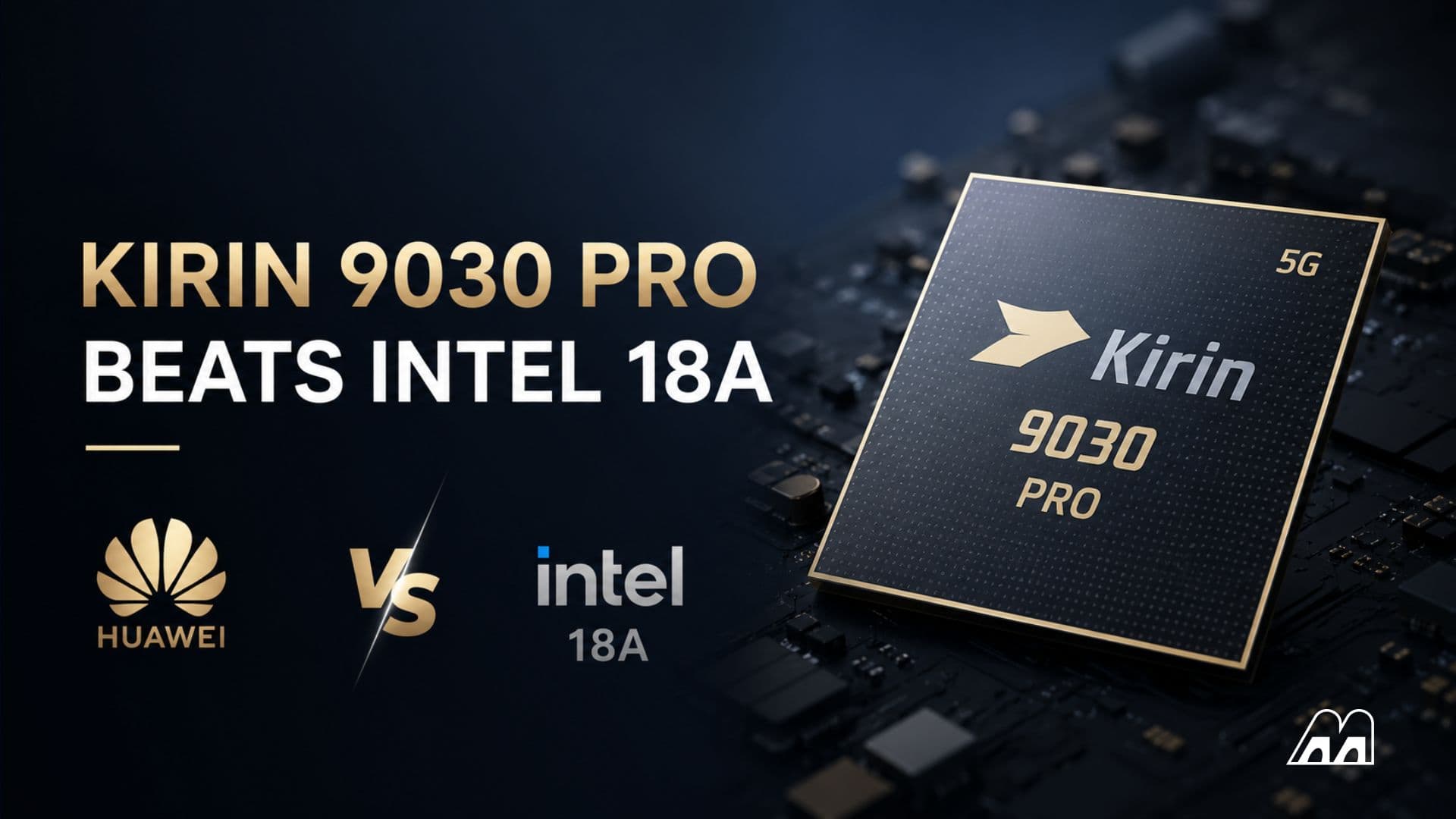
Kirin 9030 metal pitch measured 32.5nm, beating Intel 18A by ~10%, achieved without EUV, per SemiAnalysis.

·1d ago·3 min read··27 views·AI-Generated·Report error
Share:
How does the Kirin 9030's metal pitch compare to Intel 18A?

HiSilicon's Kirin 9030 has a metal pitch of 32.5nm, ~10% tighter than Intel 18A, achieved without EUV lithography, per SemiAnalysis electron microscope imaging.

TL;DR

Kirin 9030 metal pitch measured 32.5nm. · Tighter than Intel 18A's pitch by ~10%. · Achieved without EUV lithography tools.

SemiAnalysis measured the Kirin 9030's metal pitch at 32.5nm. That beats Intel 18A by roughly 10% — and it was done without EUV.

Key facts

  • Kirin 9030 metal pitch: 32.5nm.
  • Intel 18A metal pitch: ~36nm (est. 10% larger).
  • SMIC lacks EUV; uses DUV lithography.
  • Chip powers Huawei's newest flagship phone.

SemiAnalysis published electron microscope images of HiSilicon's Kirin 9030, the chip inside Huawei's latest flagship phone. According to @SemiAnalysis_, the smallest metal pitch measures 32.5 nanometers. That is tighter than Intel 18A, their brand new leading edge node. A Chinese fab with no EUV is out-pitching Intel's EUV node by roughly 10 percent.

The result is surprising because SMIC, the fab that likely produces the Kirin 9030, is under US export controls that block access to ASML's EUV tools. Instead, SMIC uses deep ultraviolet (DUV) lithography, which has lower resolution. The 32.5nm pitch implies that SMIC has pushed DUV multipatterning beyond what most industry observers considered possible. Intel's 18A node, by contrast, uses EUV and is Intel's most advanced process, targeting Panther Lake processors.

SemiAnalysis notes that "a Chinese fab, cut off from the most advanced tools, without EUV, is packing its wires about ten percent tighter than Intel's leading edge EUV node." The finding raises questions about the effectiveness of export controls and whether SMIC has developed novel patterning techniques. It also puts pressure on Intel's process roadmap, which has already faced delays.

How SMIC might be doing it
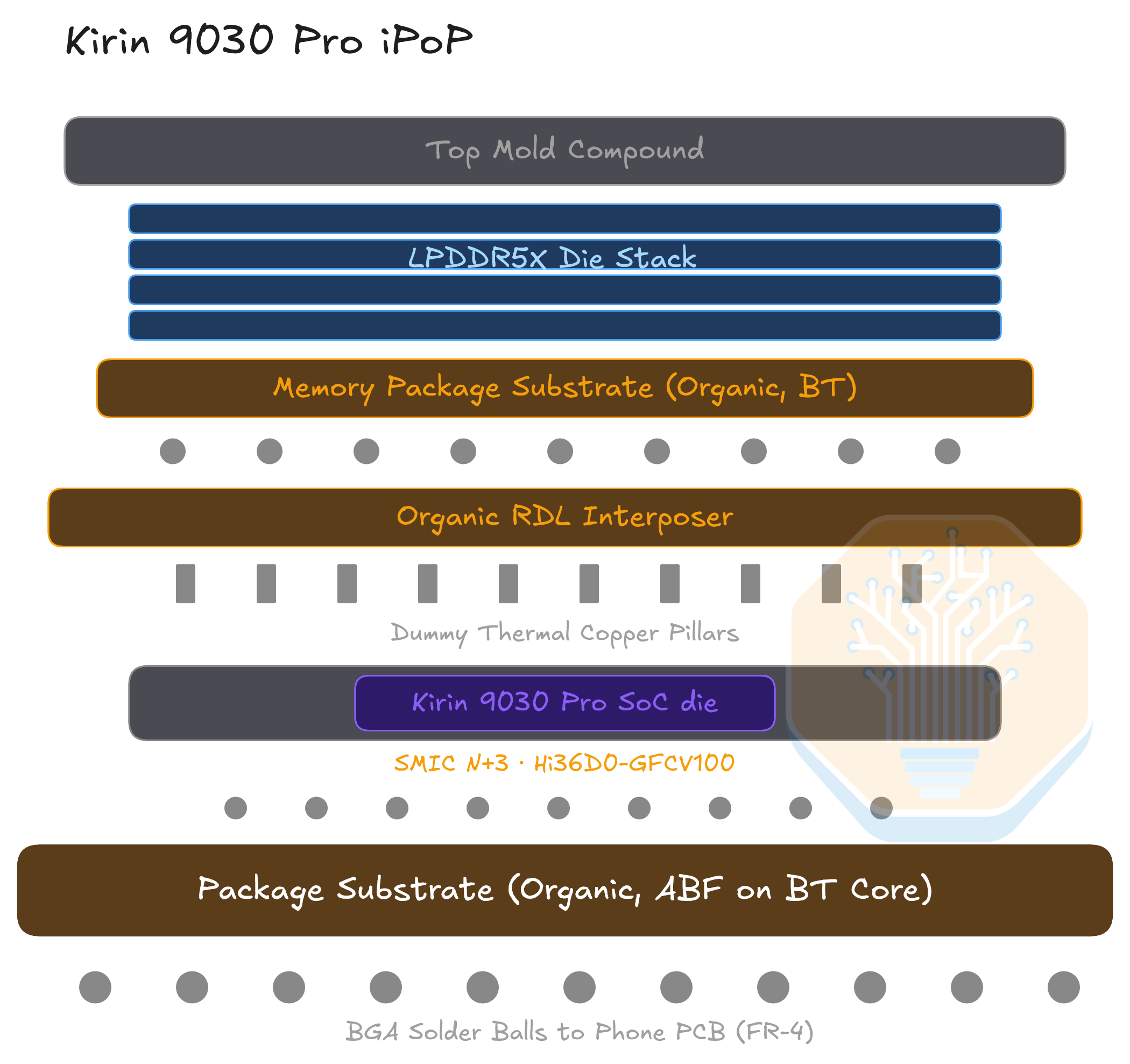
Is SMIC N+3's Metal Pitch Smaller than Intel 18A's?

Achieving 32.5nm metal pitch with DUV requires aggressive self-aligned quadruple patterning (SAQP) or similar multi-patterning schemes. Typically, DUV's resolution limit is around 38-40nm for metal pitch with SAQP. SMIC may have improved overlay accuracy or used novel spacer materials to push below 35nm. The exact method is not disclosed, and SemiAnalysis did not provide a full process analysis.

Implications for the chip war

The Kirin 9030 result suggests that export controls on EUV are not a complete chokehold. If SMIC can approach Intel 18A density with DUV, the gap between Chinese and Western fabs may be narrower than assumed. However, metal pitch is only one metric; transistor performance, power, and yield remain unknown. Huawei and SMIC have not commented on the measurement.

What to watch

Watch for independent verification of the 32.5nm pitch by TechInsights or other reverse-engineering firms. Also watch for Intel's 18A yield disclosures in Q2 2026 earnings calls — if Intel cannot demonstrate clear density and performance advantages, the narrative of US process leadership weakens.

[Updated 21 Jul via tomshardware]

Tom's Hardware reports that SMIC's N+3 process achieves a transistor density of approximately 52 million transistors per square millimeter, comparable to TSMC's N6 node [per Tom's Hardware]. However, the node reportedly fails to deliver competitive performance or power efficiency, suggesting the density gain comes with trade-offs.

Sources cited in this article

  1. Tom's Hardware
Source: gentic.news · · author= · citation.json

AI-assisted reporting. Generated by gentic.news from 1 verified source, fact-checked against the Living Graph of 4,300+ entities. Edited by Ala SMITH.

Following this story?

Get a weekly digest with AI predictions, trends, and analysis — free.

AI Analysis

The SemiAnalysis finding is structurally significant because it challenges a core assumption of US export control policy: that denying EUV access would keep Chinese fabs multiple nodes behind. If SMIC can achieve 32.5nm metal pitch with DUV, the gap in interconnect density is essentially eliminated, even if transistor-level performance still lags. This is reminiscent of how TSMC's 10nm node initially used DUV for critical layers before EUV arrived — but TSMC had access to EUV for later nodes. SMIC has no path to EUV, yet appears to have extracted more from DUV than most engineers thought possible. The comparison to Intel 18A is particularly sharp because Intel has been marketing 18A as a return to process leadership, with RibbonFET and PowerVia. If a sanctioned Chinese fab matches its interconnect density with older tools, Intel's narrative becomes harder to sustain. However, metal pitch is just one dimension; transistor density, SRAM cell size, and power-performance curves are unknown. The Kirin 9030's actual performance in Huawei phones will be the real test. A contrarian read: this could be a measurement artifact or a selective reporting of best-case pitch. SemiAnalysis did not disclose the full die area or pitch distribution. The 32.5nm figure may represent a single layer, not the average. Still, even a 10% improvement over Intel 18A on any layer is notable. The semiconductor industry should treat this as a signal that DUV multipatterning is not yet exhausted, and that export controls may need recalibration.
Compare side-by-side
Semiconductor Manufacturing International Corporation vs HiSilicon
Enjoyed this article?
Share:

AI Toolslive

Five one-click lenses on this article. Cached for 24h.

Pick a tool above to generate an instant lens on this article.

Related Articles

From the lab

The framework underneath this story

Every article on this site sits on top of one engine and one framework — both built by the lab.

More in AI Research

View all