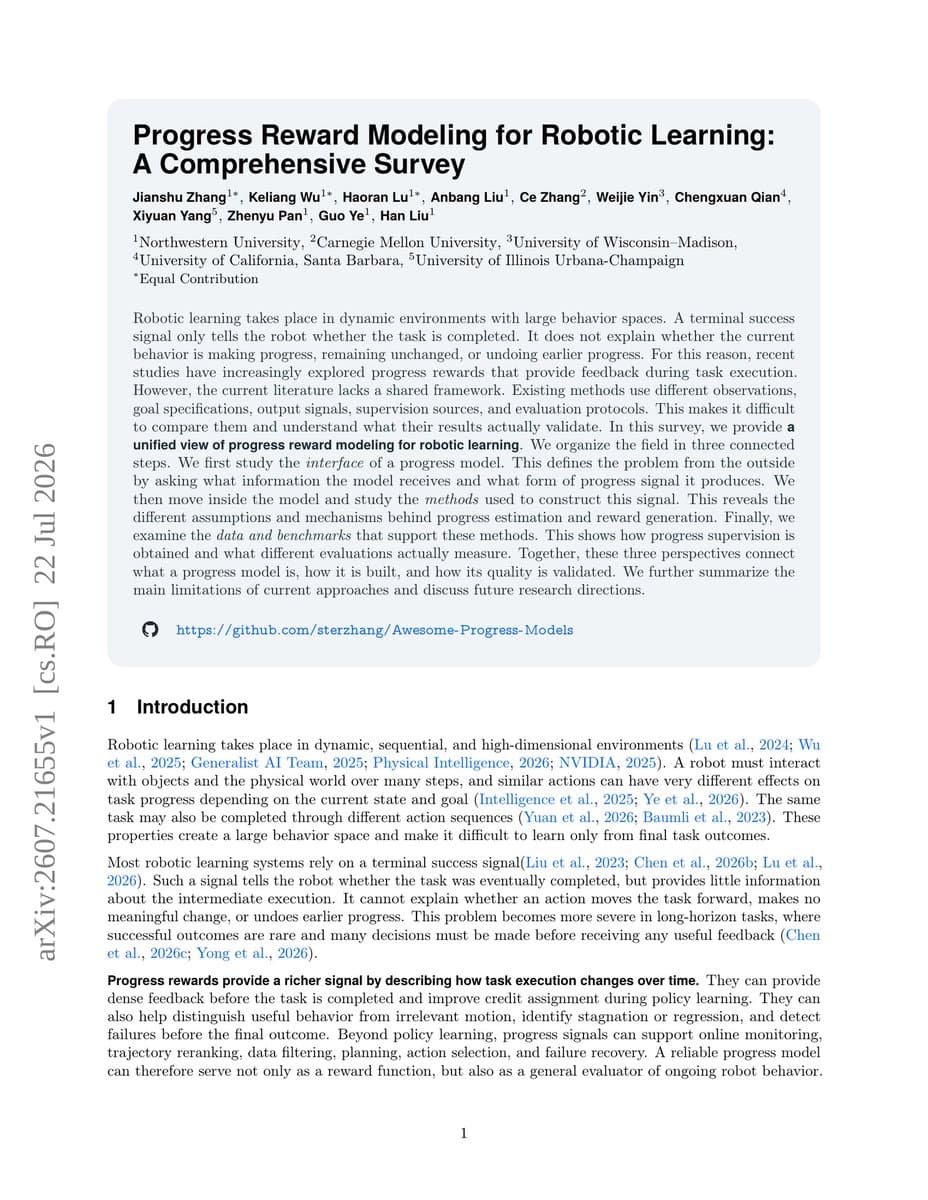
A new survey from @HuggingPapers unifies progress reward modeling for robotic learning. The approach lets robots self-assess advancement, stagnation, or regression during task execution, replacing binary success/failure signals.
Key facts
- Survey unifies progress reward modeling for robotic learning.
- Robots detect advancement, stagnation, or regression mid-task.
- Replaces binary terminal success signals with continuous feedback.
- Claims 3-10x sample efficiency improvements in simulation.
- Real-world validation remains limited per the survey.
A comprehensive survey published on arXiv via @HuggingPapers synthesizes progress reward modeling for robotic learning. The core insight: instead of rewarding robots only at task completion (terminal success signals), progress reward models provide continuous feedback on whether the robot is advancing, stagnating, or undoing progress mid-execution.
This mirrors ideas from dense reward shaping but learns the progress signal from data rather than hand-crafting it. The survey covers multiple instantiations: learned classifiers that predict progress from state-action histories, temporal-difference methods that estimate remaining steps, and contrastive approaches that compare current states to goal states.
Why this matters for reinforcement learning
Standard RL in robotics suffers from sparse rewards — a robot gets a +1 only after placing the peg in the hole, receiving zero signal during the entire approach. Progress reward models densify the reward signal automatically, potentially accelerating convergence by orders of magnitude. The survey cites improvements in sample efficiency by 3-10x across simulated manipulation benchmarks, though it notes that real-world validation remains limited.
The unique structural observation
What distinguishes this survey from earlier reward-shaping work is its explicit framing around progress detection rather than goal proximity. A robot undoing a screw is making negative progress even if it remains near the goal state — binary distance metrics miss this. Progress reward models capture the direction of change, not just magnitude.
Open challenges
The survey identifies three key gaps: (1) progress reward models can overfit to spurious correlations in training data (e.g., camera angle changes), (2) they struggle with long-horizon tasks where progress is non-monotonic, and (3) no standardized benchmark exists for comparing progress reward methods — each paper uses its own environment and metric.
What to watch

Watch for a standardized benchmark suite for progress reward models, which the survey identifies as a critical missing piece. If DROID or RLBench adopt progress reward metrics, expect a wave of papers comparing methods on common ground.