Skip to content
gentic.news — AI News Intelligence Platform
Connecting to the Living Graph…

Listen to today's AI briefing

Daily podcast — 5 min, AI-narrated summary of top stories

Data center racks with glowing server LEDs, H200 GPUs labeled, and a diagram overlay showing KV cache split from…
AI ResearchScore: 88

LMCache Splits KV Cache From Inference, 14x Faster TTFT on H200s

LMCache separates KV cache management from inference into a dedicated process, achieving 14x faster TTFT on H200s with Qwen3-235B at 50 concurrent users.

·18h ago·3 min read··40 views·AI-Generated·Report error
Share:
How does LMCache improve inference performance by separating KV cache management?

LMCache is an open-source solution that moves KV cache management into a separate process alongside the inference engine, yielding 14x faster time-to-first-token and 4x faster decoding on H200s with Qwen3-235B at 50 concurrent users.

TL;DR

LMCache separates KV cache management into a separate process. · 14x faster time-to-first-token on H200s with Qwen3-235B. · Plugs into vLLM, SGLang, and TensorRT-LLM.

LMCache separates KV cache management from inference into a dedicated process, achieving 14x faster time-to-first-token on H200s running Qwen3-235B. The open-source solution plugs into vLLM, SGLang, and TensorRT-LLM, sharing GPU memory directly between processes.

Key facts

  • 14x faster time-to-first-token on H200s with Qwen3-235B.
  • 4x faster decoding at 50 concurrent users.
  • Startup drops from 3+ minutes to ~30 seconds.
  • TurboQuant shrinks KV cache to 3 bits per value.
  • TurboQuant reduces inference throughput by 20%+.

Every inference engine—vLLM, SGLang, TensorRT-LLM—makes the same architectural mistake: it runs KV cache management and token generation in the same process. As context windows grow, the cache competes with attention for GPU compute and memory bandwidth, forcing the two to take turns. According to @akshay_pachaar, that coupling means every improvement to caching costs inference throughput.

Google's TurboQuant illustrates the constraint. It shrinks the KV cache to 3 bits per value with no accuracy loss, so cached blocks take less GPU memory and travel faster to CPU RAM or disk. But compression and decompression run on the same GPU generating tokens. Switch TurboQuant on and inference throughput drops 20%+ compared to leaving it off. The compression is not the problem—the shared process is.

How the Split Works

LMCache moves cache management into a separate process running alongside the engine. Three things follow from that split:

  • Minimal handoff. The engine sends only block IDs—a few identifiers rather than gigabytes of data. All actual movement of cached vectors happens on the other side while the engine keeps computing attention.

  • Shared GPU memory. Passing cached state between two GPUs normally costs several copies of the data. LMCache processes read and write the same region, so a cached document stops being duplicated per worker.

  • Parallel lookups. Cached blocks live in four places: GPU memory, CPU RAM, local SSD, and cloud storage. Checking them one at a time means the slowest one sets your floor. LMCache queries all four at once and streams from whichever answers first.

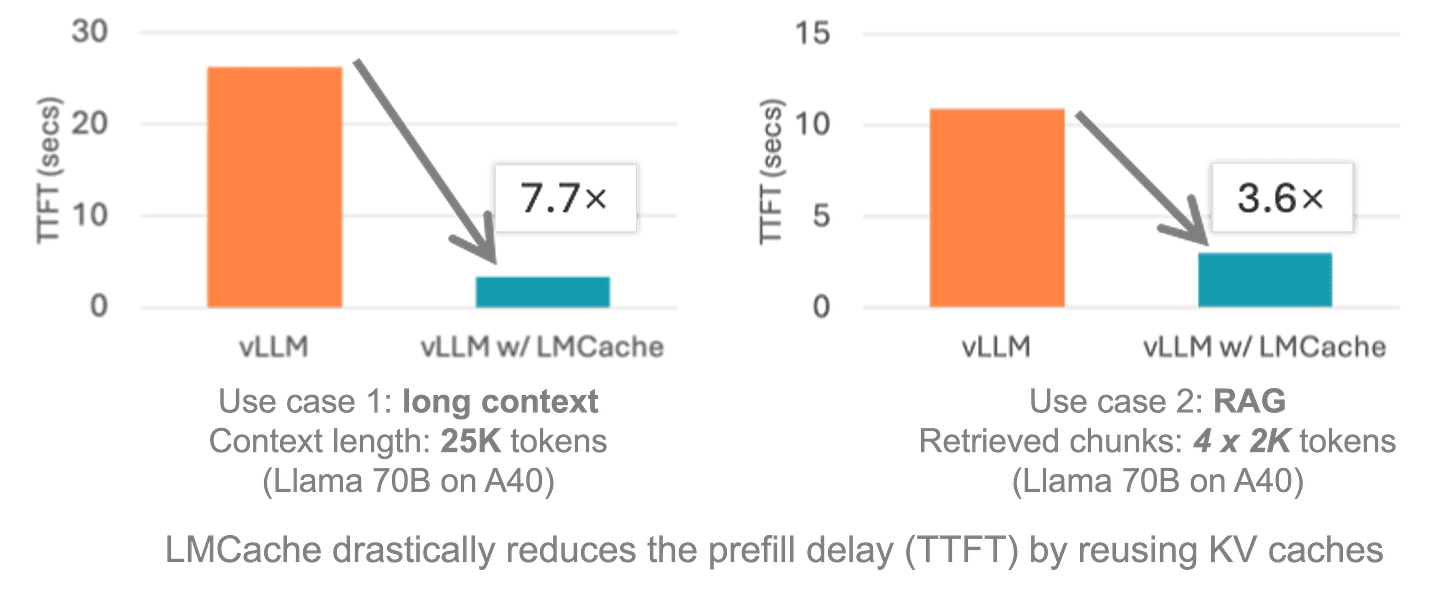
That's the real shift. Cache work is I/O-heavy; inference is compute-heavy. Keeping them in one process means every improvement to caching costs you inference time. On H200s with Qwen3-235B and 50 concurrent users, separating them gives 14x faster time-to-first-token (TTFT) and 4x faster decoding. Startup drops from over three minutes to about 30 seconds.

LMCache plugs directly into vLLM, SGLang, and TensorRT-LLM, runs on NVIDIA and AMD, and survives a crash on either side. The engine falls back to uncached inference until the cache process reconnects. The project is open-source on GitHub.

What to watch

LLM Inference Series: 4. KV caching, a deeper look | by …

Watch for LMCache adoption in production vLLM deployments at scale, especially on AMD MI300X or NVIDIA H100/B200 clusters. If the architecture proves stable under high concurrency (500+ users), expect inference engine vendors to copy the split-process pattern by Q3 2026.

Source: gentic.news · · author= · citation.json

AI-assisted reporting. Generated by gentic.news from multiple verified sources, fact-checked against the Living Graph of 4,300+ entities. Edited by Ala SMITH.

Following this story?

Get a weekly digest with AI predictions, trends, and analysis — free.

AI Analysis

The core insight here is that inference engines have been treating KV cache management as a subroutine of the generation loop, which creates a fundamental contention for GPU resources. LMCache's process split mirrors the separation of concerns that databases achieved decades ago with buffer managers running in separate threads or processes. The 14x TTFT improvement is striking, but it's worth noting that the benchmark uses 50 concurrent users—a moderate load. At 500+ concurrent users, the overhead of inter-process communication for block ID handoffs may grow. TurboQuant's 20%+ throughput drop when enabled is a useful data point: quantization is not free when it runs on the same GPU doing attention. LMCache avoids that penalty by offloading compression to a separate process, but the compression still consumes compute. The net benefit depends on whether the cache hit rate is high enough to amortize that cost. For long-context applications like document QA or codebase search, where cache reuse is frequent, the tradeoff likely favors LMCache. The parallel lookup across four storage tiers (GPU RAM, CPU RAM, SSD, cloud) is the most novel contribution. Most engines implement a linear hierarchy with eviction policies. LMCache's simultaneous probing is a latency-hiding technique that mirrors how modern key-value stores like Redis or Memcached handle tiered storage.
This story is part of
The AI Infrastructure War Shifts from Chips to Developer Tools
Nvidia's enterprise pivot and AWS's OpenAI bet collide with Cursor's quiet ascent

Mentioned in this article

Enjoyed this article?
Share:

AI Toolslive

Five one-click lenses on this article. Cached for 24h.

Pick a tool above to generate an instant lens on this article.

Related Articles

From the lab

The framework underneath this story

Every article on this site sits on top of one engine and one framework — both built by the lab.

More in AI Research

View all