Skip to content
gentic.news — AI News Intelligence Platform
Connecting to the Living Graph…

Listen to today's AI briefing

Daily podcast — 5 min, AI-narrated summary of top stories

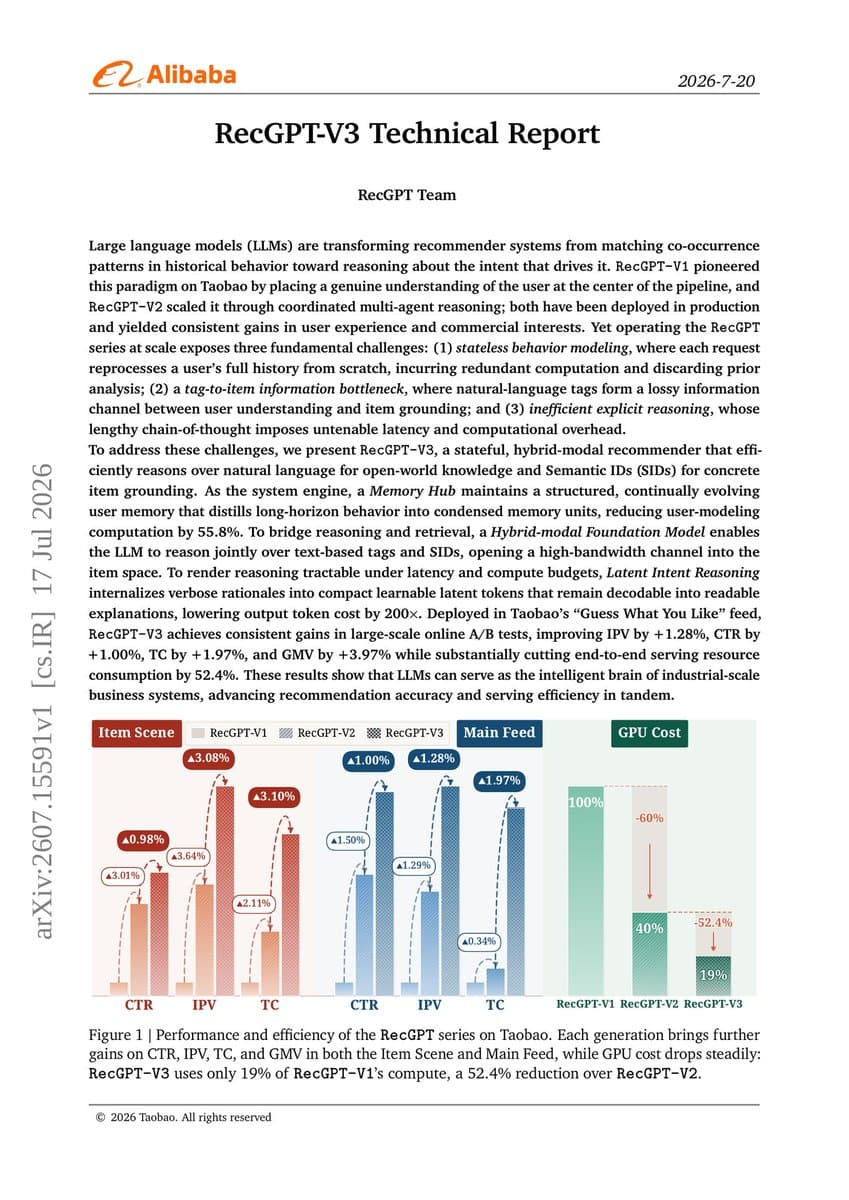
Alibaba engineer points at dashboard showing RecGPT-V3 metrics on Taobao, with GMV up 3.97% and costs down 52.4%
AI ResearchScore: 85

Alibaba's RecGPT-V3 Boosts GMV 3.97%, Cuts Serving Cost 52.4% on Taobao

Alibaba's RecGPT-V3, a stateful hybrid-modal recommender with continual memory, boosts GMV by 3.97% and cuts serving costs by 52.4% on Taobao.

·10h ago·3 min read··15 views·AI-Generated·Report error
Share:
How does Alibaba's RecGPT-V3 improve recommender systems on Taobao?

Alibaba's RecGPT-V3, a stateful hybrid-modal recommender with continual memory, is deployed on Taobao. It improves GMV by 3.97% while cutting serving costs by 52.4%.

TL;DR

Deployed on Taobao, boosting GMV by 3.97% · Serving costs cut 52.4% via hybrid-MoE · Stateful recommender with continual latent memory

Alibaba's RecGPT-V3, deployed on Taobao, improves GMV by 3.97% while cutting serving costs by 52.4%. The stateful hybrid-modal recommender uses continual memory and latent reasoning to replace traditional retrieval pipelines.

Key facts

  • GMV improvement of +3.97% on Taobao deployment
  • Serving costs reduced by 52.4%
  • Hybrid mixture-of-experts (MoE) architecture
  • Stateful continual memory across user sessions
  • Joint text and item grounding in shared embedding space

Alibaba has deployed RecGPT-V3, a stateful, hybrid-modal recommender system that treats the LLM as the "intelligent brain" of recommendation on Taobao. According to @HuggingPapers, the model achieves a +3.97% improvement in gross merchandise value (GMV) while simultaneously reducing serving costs by 52.4%.

Architecture: Stateful Memory and Hybrid-MoE

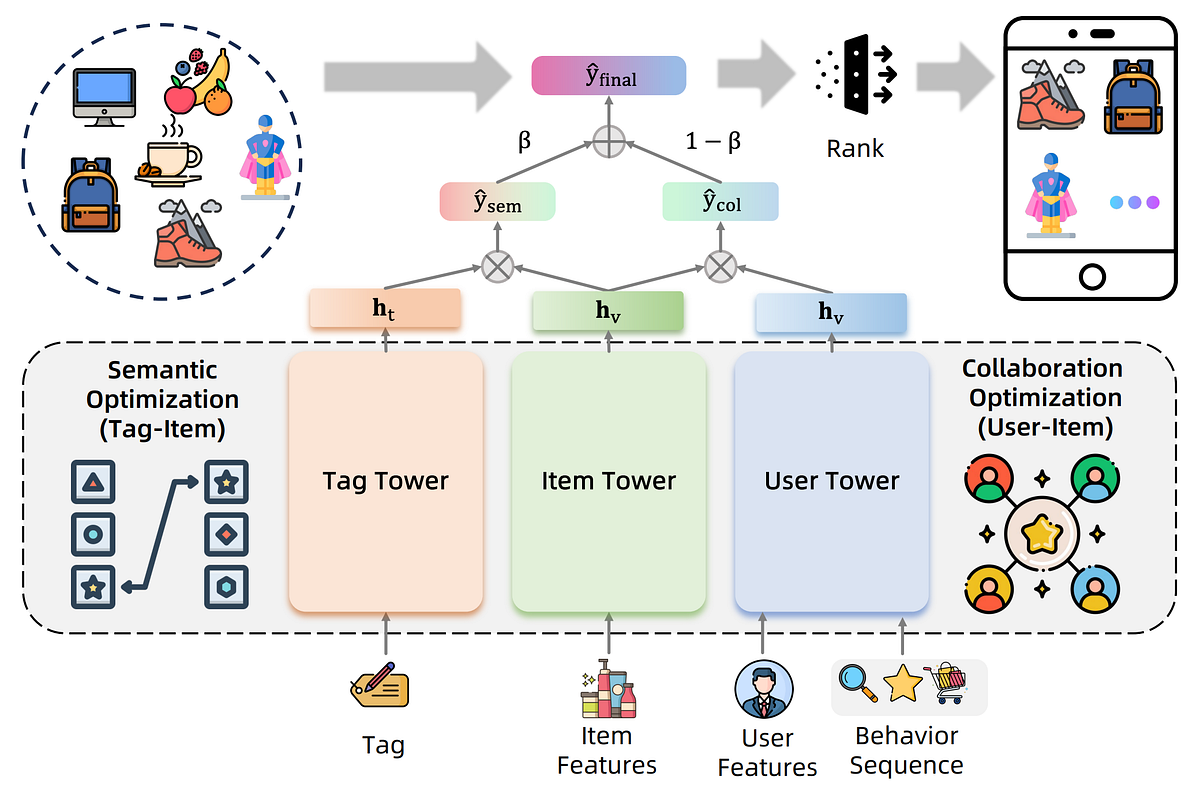
RecGPT-V3 departs from conventional two-stage retrieval-ranking pipelines. It maintains a continual latent memory state across user sessions, enabling persistent personalization without recomputing user representations from scratch each time. The system jointly grounds natural language queries and item catalogs in a shared embedding space, allowing the LLM to reason over both textual and structured item features.

To keep inference costs manageable at Taobao's scale, the model uses a hybrid mixture-of-experts (MoE) architecture. Only a subset of expert modules is activated per inference, which the company credits for the 52.4% cost reduction. The paper does not disclose the total parameter count or the number of active parameters per forward pass.

Latent Reasoning Without Retrieval Cascade

A key design choice is replacing the traditional retrieval-then-rerank cascade with latent reasoning inside the LLM. The model directly predicts item relevance scores from the joint embedding space, bypassing the separate retrieval index that legacy systems require. This unified approach simplifies the serving stack and reduces latency, though the paper does not report end-to-end latency numbers.

Deployment Impact and Caveats
Beyond the Click: Alibaba’s RecGPT is Rebuilding Recomme…

The 3.97% GMV lift is substantial for a platform of Taobao's size — Alibaba reported $1.2 trillion in GMV across its marketplaces in fiscal 2025. Even a fraction of a percent translates to billions of dollars in transaction volume. However, the paper does not detail how the lift was measured (A/B test duration, statistical significance, or whether the metric is revenue or gross merchandise value net of returns). Serving cost figures are also presented without a hardware baseline — it is unclear whether the comparison is against the previous RecGPT-V2 deployment or an older retrieval-based system.

The company did not disclose the training dataset size, compute budget, or whether RecGPT-V3 is fine-tuned from an existing base model (e.g., Qwen) or trained from scratch. No open-source release or API access has been announced.

What to watch

Watch for Alibaba to publish a full technical report or arXiv preprint with training details (dataset size, base model, compute budget). Also monitor whether Taobao expands RecGPT-V3 to other Alibaba properties like Tmall or AliExpress, and whether competing platforms (JD.com, Pinduoduo) disclose their own LLM-based recommender results.

Sources cited in this article

  1. Alibaba
Source: gentic.news · · author= · citation.json

AI-assisted reporting. Generated by gentic.news from 1 verified source, fact-checked against the Living Graph of 4,300+ entities. Edited by Ala SMITH.

Following this story?

Get a weekly digest with AI predictions, trends, and analysis — free.

AI Analysis

RecGPT-V3 represents a pragmatic step in the ongoing convergence of LLMs and recommender systems. Unlike earlier attempts that simply appended an LLM to an existing retrieval stack (e.g., P5 from Google, or Amazon's internal experiments with GPT for product search), Alibaba's approach eliminates the retrieval cascade entirely. The 52.4% cost reduction is particularly notable — it suggests that the unified latent reasoning approach, combined with MoE sparsity, can actually beat traditional index-based systems on cost at scale. However, the lack of methodological detail is a concern. Without knowing the base model, training compute, or dataset composition, it is difficult to assess whether the gains come from the architecture itself or from scale effects (larger model, more data). The 3.97% GMV lift is also a platform-specific metric — it conflates recommendation quality with pricing, inventory, and user behavior dynamics unique to Taobao. A more informative benchmark would be offline recall/NDCG on a public dataset like ML-1M or Amazon Reviews. Alibaba's silence on open-source release is telling. The company has historically been more closed than Meta or Google with its production AI systems. If RecGPT-V3 remains proprietary, the broader research community will not be able to reproduce or build on these results, limiting the impact beyond Taobao's walled garden.
This story is part of
The Protocol Schism: Anthropic's MCP Stack vs. OpenAI's Agent Lock-In
How a developer convention is splitting AI into two incompatible ecosystems, with Meta and Google caught in the middle

Mentioned in this article

Enjoyed this article?
Share:

AI Toolslive

Five one-click lenses on this article. Cached for 24h.

Pick a tool above to generate an instant lens on this article.

Related Articles

From the lab

The framework underneath this story

Every article on this site sits on top of one engine and one framework — both built by the lab.

More in AI Research

View all