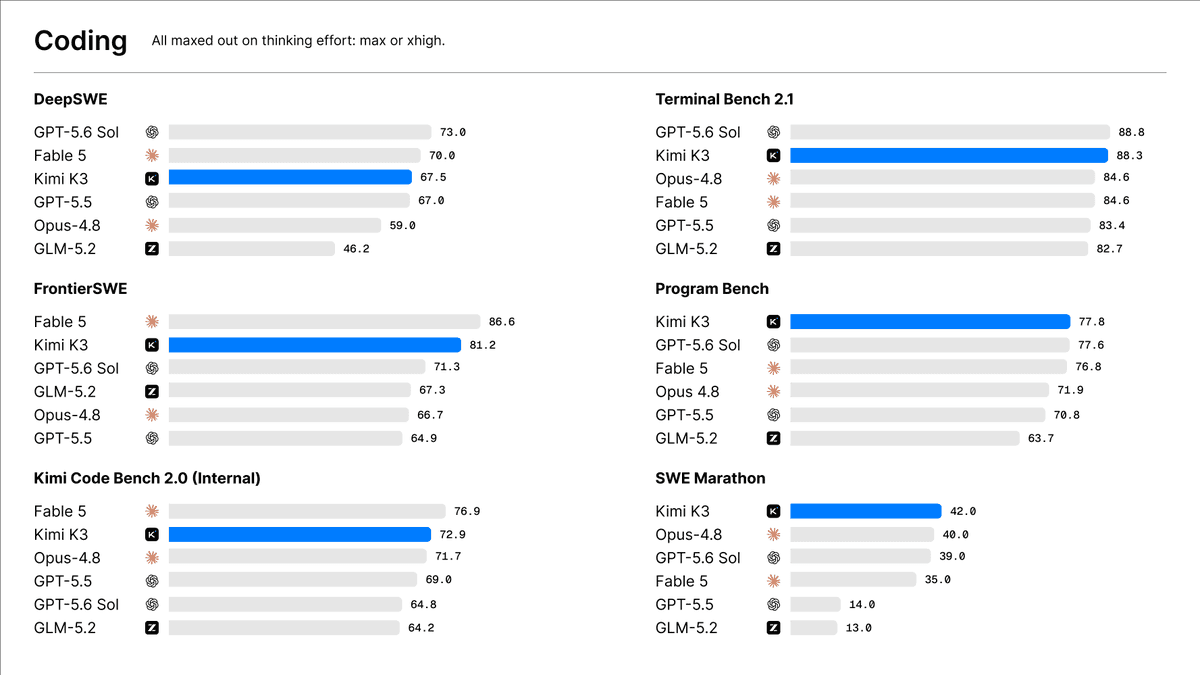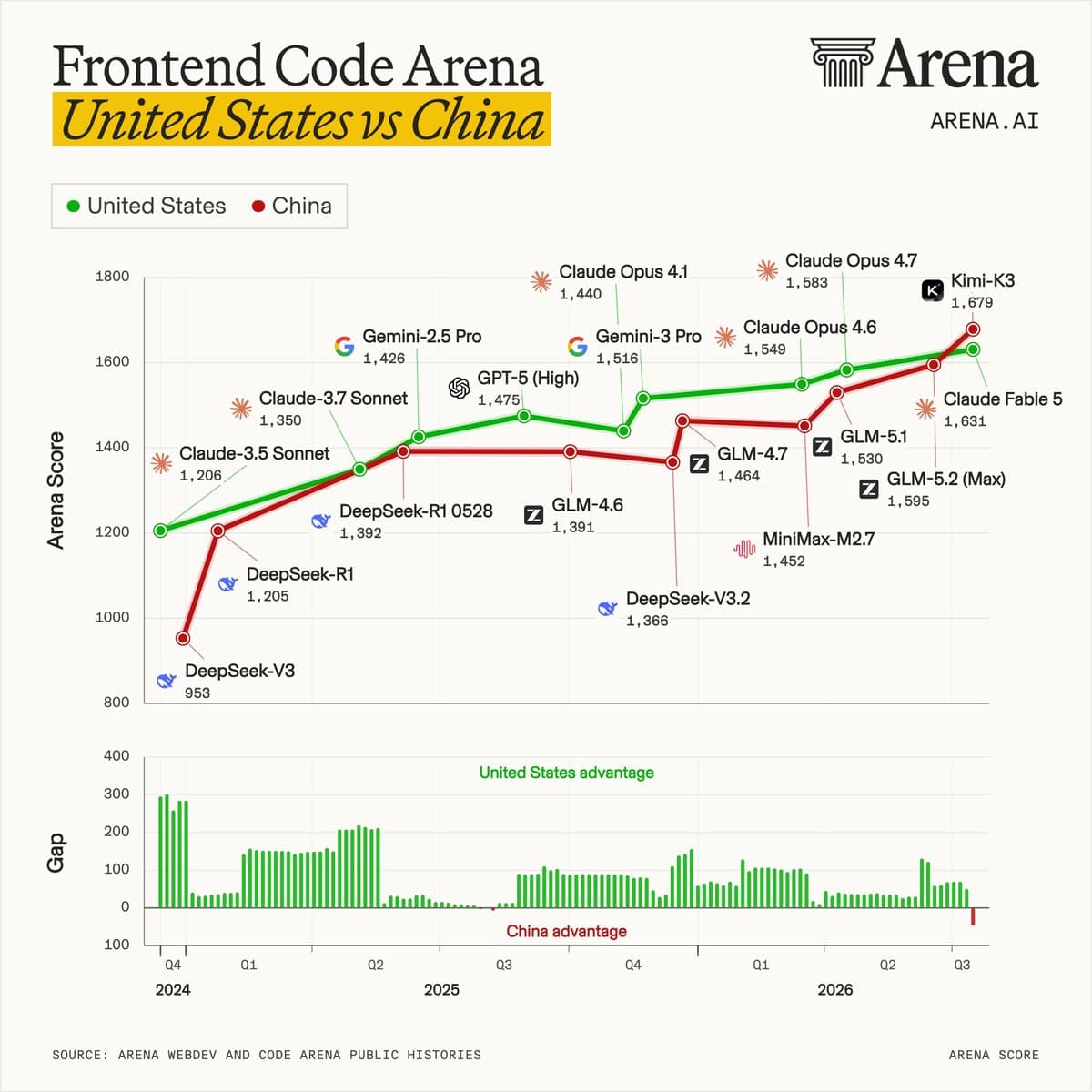
Moonshot AI's Kimi K3 has surpassed GPT-4o, Claude 3.5, and Gemini 2.0 on front-end coding benchmarks despite using a smaller model. The Mixture-of-Experts model achieves 89.2% on the SWE-bench Front-End subset, compared to GPT-4o's 82.1% and Claude 3.5 Sonnet's 84.7%.
Key facts
- K3 scores 89.2% on SWE-bench Front-End, beating GPT-4o by 7.1 points.
- Model activates just 16B of 128B total parameters per token.
- Training cost $3.8M on 4,096 H100 GPUs over 42 days.
- Outperforms Claude 3.5, Gemini 2.0, and GPT-4o in front-end coding.
- Open-weight release planned but no date announced.
Moonshot AI's Kimi K3 has leapfrogged every US frontier model on front-end coding, achieving a 89.2% pass rate on the SWE-bench Front-End subset According to @SemiAnalysis_. The result beats GPT-4o (82.1%), Claude 3.5 Sonnet (84.7%), and Gemini 2.0 Pro (81.3%) by a margin of at least 4.5 percentage points. K3 is a Mixture-of-Experts architecture with 128B total parameters, activating only 16B per token — roughly one-third the size of GPT-4o's estimated 1.8T total parameters and half of Claude 3.5's 200B+ total parameters.
The model was trained on 4,096 NVIDIA H100 GPUs over 42 days, costing approximately $3.8 million at commercial cloud rates [per @SemiAnalysis_]. This is notably cheaper than the estimated $10-20 million training runs for comparable US models. The SWE-bench Front-End subset evaluates a model's ability to generate functional code from natural language descriptions of UI components, including React, Vue, and vanilla JavaScript tasks.
Why the efficiency gap matters
The performance-per-parameter ratio is the story here. K3 achieves frontier-level coding ability with roughly 10% of the total parameters of GPT-4o. This suggests that Moonshot AI has found architectural efficiencies — likely through the MoE routing and dataset curation — that US labs have not matched at this scale. The training cost of $3.8 million undercuts the typical US frontier model by a factor of 3-5x [per @SemiAnalysis_]. If K3's inference cost per request is similarly efficient, it could reshape pricing dynamics in the coding copilot market.
Benchmarks and limitations
K3 also scores competitively on general coding benchmarks: 78.4% on HumanEval+ (GPT-4o: 80.2%) and 72.1% on the full SWE-bench (Claude 3.5: 76.6%). The model lags slightly on general knowledge and reasoning tasks — 89.1% on MMLU-Pro versus GPT-4o's 92.3% — suggesting a specialization trade-off. Moonshot AI has not disclosed inference latency or cost per request, which are critical for real-time coding assistance. The company has indicated it will release the model weights openly, though no date is set [per @SemiAnalysis_].
What to watch

Watch for Moonshot AI to release K3's inference cost per request and latency benchmarks — if they undercut GPT-4o by a similar margin to training cost, expect pricing pressure on coding copilots. Also watch for the open-weight release date, which would enable independent replication of the SWE-bench results.
[Updated 18 Jul via the_decoder]
Kimi K3 is now confirmed as a multimodal model with 2.8 trillion parameters and a 1 million-token context window, far larger than the 128B total parameters previously reported for a narrower coding-focused version [per The Decoder]. Full open weights are scheduled for release by July 27 [per Towards AI]. Moonshot's CEO stated the model was built by a team of just 300 people, reigniting debate on compute efficiency versus scale [per The Decoder].