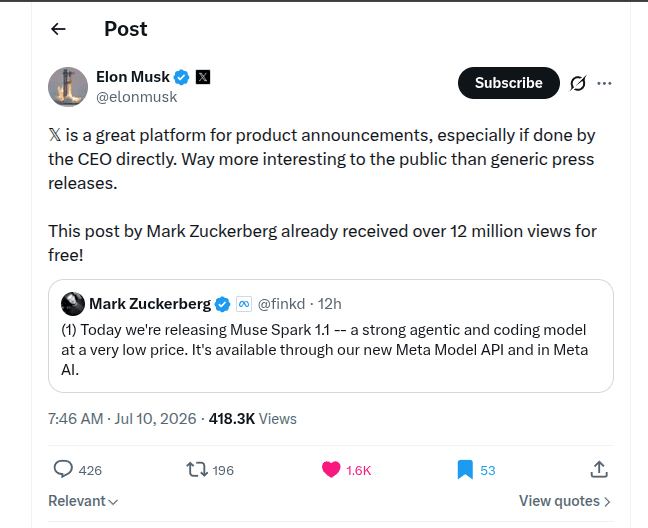
Meta released Muse Spark 1.1, entering the AI coding battle. Mark Zuckerberg's announcement post hit 12 million views in 12 hours, per @rohanpaul_ai.
Key facts
- Muse Spark 1.1 targets personal agentic task orchestration.
- Zuckerberg post: 12M views in 12 hours.
- Elon Musk quoted the post, boosting reach.
- No benchmark scores or parameter count disclosed.
- Meta AI capex forecast: $65B+ in 2026.
Meta has launched Muse Spark 1.1, a new model designed for personal agentic coding tasks that require planning and orchestration across external apps and services According to @rohanpaul_ai. The model enters a crowded field where competitors like OpenAI's GPT-4o and Anthropic's Claude 3.5 Sonnet have dominated recent benchmarks.
The announcement post by Mark Zuckerberg accumulated 12 million views in 12 hours, with Elon Musk quoting it — a move that likely pushed total views beyond 25 million, the source estimates. Meta did not disclose Muse Spark 1.1's benchmark scores, training compute, or parameter count.
Key Takeaways
- Meta released Muse Spark 1.1 for agentic coding tasks.
- Zuckerberg's post got 12M views in 12 hours; no benchmarks disclosed.
How Muse Spark 1.1 Differs
Unlike general-purpose coding models that focus on single-file generation or debugging, Muse Spark 1.1 emphasizes multi-step agentic workflows — planning, executing, and coordinating across tools like calendars, email, and code repositories. This aligns with Meta's broader push into AI agents, following earlier releases like Code Llama and the Llama 3 family.
The model's 'personal agentic tasks' framing suggests Meta is targeting consumer and prosumer use cases rather than enterprise CI/CD pipelines. The company has not published a technical paper or open-sourced the model, a departure from its usual practice with Llama variants.
The View Count Signal
Zuckerberg's 12-million-view post — with Musk's quote amplifying it — underscores Meta's aggressive marketing stance. For context, typical AI model announcements on X average 1-3 million views. The virality may pressure Meta to release benchmark results or a demo to sustain interest.
Muse Spark 1.1's launch comes as Meta faces scrutiny over its AI spending, with capex projected to exceed $65 billion in 2026 [per company filings]. The model's success hinges on whether it can differentiate in a market where agentic coding remains nascent but heavily contested.
What to watch
Watch for Meta to release benchmark results on SWE-Bench or HumanEval in the next 30 days, or for a public demo of Muse Spark 1.1 orchestrating multi-app workflows. If no benchmarks appear, the model may remain a consumer play rather than a serious coding competitor.
[Updated 10 Jul via the_decoder]
Meta undercut the AI pricing war by launching Muse Spark 1.1 at $4.25 per million output tokens, cheaper than Grok 4.5 and significantly below OpenAI and Anthropic rates [per The Decoder]. The aggressive pricing signals Meta's entry into the API business, intensifying pressure on pure-play labs already burning through billions.
[Updated 11 Jul via techcrunch_ai]
Muse Spark 1.1 is positioned for enterprise-scale tasks such as large code migrations and bug fixing, according to TechCrunch, broadening its appeal beyond consumer agentic workflows. The model aims to automate complex codebase transitions that enterprises increasingly seek from AI providers.