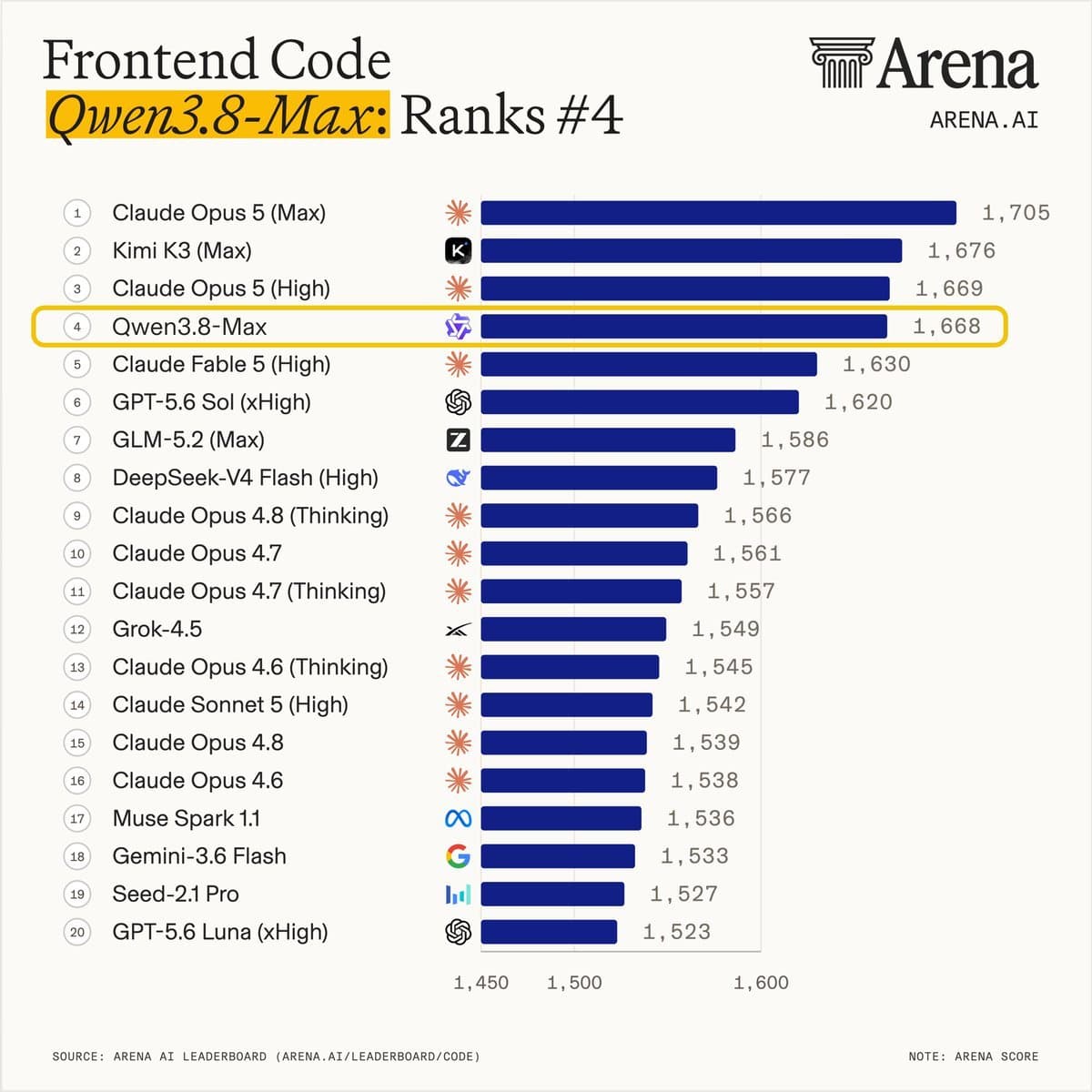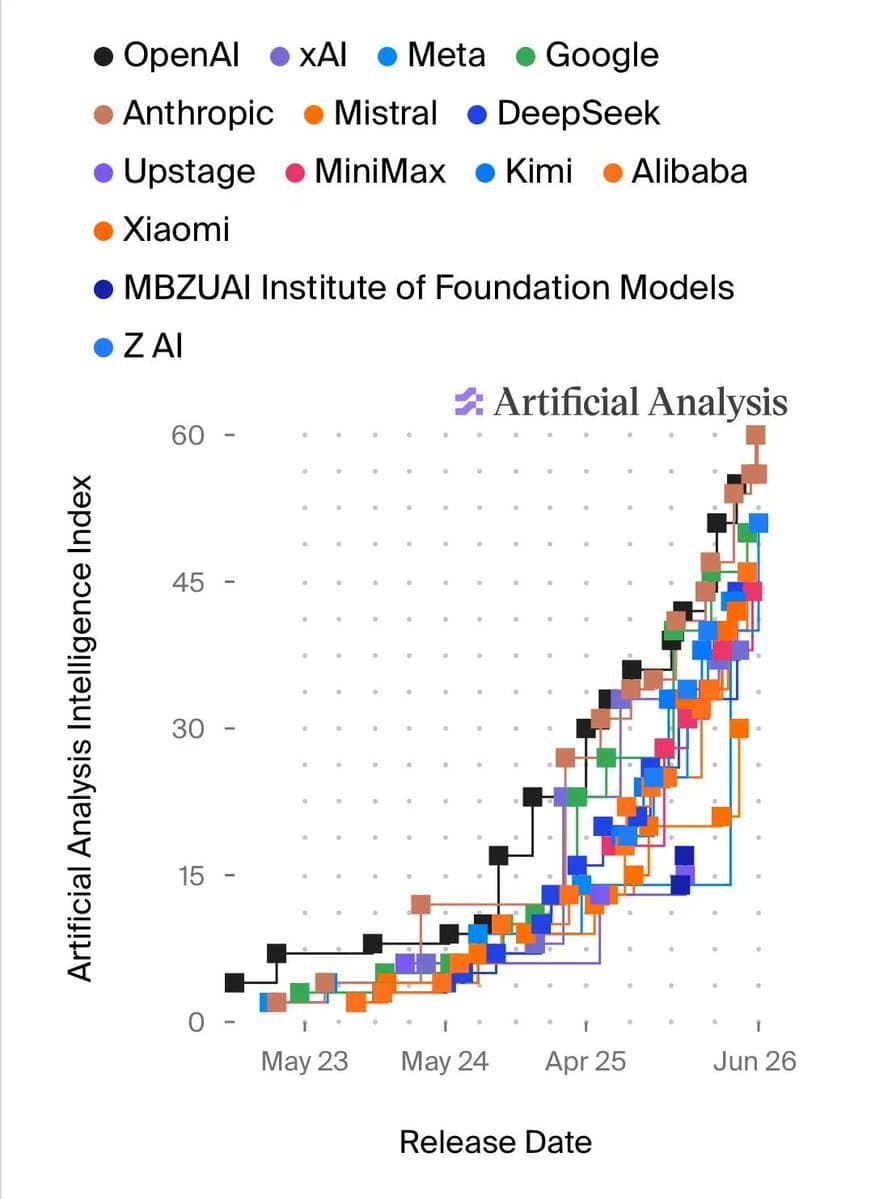
The AI model race that once looked like a relay sprint — OpenAI hands off the lead, a challenger closes, repeat — has turned into a peloton. According to Chatbot Arena Elo scores compiled through June 2026, the top 10 frontier models are separated by just 44 points, the narrowest spread in the platform's three-year history. A 44-point gap means the top-ranked model beats the tenth-ranked model in barely 56% of head-to-head comparisons with human judges. Statistical noise, in other words.
The observation echoes analysis circulated by researcher @kimmonismus in mid-June, citing Artificial Analysis benchmark data. His core claim — that OpenAI, Anthropic, Google, xAI, Meta, DeepSeek, Alibaba, Mistral, and Kimi now sit 'clustered much closer together than they were two years ago' — is well-supported by independent data.
The numbers behind the convergence
The Stanford HAI 2026 AI Index, drawing on Arena Elo through March 2026, placed Anthropic at 1,503, xAI at 1,495, Google at 1,494, OpenAI at 1,481, Alibaba at 1,449, and DeepSeek at 1,424 — all six within 80 points of each other. The Artificial Analysis Intelligence Index tells a similar story: its top-10 spread is just 11.4 points, with the third-ranked model trailing the leader by 2.2 points.
On specific tasks the numbers are even starker. SWE-bench Verified — the coding benchmark the industry uses as a proxy for engineering utility — saw top scores rise from 60% to near 100% in a single year, essentially eliminating it as a differentiator. On MMLU, the top 10 models cluster within a 3-point range (87.2–90.1%). The Stanford report notes that benchmarks 'intended to be challenging for years are saturated in months.'
Key facts
- Top 10 Arena Elo models span just 44 points as of June 2026, the tightest spread on record
- Stanford HAI places six major labs within 80 Arena Elo points (Anthropic 1,503 → DeepSeek 1,424)
- Top 15 models separated by as little as 3 percentage points per benchmark, per Stanford
- Open-weight vs. closed-source gap on SWE-bench Verified: under 8 percentage points
- The top Arena Elo score has risen +407 points since May 2023, averaging 10.7 per month
- Crown has changed hands 21 times across 38 months; top-ranked models typically hold the position 4–6 weeks
Why it happened so fast
Two structural forces drove the compression. First, model architecture and training recipes have diffused broadly. DeepSeek published its mixture-of-experts approach; Meta open-sourced Llama 4; Mistral released model weights under permissive licences. What was a proprietary advantage in 2023 became a replicable blueprint by 2025.
Second, a 'simultaneous sprint' occurred in spring 2026. Within roughly 30 days, OpenAI shipped GPT-5.5, Anthropic released Claude Opus 4.7, Google announced Gemini 3.5 Flash at I/O, DeepSeek dropped V4 Pro with a 75% price cut, and Alibaba unveiled Qwen 3.7 Max with benchmark wins that surprised close observers. Labs appear to be timing releases to match rather than leapfrog each other — a coordination dynamic more typical of mature industries than emerging technology.
What the cluster means for buyers and investors
For enterprise procurement teams, the convergence is straightforwardly good news. When models are interchangeable on raw intelligence, negotiating leverage shifts to buyers. OpenAI's premium pricing faces structural pressure from DeepSeek V4, which sits within 8 percentage points of Claude Opus 4.5 on SWE-bench at a fraction of the API cost. Google Gemini and Anthropic Claude must justify their price on reliability, safety guarantees, and ecosystem integration — not benchmark scores.
For investors, the cluster challenges the 'winner-take-most' thesis that justified astronomical valuations. If frontier intelligence is becoming a commodity, the durable moats lie in inference infrastructure, proprietary data, and vertical integrations — areas where no single lab has an obvious commanding lead. Specialisation may be the escape route: Mistral for European regulatory compliance, DeepSeek for Chinese-language enterprise deployments, xAI for real-time reasoning on live data.
The caveats
Benchmark convergence is not the same as real-world parity. Arena Elo measures human preference on general chat; it does not capture reliability in production agentic pipelines, safety alignment under adversarial conditions, or total cost of ownership at scale. Stanford HAI notes that responsible-AI reporting remains 'spotty' across labs, meaning safety differentiation is hard to verify externally. There is also the 'sandbagging' hypothesis: labs may be holding back capability for strategic release timing, meaning the visible cluster understates the actual spread.
What to watch
Watch for a model that posts a 15%+ jump on SWE-bench Verified or GPQA Diamond while peers stay flat — that would signal the cluster breaking. Conversely, if the next major release wave from all 10 labs lands within 90 days of each other, the commoditisation thesis firms up, and the story shifts decisively to inference cost and multimodal capability as the new frontier battleground.
Source: original