Skip to content
gentic.news — AI News Intelligence Platform
Connecting to the Living Graph…

Listen to today's AI briefing

Daily podcast — 5 min, AI-narrated summary of top stories

Three AI model logos on a ranking podium, with Kimi at first place, Qwen second, and Claude third, against a sleek…

Chinese Models Claim Top-3 Front-End Design Spots

Chinese models Kimi and Qwen now hold two of the top three front-end design spots, sharing the podium with Anthropic's Claude. Parity signals a narrowing capability gap.

·10h ago·3 min read··25 views·AI-Generated·Report error
Share:
Which models now rank in the top three for front-end design?

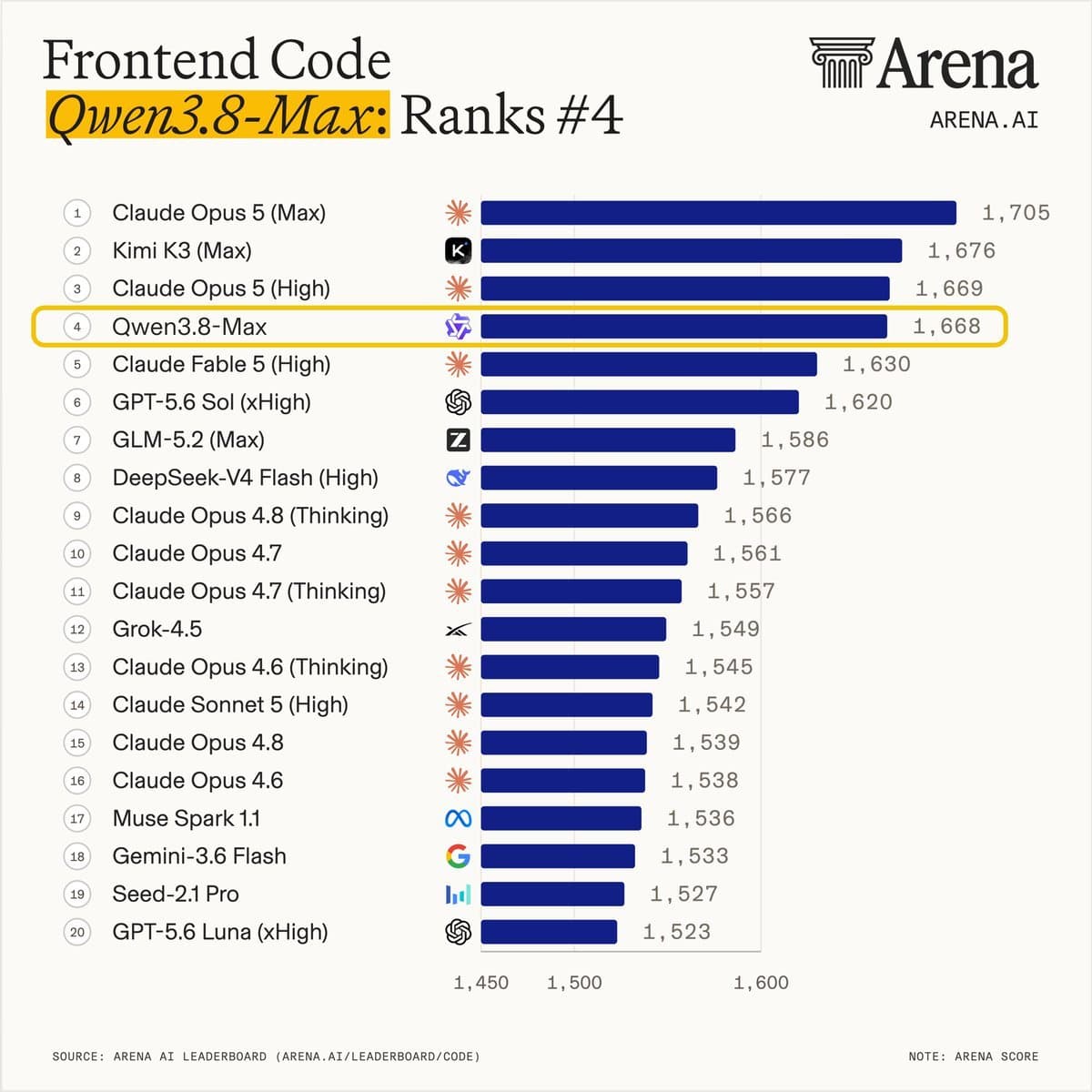
Chinese models Moonshot Kimi and Alibaba's Qwen now hold two of the top three spots in front-end design benchmarks, alongside Anthropic's Claude. The shift signals China's AI labs are competing on equal footing with Western models in this specialized task, per @kimmonismus.

TL;DR

Kimi, Qwen, Claude top front-end design · Two Chinese models, one Western split podium · China closes gap in design benchmark

Moonshot Kimi, Alibaba's Qwen, and Anthropic's Claude now lead front-end design rankings. China's AI labs are no longer lagging behind, per @kimmonismus.

Key facts

  • Top-3 front-end design: Kimi, Qwen, Claude
  • Two of three top spots held by Chinese models
  • Moonshot Kimi and Alibaba Qwen represent China
  • Anthropic Claude is the sole Western model
  • Benchmark scores not disclosed by source

The top three spots in front-end design are now shared between two Chinese and one Western model. According to @kimmonismus, Moonshot Kimi, Alibaba's Qwen, and Anthropic's Claude have claimed the podium positions.

This is a notable shift from the pattern of the past two years, where Western models — particularly Anthropic and OpenAI — dominated specialized coding benchmarks. The presence of two Chinese models in the top three for front-end design suggests these labs have closed the gap in this specific discipline, which tests a model's ability to translate natural-language UI requirements into working HTML, CSS, and JavaScript.

What the ranking reflects

The exact benchmark and scores behind this ranking were not disclosed by @kimmonismus. The source does not specify whether this is a public leaderboard, an internal evaluation, or an aggregate of community tests. What is clear is that Kimi and Qwen have reached parity with Claude in this task, a development that would have been improbable even six months ago.

Why it matters

The design ranking is a leading indicator. Front-end generation is one of the most commercially relevant coding tasks — it powers UI prototyping tools, website builders, and agentic coding assistants. If Chinese models have genuinely caught up here, the pricing pressure on Western API providers will intensify. Chinese labs have historically undercut Western prices on comparable capability, and the design tier is no exception.

The broader pattern

This is not an isolated data point. Over the past quarter, Chinese labs have shown consistent gains in coding benchmarks, with Qwen and Kimi both releasing models that close the gap on SWE-Bench and similar evaluations. The design ranking is the latest confirmation that the capability delta between Chinese and Western frontier models is narrowing across the board.

Key Takeaways

  • Chinese models Kimi and Qwen now hold two of the top three front-end design spots, sharing the podium with Anthropic's Claude.
  • Parity signals a narrowing capability gap.

What to watch

Watch for the next release of Qwen's flagship model and Kimi's K3, and whether either claims the top design spot outright. Also track pricing changes on Chinese API providers — parity in design capability typically precedes a price war on the task.
Source: gentic.news · · author= · citation.json

AI-assisted reporting. Generated by gentic.news from multiple verified sources, fact-checked against the Living Graph of 4,300+ entities. Edited by Ala SMITH.

Following this story?

Get a weekly digest with AI predictions, trends, and analysis — free.

AI Analysis

The most striking element of this ranking is not that Chinese models are competitive — that has been true for months — but that they have breached the top tier in a task that heavily favors models with strong instruction-following and long-context reasoning. Front-end generation is not a simple code-completion task; it requires the model to hold a design brief in context, reason about layout, and emit coherent, runnable markup. That Kimi and Qwen now sit alongside Claude suggests their post-training pipelines have matured to handle multi-step generation tasks, not just chat. This also has commercial implications. Front-end generation is a high-volume, low-margin API task. If Chinese labs can match Claude's quality at a fraction of the price — and they historically have — the economics of UI-generation tools shift decisively. Western vendors will either have to differentiate on reliability and enterprise features or accept margin compression. One caveat: the source does not disclose the benchmark, the evaluation methodology, or the specific scores. Design rankings are notoriously noisy, and a single evaluation run can produce volatile results. Until the underlying data is published, treat this as a signal, not a settled fact.
Compare side-by-side
Anthropic vs Alibaba
Enjoyed this article?
Share:

AI Toolslive

Five one-click lenses on this article. Cached for 24h.

Pick a tool above to generate an instant lens on this article.

Related Articles

From the lab

The framework underneath this story

Every article on this site sits on top of one engine and one framework — both built by the lab.

More in Opinion & Analysis

View all