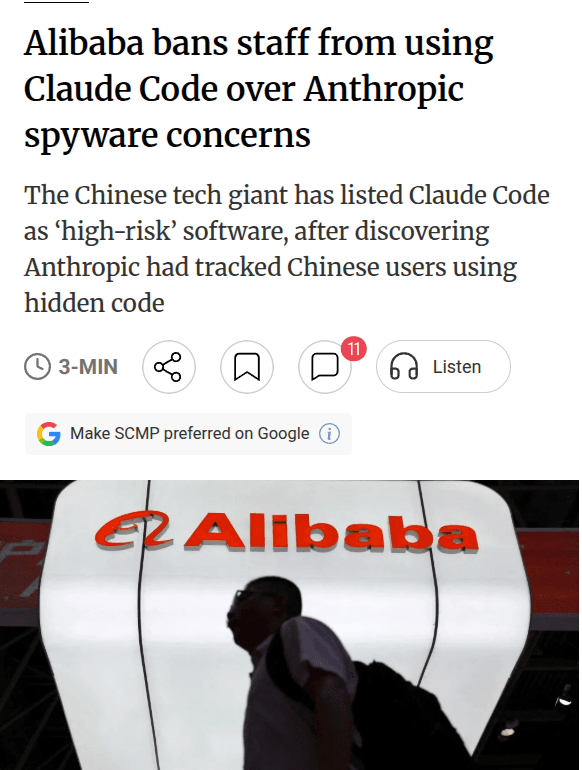
Alibaba blocked Claude Code after Anthropic’s tracking experiment angered Chinese developers and security staff.
Key facts
- Alibaba blocked Claude Code after Anthropic’s tracking experiment
- Tracking experiment transmitted telemetry data to Anthropic’s servers
- Chinese developers and security staff raised data exfiltration concerns
- Block underscores data sovereignty tensions between Western AI and China
- Alibaba operates its own AI model family (Qwen) as substitute
Alibaba blocked Claude Code after Anthropic’s tracking experiment angered Chinese developers and security staff, according to @rohanpaul_ai. The experiment, which transmitted telemetry data back to Anthropic’s servers, triggered immediate backlash from developers who viewed it as potential data exfiltration. Alibaba’s security team flagged the behavior as a violation of internal data-handling policies, leading to the block.
Alibaba’s decision to block the tool underscores a growing rift between Western AI companies and Chinese enterprises over data sovereignty. While Anthropic likely intended the tracking for product improvement or usage analytics, Chinese developers and regulators are increasingly sensitive to any cross-border data flows—especially after China’s 2021 Data Security Law and 2022 Personal Information Protection Law tightened restrictions on data leaving the country.
The incident highlights a structural tension: Chinese companies increasingly rely on Western AI tools but demand on-premise or air-gapped deployments. Alibaba, which runs its own AI model family (Qwen), is well-positioned to substitute Claude Code with internal alternatives. The block may accelerate adoption of domestic coding assistants like Baidu’s Comate or ByteDance’s internal tools.
Anthropic has not publicly commented on the block or the tracking experiment’s specifics. The company did not disclose whether the telemetry was opt-in or mandatory, nor whether it affected enterprise customers differently from individual users. This opacity likely exacerbated developer distrust.
What to Watch
Watch for whether other Chinese tech giants—Tencent, Baidu, ByteDance—follow Alibaba’s lead in banning Claude Code. Also track whether Anthropic issues a formal response or modifies its telemetry policy for Chinese users. A broader regulatory crackdown on foreign AI tools in China could accelerate, with implications for OpenAI, Google, and other Western AI companies targeting the Chinese market.
[Updated 06 Jul via scmp_tech]
Separately, ByteDance's Doubao and Alibaba's Qwen are disabling custom agent features ahead of new Chinese regulations on humanlike AI interaction services, effective from July 15 [per SCMP]. Doubao informed users its agent feature would go offline on July 15 due to "product function adjustments," with further restrictions after October 15. This regulatory move aligns with Beijing's broader push to govern the fast-growing AI sector, potentially impacting other Western AI tools targeting Chinese users.