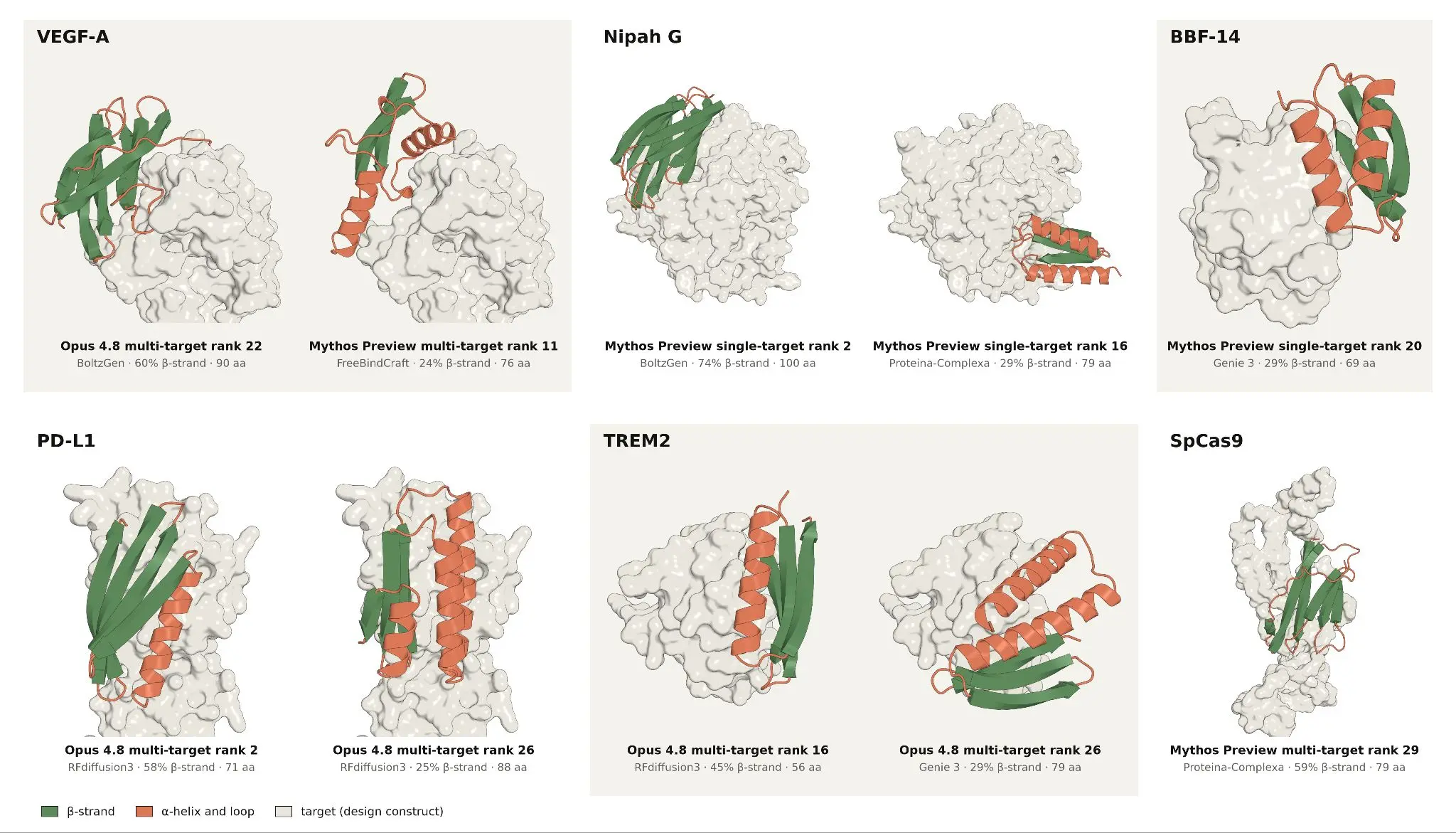
Anthropic's Claude designed novel protein binders for 14 out of 15 targets, with validation by Adaptyv Bio and Twist Bioscience. The result suggests AI can compress a traditionally weeks-long design cycle into days.
Key facts
- Claude designed binders for 14 of 15 targets (93%).
- Validated by Adaptyv Bio and Twist Bioscience.
- Human expert wrote the protein design prompt.
- Traditional design takes weeks to months per target.
- No affinity values or target details disclosed.
Anthropic announced on X that Claude, given a protein design prompt written by a human expert, autonomously generated protein binders against 14 of 15 targets. The company then contracted Adaptyv Bio and Twist Bioscience to independently build and test the proteins Claude designed.
The 93% success rate
Claude's success rate of 93% on this benchmark far exceeds typical computational design pipelines. For reference, published de novo binder design efforts, such as those using RoseTTAFold or AlphaFold-based pipelines, often report success rates in the single digits to low teens per design round. Anthropic did not disclose the exact number of candidates tested per target or the binding affinity thresholds, saying only that the proteins were 'built and tested.'
What this means for drug development
Designing a molecule that binds tightly to a target is a first step in drug development, traditionally requiring weeks or months of expert work per target. Claude's performance suggests that large language models, trained on protein sequences and structures, can propose viable binders with minimal human intervention. However, the company stopped short of claiming clinical relevance; binding in vitro does not guarantee therapeutic efficacy.
The unique angle here is not just that Claude succeeded, but that Anthropic chose external validation rather than self-reported metrics. By partnering with Adaptyv Bio and Twist Bioscience—companies that routinely synthesize and assay designed proteins—Anthropic has set a precedent for third-party verification in AI-driven drug discovery, a field often criticized for overhyped claims.
Limitations and open questions
Anthropic did not specify which targets were tested, how many designs were generated per target, or the affinity values achieved. Without these numbers, it's difficult to compare against state-of-the-art methods like RFdiffusion or Chroma. The company also did not disclose whether the binders were tested in vivo or only in vitro.
Still, the 14/15 hit rate is striking. If reproducible, it could shift the bottleneck in early-stage drug discovery from design to synthesis and assay, which are already high-throughput. The next step is to see whether these binders hold up in functional assays and whether the approach generalizes across diverse target classes, including protein-protein interfaces and allosteric sites.
What to watch
Watch for a peer-reviewed publication or technical report from Anthropic detailing the targets, candidate counts, and binding affinities. Also monitor Adaptyv Bio's public assay data and whether other labs replicate Claude's 93% hit rate on independent target sets.