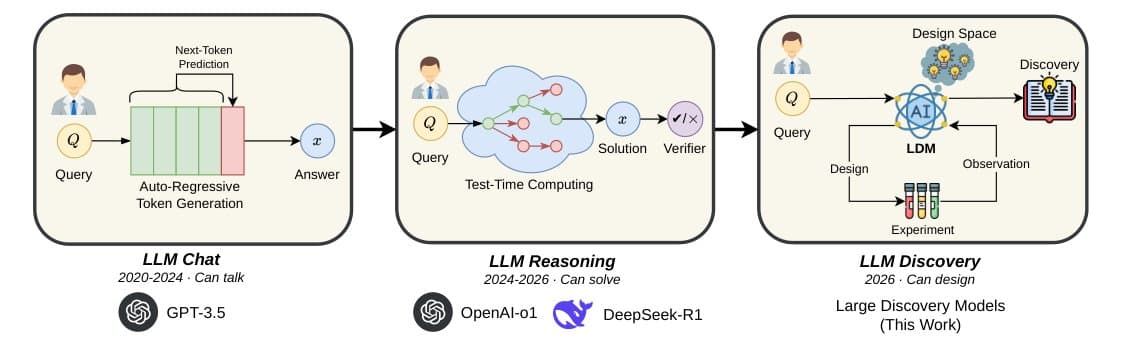
A new arXiv preprint, highlighted by @HuggingPapers, pairs an LLM proposer with a Bayesian surrogate scorer to cut validation error 2.4x across programs, proteins, and molecules.
Key facts
- Validation error reduced by 2.4x
- Binding energy cut by 18%
- Molecular objectives improved by 60%+
- Loop spans programs, proteins, and molecules
- LLM proposes, Bayesian surrogate scores
The paper, Large Discovery Models: learning where to search next, proposes a hybrid loop: an LLM generates candidate designs, a Bayesian surrogate scores their uncertainty, and the system iterates to focus search where it matters most. The reported results show a 2.4x reduction in validation error, an 18% drop in binding energy, and a 60%+ boost in molecular objectives According to @HuggingPapers.
The architecture is a departure from pure generative or pure Bayesian optimization. The LLM handles the combinatorial proposal space, while the surrogate provides a principled uncertainty estimate. This division of labor lets the model avoid wasteful sampling of known-bad regions and instead target high-uncertainty, high-potential areas. The paper does not detail the exact LLM size or the surrogate's kernel choice, leaving those specifics to the full preprint.
Why the loop matters
This is not a new model family but a new orchestration pattern. Prior work like Bayesian optimization with deep kernels or LLM-guided evolutionary search handles one side of the problem. This framework fuses both, treating the LLM as a proposal generator and the surrogate as a critic. For practitioners, the implication is that the bottleneck is no longer the generative model's creativity but the quality of the uncertainty signal. The 2.4x error reduction suggests the loop is robust across three distinct domains, which is rare in this literature.
The 60%+ improvement in molecular objectives is the headline number, but the binding energy reduction of 18% is arguably more physically meaningful. It indicates the model is not just optimizing a proxy but improving a downstream physical property. The paper does not disclose wall-clock training time or inference cost, a notable omission for anyone planning to deploy this at scale.
What the source doesn't say
The tweet and the abstract are thin on ablations. There is no comparison against a pure LLM baseline or a pure Bayesian optimization baseline. Without those, it is hard to attribute the gains specifically to the loop rather than to the underlying components. The preprint likely contains these details, but the public signal does not. That is a gap worth watching.
What to watch
Watch for the full arXiv paper to disclose the LLM's parameter count, the surrogate's exact formulation, and the ablation against single-model baselines. If the loop's gains hold under those conditions, this becomes a strong candidate for integration into commercial drug-discovery pipelines. Also track whether any lab adopts the pattern for protein design, where the 2.4x error reduction could translate to fewer wet-lab iterations.
Key Takeaways
- LLM-Bayesian loop cuts validation error 2.4x and binding energy 18% across domains.
- Molecular objectives up 60%+.