Key Takeaways
- Federated MCP networks turn Claude Code from a monolith into a microservices mesh.
- Use a Supervisor agent + specialized MCP servers (Stdio/SSE transports) to cut integration complexity from O(N²) to O(N) and scale horizontally.
The Problem: Your Single Claude Code Session Hits a Ceiling
You're probably running Claude Code as a monolith. One session, one context window, one tool loop. That works fine for single-turn tasks — but the moment you need cross-domain dependencies (scraping a page, writing to Postgres, checking compliance), you hit a wall. Bigger prompts and longer sessions just bloat the context and slow everything down.
The fix isn't more tokens. It's distributed systems thinking. The same way you broke monoliths into microservices, you should break your Claude Code workflow into a federated MCP network.
What Changed: MCP as Your Agentic Service Mesh
Model Context Protocol (MCP) — Anthropic's open standard — isn't just for connecting one tool. It's the JSON-RPC 2.0 backbone for a mesh of specialized agents. Here's the architecture:
- Supervisor Agent (your main Claude Code session) acts as the API gateway. It doesn't hold every tool. Instead, it queries a registry of available MCP servers.
- Federated MCP Servers are your microservices. Each encapsulates a domain: browser automation, database manipulation, secure code execution.
- Transport Layer replaces internal function calls with standardized protocols:
StdioServerTransportfor local Node processes,SSEServerTransportfor remote HTTP streaming.
The Architecture: 4 Layers You Need
1. Context Layer — Don't Broadcast, Namespace
Don't blindly share the full context window between agents. Use Context Namespaces (like Pinecone namespaces) to isolate memory per agent or domain. Allow controlled cross-namespace reads via cryptographic handles. This prevents token bloat and data leakage.
2. Transport & Protocol Layer
MCP enforces three primitives: Resources (data exposed), Tools (executable functions with JSON Schema validation), Prompts (templates). For local agents, use StdioServerTransport. For distributed/remote agents, use SSEServerTransport — an HTTP streaming channel for notifications plus a POST endpoint for tool invocations.
3. Registry & Discovery Layer
Your Supervisor needs a Decentralized Server Registry. When an MCP server boots, it broadcasts a manifest (tools, resource URIs, permissions). The registry handles:
- Capability advertisement
- Dynamic tool routing (which server owns the tool for this sub-task?)
- Health heartbeats (unbind dead servers so the Supervisor never dispatches to a crash)
4. Governance & Consensus Layer
Multiple agents mean conflict risk. Implement a Consensus Mechanism: multiple workers tackle the same problem, a Supervisor/Reviewer compiles outputs. For high-impact tool executions, enforce multi-party authorization and cryptographic audit logging.
The Payoff: O(N²) → O(N) Integration Complexity
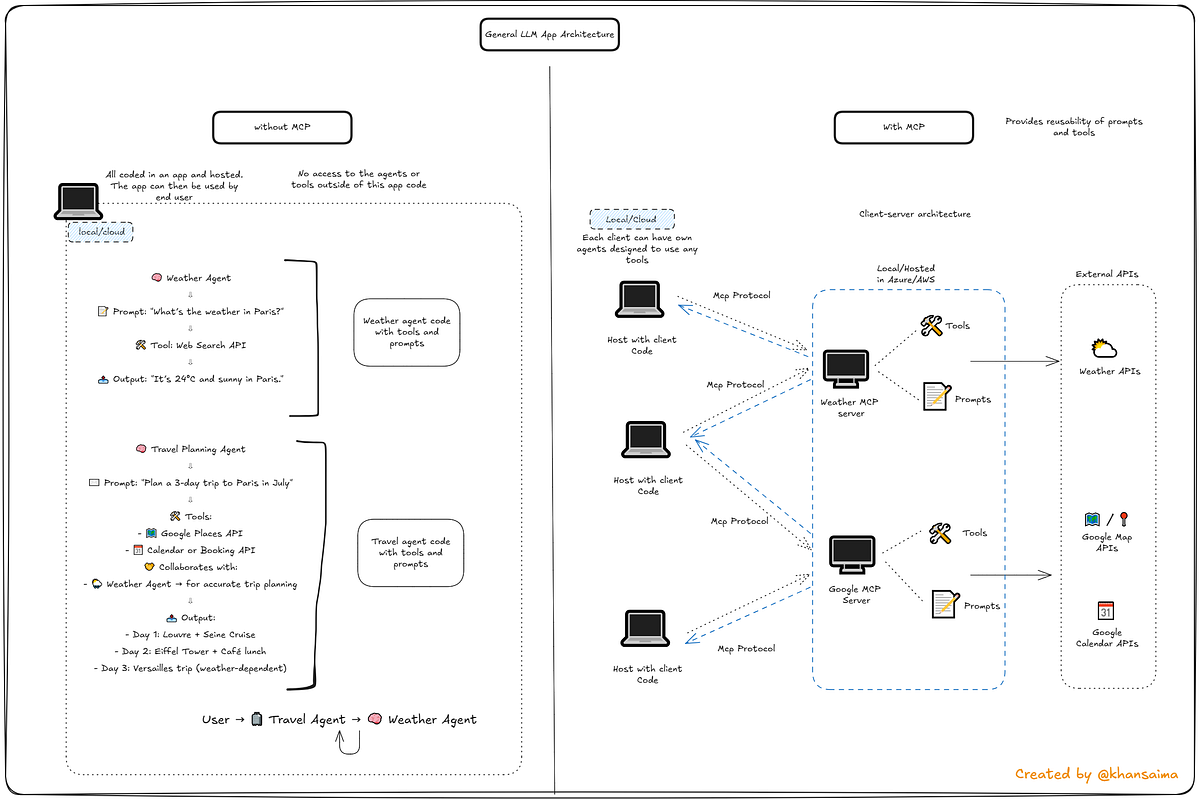
Here's the concrete math. Without MCP, integrating N agents requires custom glue code for every pairwise interaction — O(N²) integration points. With a federated MCP network, every agent exposes capabilities as an MCP Server and consumes as an MCP Client. Complexity drops to O(N).
Try It Now: Build Your First Federated Flow
Setup: Create three MCP servers — a browser scraper, a Postgres writer, a compliance checker. Run the scraper and compliance checker as local StdioServerTransport processes. Run the database writer as a remote SSEServerTransport in a Docker container.
CLAUDE.md snippet for your Supervisor:
When handling multi-step tasks:
1. Decompose into sub-tasks (execution DAG).
2. Query MCP registry for the server owning each sub-task's tools.
3. Execute tool calls via the registry — never hardcode tool paths.
4. If a server is unhealthy, re-route to a fallback or fail fast.
Prompt to test: "Audit our competitor's pricing page using the browser agent, extract tiers, validate against compliance rules, store in database."
Your Supervisor should decompose this, route to the browser server, pass output to compliance, then to the DB writer — all without you writing a single line of glue code.
Bottom Line
Federated MCP isn't theoretical. It's the difference between a Claude Code session that chokes on enterprise complexity and one that scales horizontally. Start with two specialized servers. Add a registry. Watch your integration pain disappear.
Source: dev.to
[Updated 03 Aug via devto_claudecode]
A key implementation detail from Anthropic's official docs: sub-agents can declare their own MCP servers in frontmatter, and the parent session never loads them. Inline servers connect when the sub-agent starts and disconnect when it finishes, keeping tool descriptions out of the main context. The canonical example pairs a browser-tester sub-agent with an inline Playwright MCP server plus a referenced GitHub server. Sub-agent definitions live in .claude/agents/ as Markdown files with optional mcpServers, tools, disallowedTools, model, permissionMode, and maxTurns fields. This gives you the namespace isolation the original architecture calls for — without a separate registry. [per dev.to]