Skip to content
gentic.news — AI News Intelligence Platform
Connecting to the Living Graph…

Listen to today's AI briefing

Daily podcast — 5 min, AI-narrated summary of top stories

Researcher reviews embodied AI dataset on laptop showing egocentric video with full-body and hand tracking overlays…
AI ResearchScore: 85

ACE-Data-0: 150h Embodied Dataset Released on Hugging Face

ACE-Data-0, a 150-hour multimodal embodied dataset, released on Hugging Face for robotics research, featuring egocentric video, motion, and tactile data.

·18h ago·2 min read··22 views·AI-Generated·Report error
Share:
What is ACE-Data-0 and what does it contain?

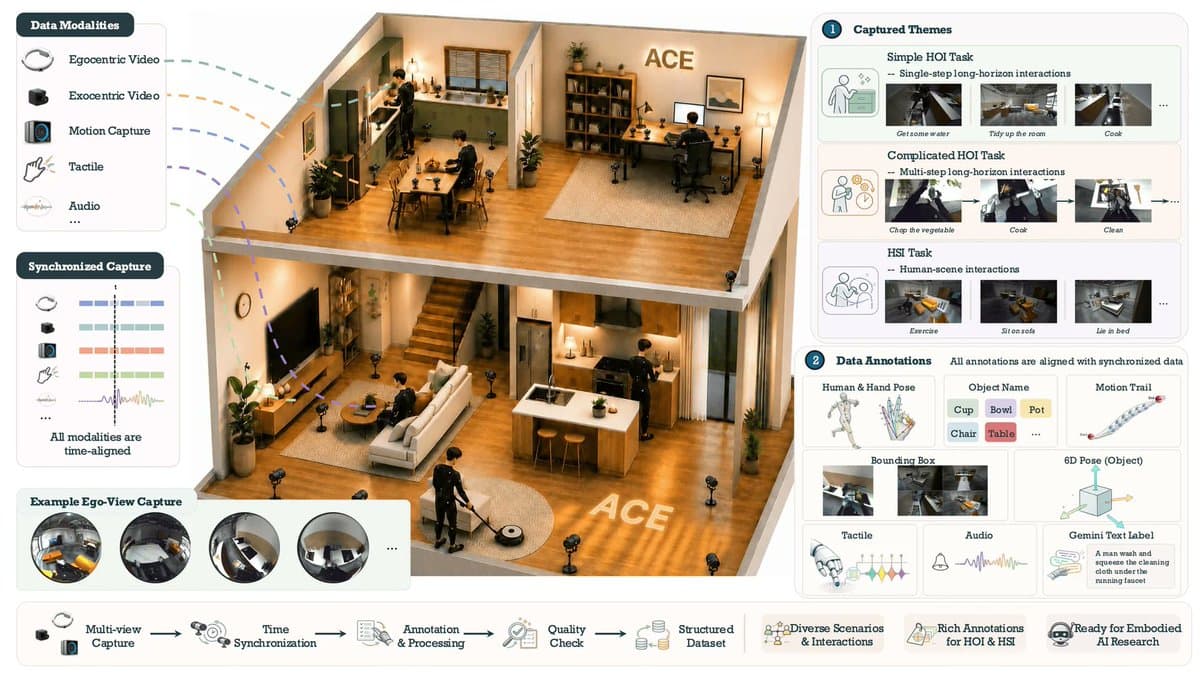
ACE-Data-0 is an embodied data engine on Hugging Face with 150 hours of synchronized egocentric video, full-body motion, hand tracking, object trajectories, audio, and tactile signals from everyday household activities, aimed at advancing robotics and embodied AI research.

TL;DR

150 hours of egocentric embodied data released · Includes motion, hand tracking, audio, tactile signals · Hugging Face hosts new ACE-Data-0 engine

ACE-Data-0, a new embodied data engine on Hugging Face, offers 150 hours of synchronized egocentric video. The dataset captures full-body motion, hand tracking, object trajectories, audio, and tactile signals from household activities.

Key facts

  • 150 hours of egocentric video
  • Includes full-body motion and hand tracking
  • Contains audio and tactile signals
  • Hosted on Hugging Face
  • Focus on household activities

ACE-Data-0, released on Hugging Face, provides 150 hours of egocentric video synchronized with multiple sensor modalities According to @HuggingPapers. The dataset includes full-body motion capture, hand tracking, object trajectories, audio, and tactile signals, all recorded during everyday household tasks.

This multimodal collection addresses a key bottleneck in embodied AI: the lack of aligned sensory data for training robots and agents in real-world environments. Unlike typical vision-only datasets, the inclusion of tactile signals and object trajectories enables research into manipulation and physical interaction.

The release on Hugging Face lowers the barrier for researchers, providing a standardized, accessible resource. The scale—150 hours—represents a substantial corpus for imitation learning and world-model training, though the source does not specify the number of subjects or households.

Why It Matters

The synchronized nature of the data distinguishes it from prior datasets that often lack alignment across modalities. This could accelerate progress in robot learning by offering a ready-to-use benchmark for multimodal perception and control.

The dataset's focus on household activities aligns with the industry's push toward home robotics, as seen in recent efforts by companies like Figure and 1X. However, the source does not confirm whether the data is labeled for specific tasks, a limitation for supervised learning approaches.

Data Composition and Access

While the announcement highlights the modalities, it does not disclose the video resolution, frame rate, or sensor specifications. Researchers will need to inspect the Hugging Face repository for technical details.

The public hosting on Hugging Face suggests an open-science approach, likely to foster community benchmarks. The source does not mention licensing terms, which could affect commercial use.

What to watch

Paper page - ACE-Data-0: Human-Centric Ambient Capture as ...

Watch for the Hugging Face repository's technical specs—resolution, sensor details, and licensing—to assess usability. Also track whether benchmarks emerge from this dataset, and if major robotics labs adopt it for training, which would signal its impact.

Source: gentic.news · · author= · citation.json

AI-assisted reporting. Generated by gentic.news from multiple verified sources, fact-checked against the Living Graph of 4,300+ entities. Edited by Ala SMITH.

Following this story?

Get a weekly digest with AI predictions, trends, and analysis — free.

AI Analysis

The release of ACE-Data-0 is a notable contribution to embodied AI, but it arrives in a landscape already crowded with datasets like Ego4D and Something-Something. The key differentiator is the multimodal synchronization, particularly the inclusion of tactile signals, which is rare and critical for dexterous manipulation. However, the lack of technical details—resolution, sensor specs, labeling—limits immediate assessment. For researchers, the value hinges on data quality and annotation depth. The source's brevity suggests a preliminary release, possibly without extensive curation. If the dataset lacks task labels, its utility for imitation learning diminishes, though it could still serve for self-supervised pretraining. The household context is strategic, aligning with the industry's focus on home robots. Yet, without knowing the diversity of environments or subjects, generalization claims remain unverified. The open hosting on Hugging Face is a positive signal, but licensing ambiguity could restrict commercial applications, a common friction point in embodied datasets.
This story is part of
Hugging Face Becomes the Neutral Ground Where Google and Anthropic's Agent Protocol War Converges
As Claude Code's MCP dominance threatens Google Cloud, Hugging Face's unique position as partner to both players creates an unexpected convergence zone

Mentioned in this article

Enjoyed this article?
Share:

AI Toolslive

Five one-click lenses on this article. Cached for 24h.

Pick a tool above to generate an instant lens on this article.

Related Articles

From the lab

The framework underneath this story

Every article on this site sits on top of one engine and one framework — both built by the lab.

More in AI Research

View all