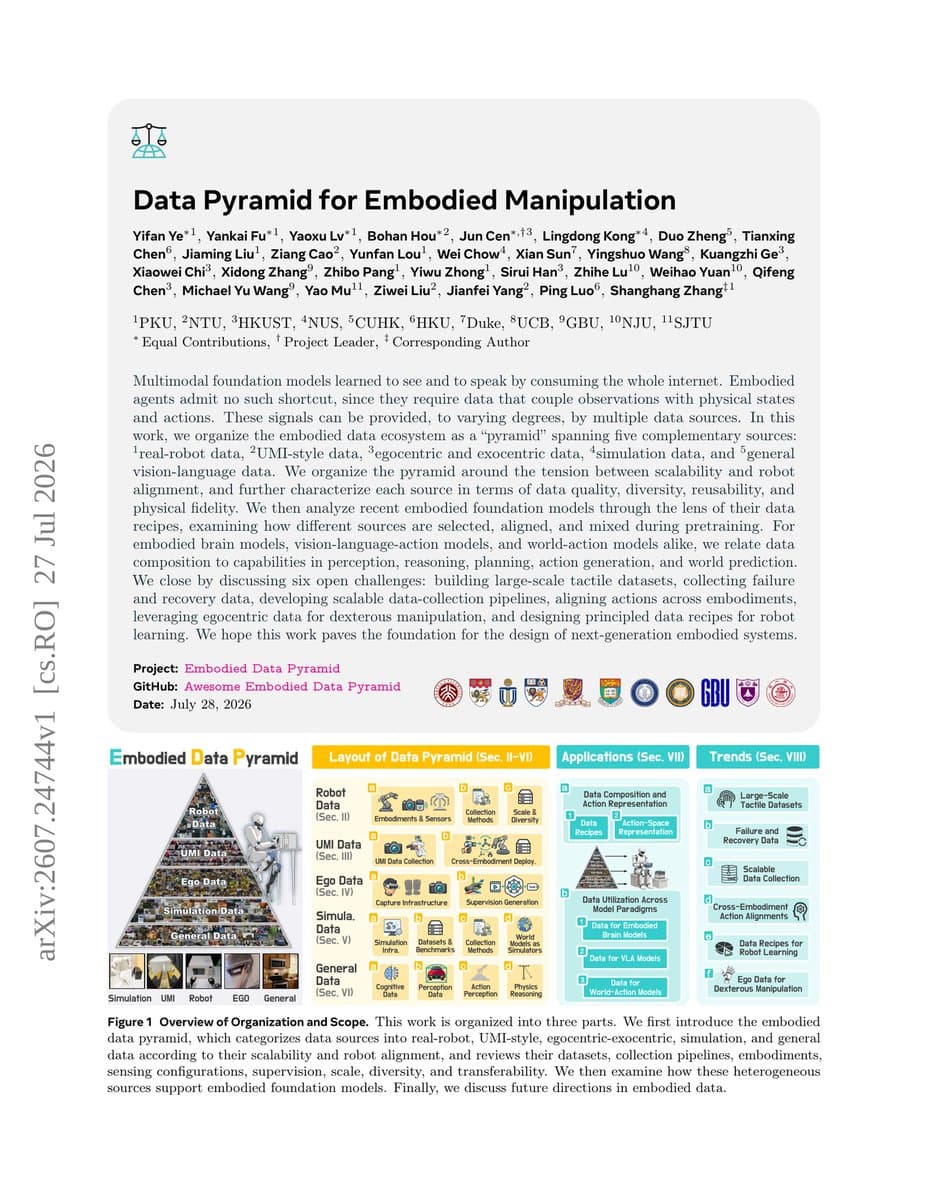
A new survey from @HuggingPapers organizes embodied manipulation data into a five-layer pyramid: real-robot, UMI, egocentric, simulation, and general. The framework maps how recent models combine these layers to advance robotic manipulation.
Key facts
- Five layers: real-robot, UMI, egocentric, simulation, general
- UMI data bridges simulation and real-robot deployment
- Survey announced via @HuggingPapers on X
- Real-robot data is highest fidelity but expensive to collect
A new survey announced via @HuggingPapers proposes a "data pyramid" for embodied manipulation, organizing training data into five distinct layers. The layers are: real-robot data, UMI (Universal Manipulation Interface) data, egocentric data, simulation data, and general data. The survey analyzes how recent models combine these layers to improve robotic manipulation performance.
Key Takeaways
- A new survey organizes embodied manipulation data into five layers — real-robot, UMI, egocentric, simulation, general — and analyzes how models combine them.
- The framework maps data quality against cost, highlighting UMI as a key bridge.
Why the Pyramid Structure Matters
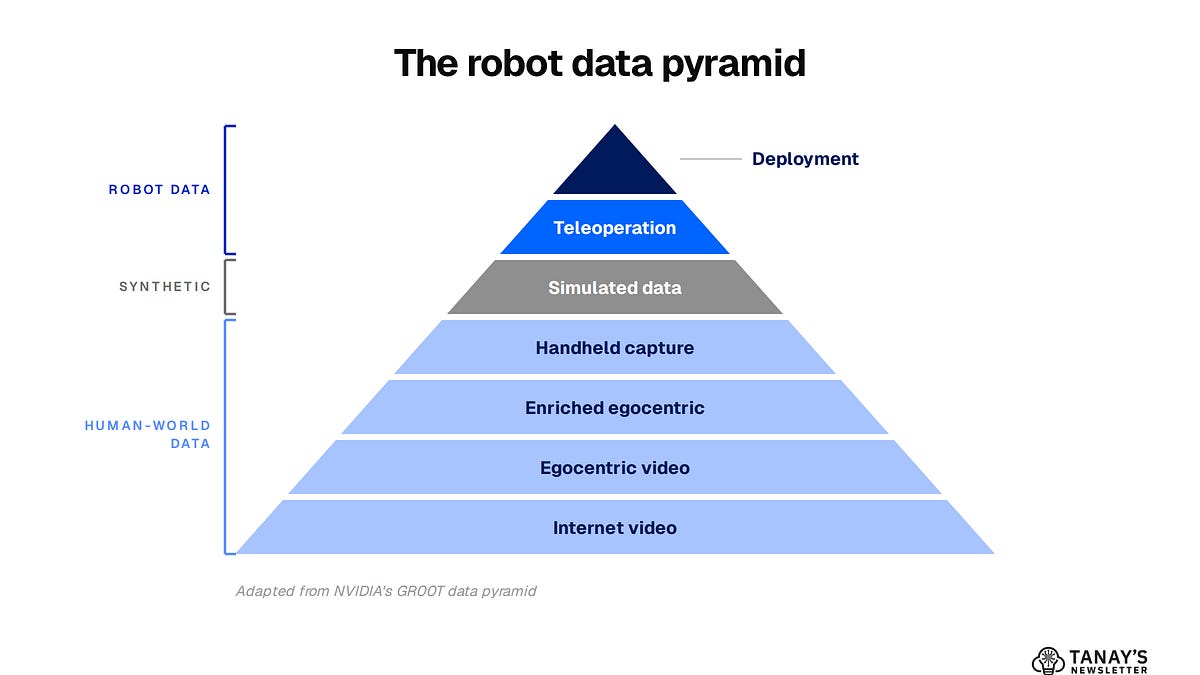
The pyramid framing is more than a taxonomy — it reflects a hierarchy of data quality and cost. Real-robot data sits at the apex as the highest-fidelity signal, but it is expensive and slow to collect. At the base, general data (web-scale text, images, video) is cheap and abundant but far from the embodied task distribution. The survey's contribution is mapping how state-of-the-art models blend these layers, a pattern visible in recent robotics work.
UMI data — collected via handheld grippers that record both visual and proprioceptive signals — has emerged as a middle ground, offering real-world physics without the cost of full robotic platforms. The survey positions this layer as a key bridge between simulation and full real-robot deployment. Egocentric data, captured from human-worn cameras, adds a rich source of manipulation demonstrations that recent models increasingly leverage.
The pyramid also exposes a structural tension: models trained heavily on simulation data often fail to transfer to real hardware, while pure real-robot data collection does not scale. The survey's analysis of how recent models combine these layers suggests the field is converging on hybrid strategies — pre-training on general and simulation data, then fine-tuning on UMI and real-robot data.
What the Survey Does Not Cover
The source announcement is thin on specifics. It does not disclose the number of papers surveyed, the exact models analyzed, or quantitative comparisons of data-mixing ratios. The survey's full findings remain behind the linked resource, so the field-level claims here are drawn from the announcement's framing and publicly known trends in embodied AI research.
The Structural Take
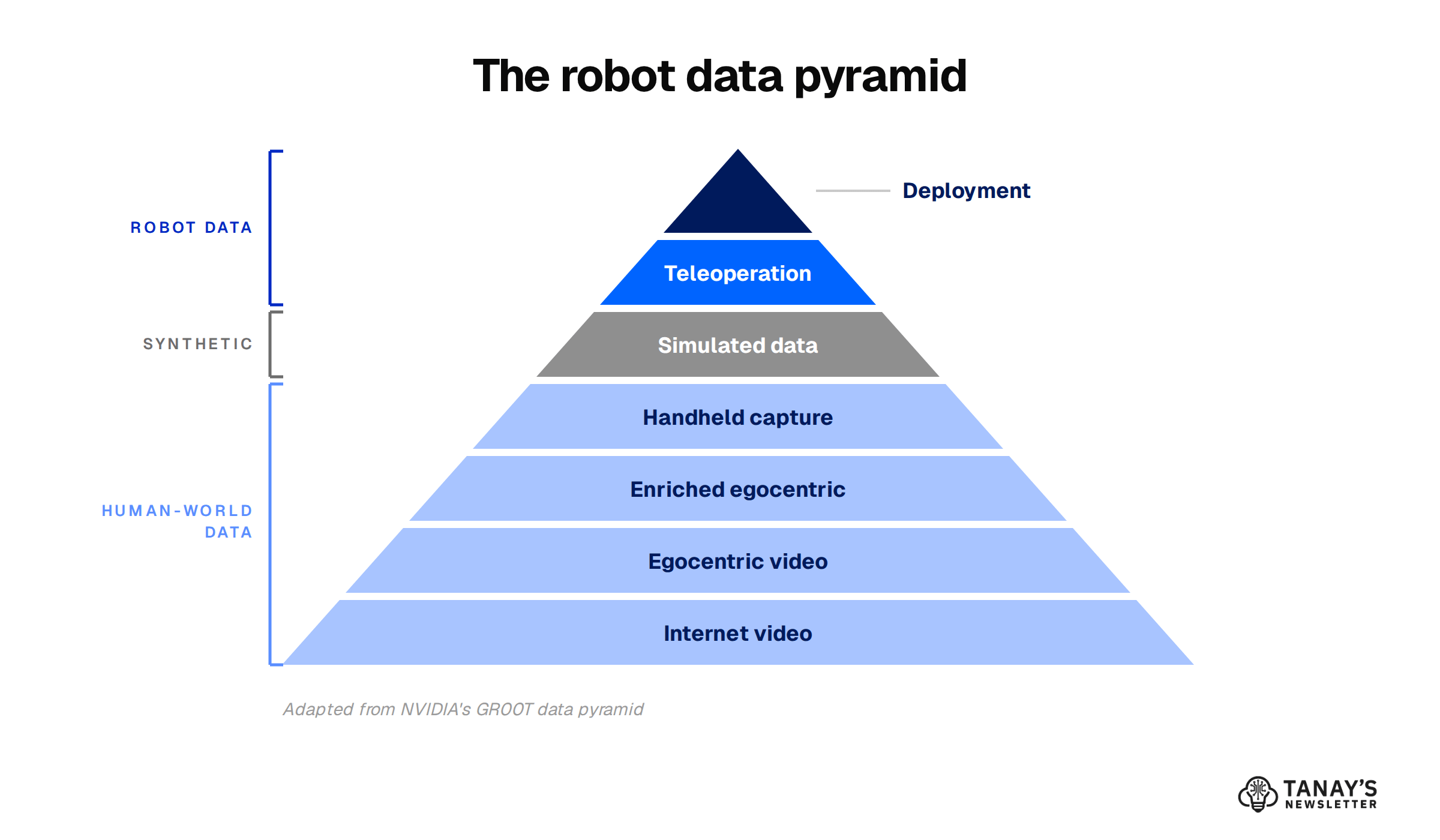
The pyramid's real value is as a cost-benefit map. Every embodied AI lab faces the same budget constraint: real-robot data is the bottleneck. The survey's five-layer framework gives researchers a shared vocabulary for discussing data strategy — and implicitly argues that the winning approach is not any single layer, but the right mixing ratio. That is a more useful contribution than another benchmark.
What to Watch
The survey's release signals a maturing of the embodied manipulation field, but the proof will be in the data-mixing recipes. Watch for follow-up papers that publish specific mixing ratios and ablations — the field needs quantitative guidance, not just a taxonomy. Also watch whether the UMI layer gains traction as a standard data format, which would lower the barrier to real-robot training for smaller labs.