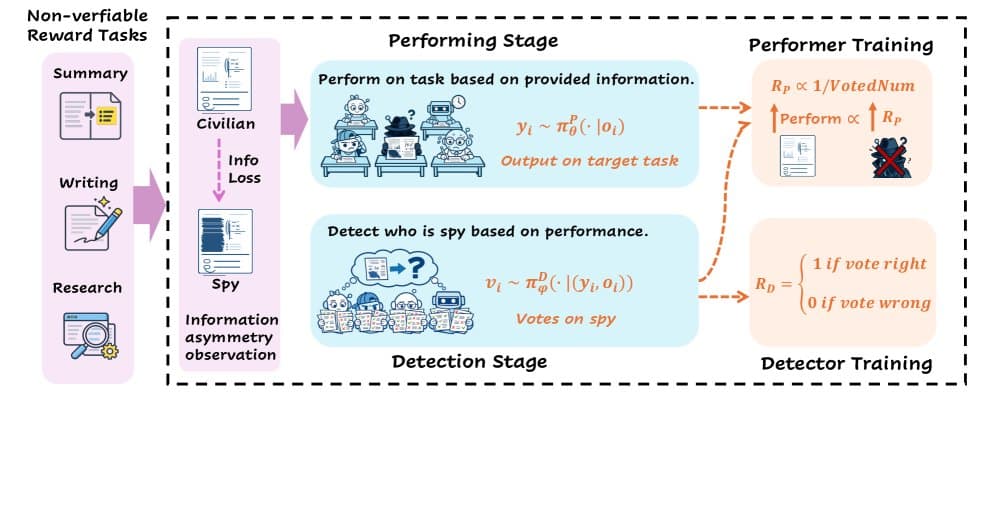
HuggingFace's @HuggingPapers announced RLSVR, a method that turns open-ended tasks into a 'Who Is the Spy?' game. The approach generates verifiable rewards for LLM self-improvement without a judge model.
Key facts
- RLSVR extends RLVR to open-ended tasks
- Uses 'Who Is the Spy?' game for rewards
- No judge model needed
- Applies to summarization, creative writing, math reasoning
- Announced via @HuggingPapers tweet
- No benchmark numbers disclosed
RLSVR (Reward Learning from Self-Verifiable Reasoning) extends the RLVR paradigm to tasks where ground-truth verification isn't available. According to @HuggingPapers, the method transforms open-ended tasks—summarization, creative writing, math reasoning—into a two-player game where the model must identify a 'spy' among candidates, producing verifiable rewards from the game's structure rather than an external judge.
Why this matters: escaping the judge bottleneck
Standard RLVR (Reinforcement Learning from Verifiable Rewards) works when answers are checkable—code compiles, math has a numeric answer. But open-ended tasks lack that. Prior work like RLHF needed a reward model, which is expensive to train and can be gamed. RLSVR's game formulation creates a self-contained verification signal: the model's own reasoning about who the spy is becomes the reward. This eliminates the judge model entirely, cutting training cost and removing a source of reward hacking. The 'spy' mechanic forces the model to reason about consistency and contradiction, which is a more structured signal than a scalar preference.
How it works
The game setup is simple: given a task output, the model plays both roles—one generates a plausible response, the other tries to detect the 'spy' (i.e., the inconsistent or low-quality output). The reward is derived from the detection success. This is self-supervised in the sense that no human labels or external judge are needed; the model's own reasoning provides the training signal. The paper—linked in the tweet—likely details the exact game mechanics and reward shaping, though the tweet doesn't specify hyperparameters or benchmark results. The source does not disclose model sizes, datasets, or performance deltas, so concrete numbers are absent.
Prior art and the gap
This builds on the RLVR line from OpenAI's Let's Verify Step by Step (Lightman et al. 2023) and DeepMind's process supervision work. But those required verifiable ground truths. RLSVR's contribution is moving verification into the model's own reasoning. The closest prior work is self-rewarding language models (Yuan et al. 2024), which used the model as its own judge via prompting. RLSVR's game structure is more robust because it forces a binary decision with a clear correct answer (who is the spy?), reducing the variance of self-judgment. The trade-off is that the game may not capture all aspects of quality—a model could produce a good but non-spy output that still gets penalized. The tweet doesn't address this limitation.
What's missing
The announcement is a single tweet with a link to a paper. No arXiv ID, no benchmark numbers, no model names. The source is thin. For a technical audience, the key question is whether RLSVR matches or beats RLHF on standard summarization benchmarks like ROUGE or on creative writing human eval. The tweet suggests math reasoning too, which is odd since math has verifiable answers—perhaps RLSVR is meant to handle the open-ended parts of math word problems. Without the paper, we can't verify the claims. [According to @HuggingPapers], the method 'enables LLM self-improvement on summarization, creative writing, and math reasoning without a judge,' but the specifics remain undisclosed.
Bottom line
RLSVR is a promising direction for scaling RL beyond verifiable tasks. The 'spy' game is a clever trick to generate rewards from the model's own reasoning, potentially reducing reliance on reward models. But the lack of quantitative results means we should treat it as a research preview, not a proven method. The next step is to see the paper's ablations: does the game reward correlate with human judgment? Does it hold up across model sizes? Until then, the claim is plausible but unverified.
What to watch
Watch for the full paper on arXiv or a blog post with benchmark results. If RLSVR shows ROUGE or human-eval parity with RLHF on summarization, it could displace reward models for open-ended tasks. Also watch for open-source code release—if it works, expect replication attempts within weeks.