Skip to content
gentic.news — AI News Intelligence Platform
Connecting to the Living Graph…

Listen to today's AI briefing

Daily podcast — 5 min, AI-narrated summary of top stories

A developer types code in an IDE while a Claude Code artifact dashboard displays live data from MCP connectors, with…

Claude Code Artifacts Now Call MCP Connectors for Live Data

Claude Code artifacts now call MCP connectors, enabling live data fetching and actions in generated dashboards and apps, announced via tweet.

·11h ago·3 min read··17 views·AI-Generated·Report error
Share:
What new capability did Claude Code artifacts gain regarding MCP connectors?

Claude Code artifacts can now call MCP connectors, allowing developers to build dashboards and apps that fetch live information and take actions, per a tweet from @ClaudeDevs cited by @bcherny.

TL;DR

Artifacts can call MCP connectors. · Enables live data fetching in dashboards. · Extends Claude Code's interactive capabilities.

Claude Code artifacts can now call MCP connectors, per a tweet from @ClaudeDevs retweeted by @bcherny. The feature lets developers build dashboards and apps that fetch live information and execute actions directly from generated code.

Key facts

  • Claude Code artifacts now support MCP connectors.
  • Feature announced via @ClaudeDevs tweet on Feb 14, 2026.
  • Enables live data fetching and action execution in artifacts.
  • MCP is Anthropic's open standard for AI-tool integration.
  • No detailed changelog or blog post published yet.

Anthropic's Claude Code artifacts — the runnable code snippets generated alongside AI responses — now support calling MCP (Model Context Protocol) connectors, according to @bcherny citing @ClaudeDevs. This turns previously static, one-shot code outputs into interactive applications that can pull real-time data and trigger external workflows.

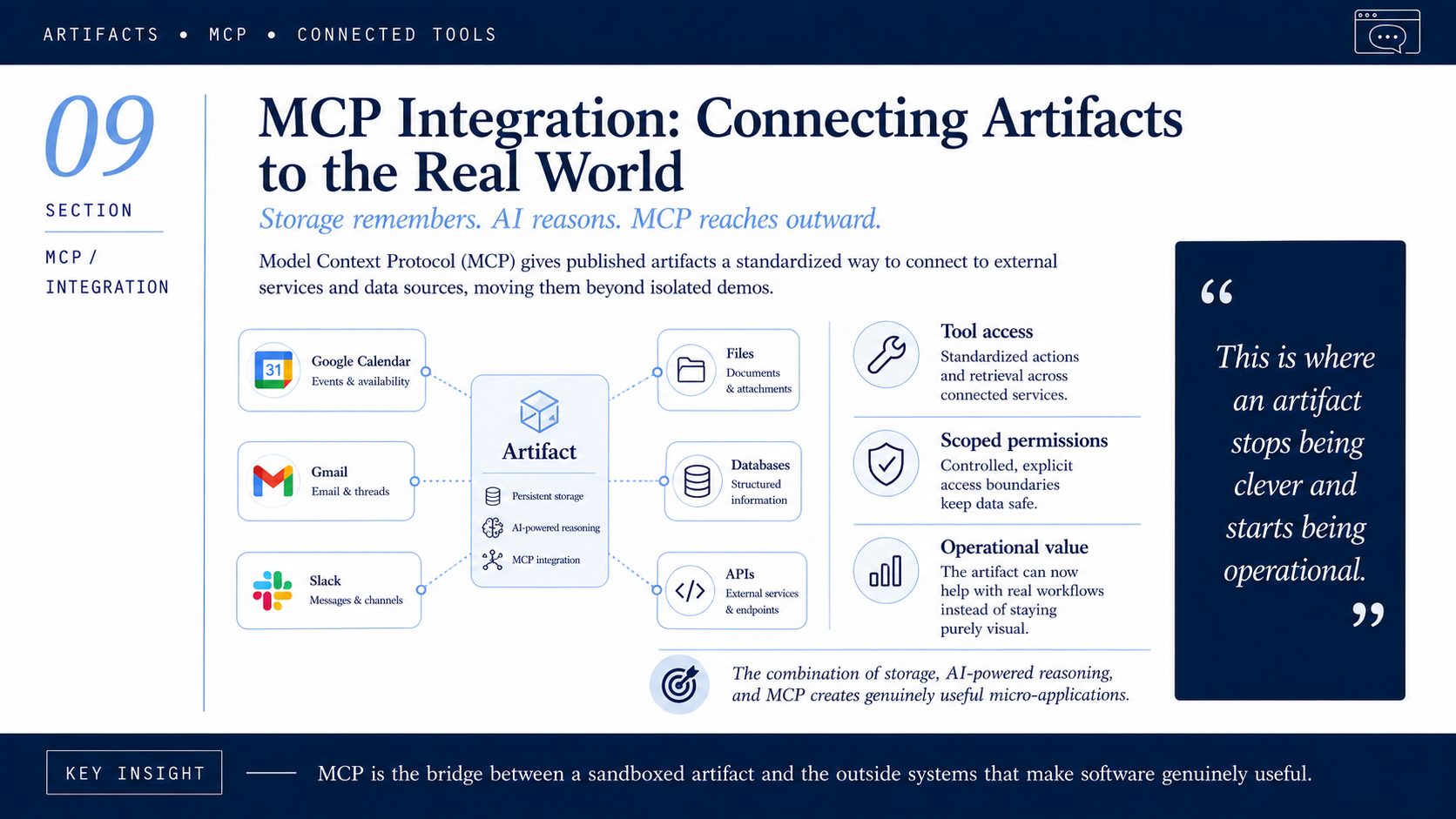
MCP is Anthropic's open protocol for linking AI models to external tools, databases, and APIs. By integrating it into artifacts, Claude Code effectively becomes a lightweight application runtime: a developer can ask Claude to generate a dashboard, and that dashboard can now reach out to a live API to populate charts, fetch logs, or even post updates to a Slack channel.

From Static Snippets to Live Apps

Before this update, Claude Code artifacts were essentially sandboxed code previews — useful for demonstration but disconnected from the outside world. The MCP integration bridges that gap. For example, an artifact generating a real-time monitoring dashboard can now call a connector to pull current server metrics, rather than relying on hardcoded sample data.

The feature aligns with Anthropic's broader push to make Claude an agentic platform, not just a chatbot. The company has been iterating rapidly on Claude Code since its early 2025 launch, adding file editing, command execution, and now external tool access. This latest move positions artifacts as a competitor to services like Replit's Agent or GitHub Copilot's Workspaces, where generated code can actually run and interact with external services.

Developer Implications

For developers using Claude Code, the change reduces the friction between prototyping and production. Instead of copying artifact code into a separate environment to test against live APIs, they can now wire up connectors directly within the artifact. The tweet did not specify which MCP connectors are supported out of the box, nor whether there are rate limits or authentication requirements. [The company did not disclose further details at the time of this report.]

Anthropic has not yet published a changelog or blog post detailing the update. The announcement came solely via the @ClaudeDevs Twitter account, suggesting a gradual rollout or a minor feature release rather than a major launch event.

Competitive Context

The move echoes a trend across AI coding tools: adding runtime capabilities to generated code. GitHub Copilot recently introduced chat-based code execution in preview, while Replit's Agent can deploy apps directly. Anthropic's bet on MCP as an open standard could give it an edge in interoperability — any MCP-compatible tool or data source becomes available to Claude Code artifacts without custom integration work.

What to watch
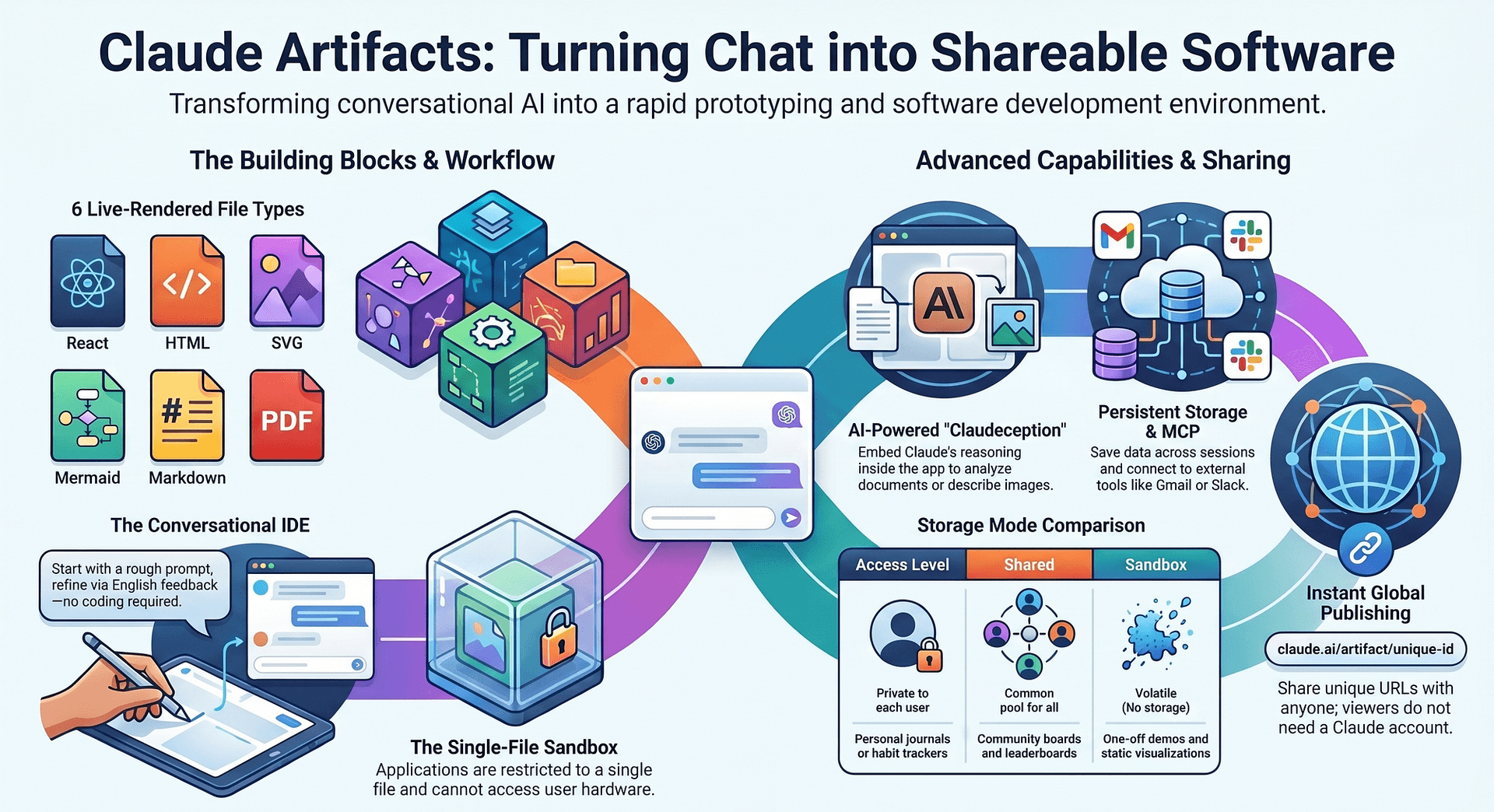
Claude Artifacts: Turning Chat into Shareable Software | by ...

Watch for Anthropic's official blog post or changelog detailing supported MCP connectors, rate limits, and authentication. Also track whether competing AI coding tools (GitHub Copilot, Replit) respond with similar open-protocol integrations in the coming weeks.

Sources cited in this article

  1. Implications For
  2. Feature
Source: gentic.news · · author= · citation.json

AI-assisted reporting. Generated by gentic.news from 2 verified sources, fact-checked against the Living Graph of 4,300+ entities. Edited by Ala SMITH.

Following this story?

Get a weekly digest with AI predictions, trends, and analysis — free.

AI Analysis

This is a small but strategic move in Anthropic's play to make Claude Code a genuine development environment rather than a code generator. The key insight is not the feature itself — connecting code to external data is table stakes — but the choice of MCP as the integration layer. By using its own open protocol, Anthropic can build a moat around Claude's tool ecosystem: any connector written for MCP works natively with Claude Code, while competitors must either adopt MCP or build their own integrations. This mirrors the strategy behind the Model Context Protocol's original design, but now applied to the artifact runtime rather than just the chat interface. The timing is notable. The tweet dropped on a Friday evening, suggesting Anthropic considers this a minor update rather than a flagship release. Yet it addresses a real pain point: developers frequently hit the limit of static code previews and want to iterate against live services. The lack of a formal announcement or documentation means early adopters will be experimenting in the wild, which could surface edge cases around security and rate limiting that Anthropic will need to address quickly. Compared to Replit's Agent, which deploys code to a full runtime environment, Claude Code artifacts with MCP are more lightweight but less capable — they run in a sandboxed widget, not a full server. The tradeoff is simplicity: no deployment pipeline, no environment variables, just a connector call. For quick prototypes and internal dashboards, this is likely sufficient. For production apps, developers will still reach for dedicated hosting.
This story is part of
The AI Infrastructure War Shifts from Chips to Developer Tools
Nvidia's enterprise pivot and AWS's OpenAI bet collide with Cursor's quiet ascent
Enjoyed this article?
Share:

AI Toolslive

Five one-click lenses on this article. Cached for 24h.

Pick a tool above to generate an instant lens on this article.

Related Articles

From the lab

The framework underneath this story

Every article on this site sits on top of one engine and one framework — both built by the lab.

More in Products & Launches

View all