OpenAI's GPT-5.6 Sol, Terra, and Luna are now generally available on Amazon Bedrock. The three-tier lineup brings OpenAI's latest models to AWS at the same pricing as first-party API access.
Key facts
- GPT-5.6 Sol scores 80 on Artificial Analysis Coding Agent Index
- Sol achieves 73.5% on ExploitBench vs GPT-5.5's 47.9%
- Pricing matches OpenAI first-party rates on Bedrock
- Usage counts toward existing AWS commitments
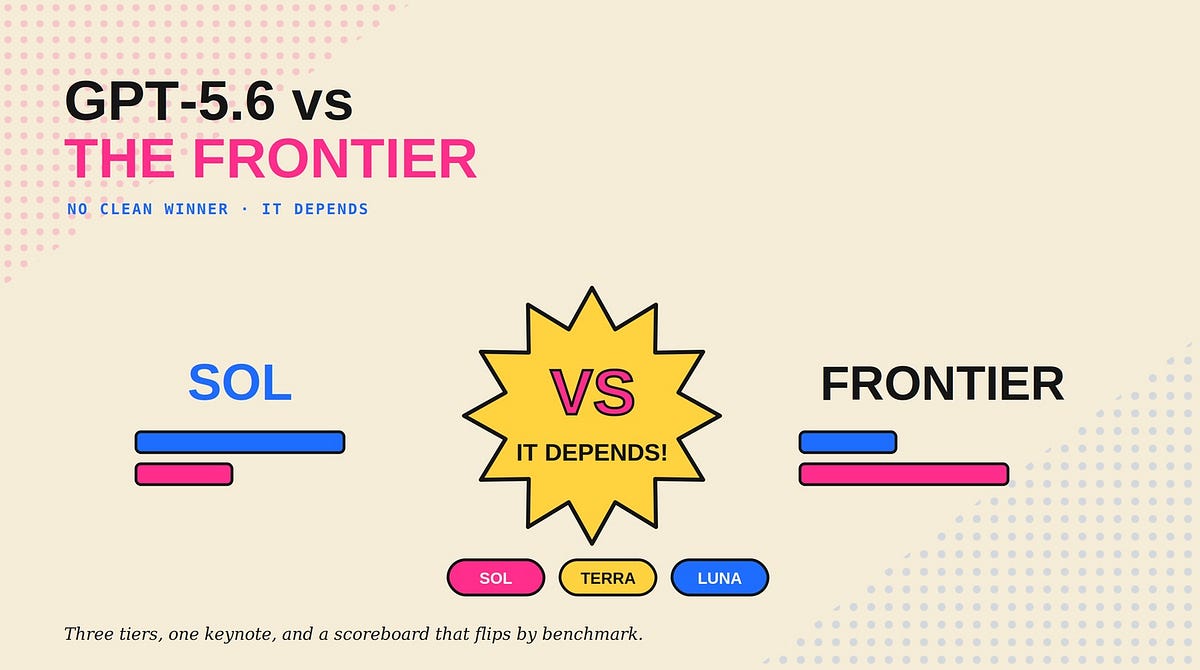
- Three tiers: Sol (flagship), Terra (balanced), Luna (fast)
OpenAI's GPT-5.6 family — Sol, Terra, and Luna — launched on Amazon Bedrock today, bringing the company's most capable models to AWS customers without a price premium. According to the AWS blog post, pricing matches OpenAI first-party rates, and usage counts toward existing AWS commitments.
Key Takeaways
- OpenAI's GPT-5.6 Sol, Terra, and Luna launch on Amazon Bedrock at matching first-party pricing.
- Sol scores 80 on Coding Agent Index.
The three tiers
GPT-5.6 Sol is the flagship reasoning model. OpenAI claims it scores 80 on the Artificial Analysis Coding Agent Index — 2.8 points above the next-best model — while using less than half the output tokens, taking less than half the time, and costing about one-third less. On ExploitBench, a cybersecurity benchmark, Sol scores 73.5% versus GPT-5.5's 47.9% at a comparable output-token budget. On Agents' Last Exam, which evaluates long-running professional workflows across 55 fields, Sol hits 53.6, outperforming the next-best model by 13.1 points. At medium reasoning effort, it still leads by 11.4 points at roughly one-quarter the estimated cost. Sol also introduces a max reasoning effort setting.
GPT-5.6 Terra is the balanced model for everyday production work. The blog post says it delivers superior performance to GPT-5.5 at a lower cost, targeting code generation, content workflows, structured data extraction, and general-purpose agentic tasks.
GPT-5.6 Luna is the fast and affordable model for high-volume inference tasks like classification, summarization, routing, and real-time applications where latency and cost per token matter most.
The naming convention
GPT-5.6 introduces a new naming system: the number identifies the generation, while Sol, Terra, and Luna identify durable capability tiers that can advance on their own cadence. This allows OpenAI to update individual tiers without changing the generation label.

What this means for the market
The Bedrock availability matters most for enterprises that have existing AWS commitments and data residency requirements. By matching first-party pricing and counting toward AWS spend, OpenAI removes the two biggest friction points for enterprise adoption: cost uncertainty and vendor lock-in concerns. The move also puts direct pressure on Anthropic, which Amazon has invested $4B+ in, and whose Claude models are also available on Bedrock.

However, the timing is notable. Our previous reporting on OpenAI GPT-5.6 Sol matching Fable 5 at 1/3 cost noted that Sol's 80-point Coding Agent Index score still trails Claude Code's 80.8% on SWE-Bench, as we covered in Why Claude Code's 80.8% SWE-Bench Score and 1M Context Window Beat Codex. The benchmarks are not directly comparable — Coding Agent Index and SWE-Bench measure different things — but the competitive narrative is clear.
Security and data handling
Per the blog post, Bedrock's next-generation inference engine handles security and reliability. AWS does not train on customer data, and the service supports data residency controls. The blog post emphasizes that these workloads "run on sensitive data" and "operate in environments where data residency and security are non-negotiable."

Availability
All three models are generally available now on Amazon Bedrock in select AWS regions. The company did not disclose which regions or whether there are throughput limits.
What to watch
Watch for Q3 enterprise adoption numbers from AWS earnings calls, and whether Anthropic responds with a Bedrock-specific pricing discount or feature exclusivity. Also track the next Artificial Analysis Coding Agent Index update to see if competitors close the gap.
Source: aws.amazon.com