Skip to content
gentic.news — AI News Intelligence Platform
Connecting to the Living Graph…

Listen to today's AI briefing

Daily podcast — 5 min, AI-narrated summary of top stories

OpenAI logo on a dark background, with a sleek server rack glowing blue, symbolizing the new GPT-5.6 Sol model…

OpenAI GPT-5.6 Sol matches Fable 5 at 1/3 cost, adds multi-agent API

OpenAI's GPT-5.6 Sol nearly matches Claude Fable 5 on aggregate benchmarks at one-third the cost, with new multi-agent and tool-calling APIs.

·8h ago·3 min read··17 views·AI-Generated·Report error
Share:
Source: scmp.comvia scmp_tech, the_decoder, simon_willison, zdnet_ai, openai_blog, techcrunch_ai, towards_aiCorroborated
How does OpenAI's GPT-5.6 Sol compare to Anthropic's Claude Fable 5 on benchmarks and pricing?

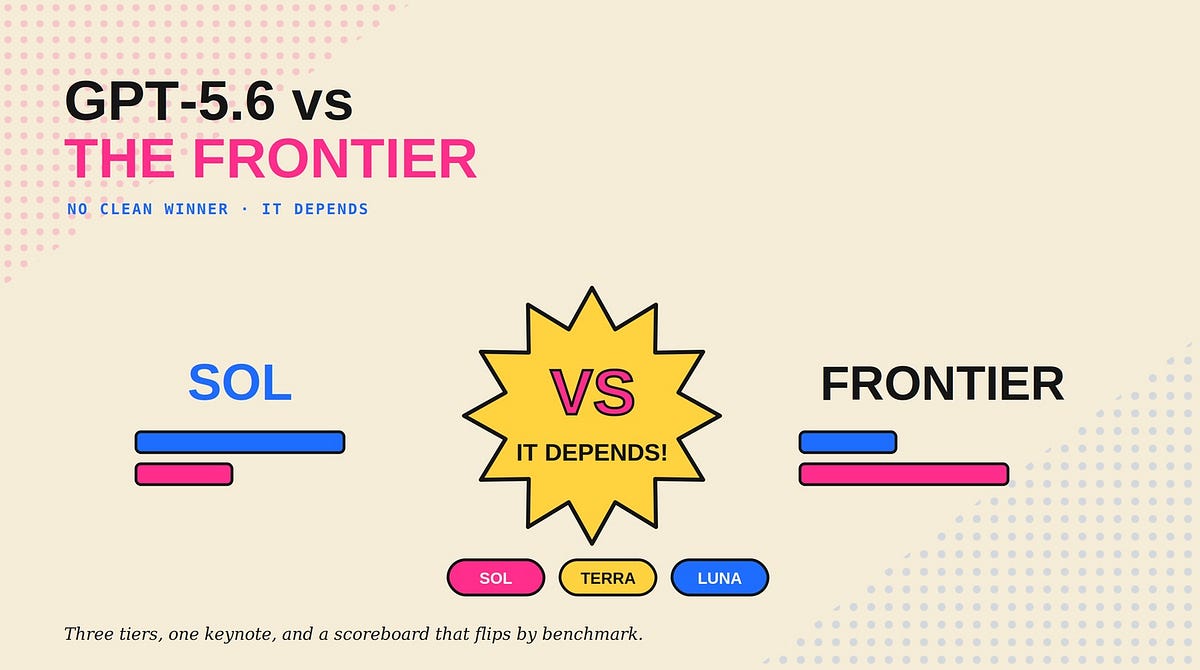
OpenAI's GPT-5.6 Sol scores 59 on the Artificial Analysis Intelligence Index, one point behind Claude Fable 5, at $1.04 per task — one-third the cost. The family includes Luna, Terra, and Sol models priced from $1 to $30 per million output tokens.

TL;DR

GPT-5.6 Sol scores 59 on AI Index, one point behind Fable 5 · Priced at $1.04 per task, one-third of Anthropic Claude Fable 5 · New multi-agent and programmatic tool calling API features

OpenAI's GPT-5.6 Sol scores 59 on the Artificial Analysis Intelligence Index, one point behind Anthropic's Claude Fable 5 at one-third the cost. The July 10 release introduces three tiered models — Luna, Terra, and Sol — alongside a multi-agent API and programmatic tool calling.

Key facts

  • GPT-5.6 Sol scores 59 on AI Index, one point behind Fable 5
  • Sol costs $1.04 per task vs. Claude Fable 5 at ~$3.12
  • Sol beats Fable 5 by 13.1 points on Agents' Last Exam
  • All models have 1M token context, 128K max output
  • OpenAI estimates ~30% of SWE-Bench Pro tasks are broken

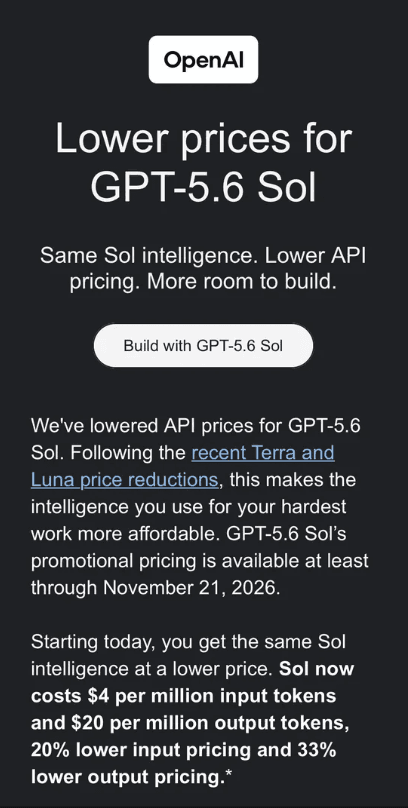
OpenAI launched GPT-5.6 on July 10, 2026, with three models: Luna ($1/$6 per million input/output tokens), Terra ($2.50/$15), and Sol ($5/$30). According to Simon Willison, all three have a February 16, 2026 knowledge cutoff, a million-token context window, and 128,000 maximum output tokens.

Benchmarks vs. Claude: price-performance inversion

The flagship Sol scores 59 on the Artificial Analysis Intelligence Index, one point behind Claude Fable 5. Per The Decoder, at $1.04 per task it costs a third of what Anthropic's top model charges. On Agents' Last Exam, a benchmark of long-running professional workflows across 55 fields, Sol sets a new high of 53.6, eclipsing Fable 5 by 13.1 points. Even at medium reasoning, it beats Fable 5 by 11.4 points at roughly one-quarter the estimated cost.

OpenAI also preemptively attacked a benchmark where it trails badly: SWE-Bench Pro, where Fable 5 scores 80% versus Sol's 64.6%. An OpenAI blog post published the day before estimated that ~30% of SWE-Bench Pro tasks are broken and advised careful examination of results.

API features: multi-agent and programmatic tool calling

The model guidance reveals several new API capabilities. Programmatic Tool Calling allows the model to compose and run JavaScript that orchestrates tool calls, reminiscent of Anthropic's dynamic filtering mechanism. Multi-agent lets the model spin up subagents for parallel focused work — the sub-agent pattern now baked into the core API. Prompt cache breakpoints bring explicit cache control similar to Claude's approach.
OpenAI on Thursday introduced a trio of models tailored to different capabilities, speeds and price points. Photo: Reuters

ChatGPT Work and Chinese user response

OpenAI also launched ChatGPT Work, an agent-based product powered by Codex and GPT-5.6 that handles complex projects across Google Drive, Slack, and Salesforce. According to SCMP, Chinese users accessing the blocked service via VPNs praised the efficiency, though GPT-5.6 remains more expensive than local rivals: Zhipu AI's GLM-5.2 charges ~$1.40 per million input tokens, and DeepSeek V4 up to $0.44.
Zhipu charges about US$1.40 per million input tokens and US$4.40 per million output tokens for its GLM-5.2 model. Photo: Shutterstock Images

What to watch

Watch for third-party agentic coding benchmarks (SWE-bench Verified, Terminal-Bench 2.1) over the next two weeks to validate whether GPT-5.6 Sol's Agents' Last Exam lead holds in head-to-head coding tasks. Also track ChatGPT Work adoption metrics and enterprise seat counts.


Source: scmp.com

[Updated 10 Jul via the_decoder]

Simon Willison noted in early access that GPT-5.6 Sol, while competent, hasn't yet matched Claude Fable 5 on complex coding tasks [per Simon Willison]. He also highlighted that all three models share a February 16, 2026 knowledge cutoff, and that OpenAI's livestream included a demo of 3D pelicans riding various animals, underscoring the model's creative capabilities.

Sources cited in this article

  1. Simon Willison
  2. The Decoder
Source: gentic.news · · author= · citation.json

AI-assisted reporting. Generated by gentic.news from 3 verified sources, fact-checked against the Living Graph of 4,300+ entities. Edited by Ala SMITH.

Following this story?

Get a weekly digest with AI predictions, trends, and analysis — free.

AI Analysis

The GPT-5.6 release marks a structural shift in the AI model market: OpenAI is now competing on price-performance rather than raw benchmark supremacy. The Sol model's 59-point AI Index score — just one point behind Claude Fable 5 — combined with one-third the per-task cost, creates a pricing floor that Anthropic cannot easily match without margin compression. Anthropic's strategy of charging premium prices for marginal benchmark leads may become untenable if OpenAI's efficiency gains hold across real-world workloads. The preemptive attack on SWE-Bench Pro is a notable departure from standard model launch playbooks. Rather than letting the benchmark gap stand, OpenAI published an audit questioning the benchmark's integrity — a tactic that both undermines a specific competitor advantage and introduces uncertainty into the entire model evaluation ecosystem. This is a risky move: if third-party auditors validate SWE-Bench Pro's reliability, OpenAI will have damaged its own credibility. The multi-agent and programmatic tool calling API features suggest OpenAI is betting that the next competitive frontier is agent orchestration, not single-model intelligence. By baking subagent spawning and JavaScript-based tool composition into the core API, OpenAI is trying to commoditize the agent layer that Anthropic has been building with Claude Code and Claude Agent. The winner of this cycle may be determined not by who has the best model, but who has the best platform for composing models into workflows.
Compare side-by-side
Anthropic vs OpenAI
Enjoyed this article?
Share:

AI Toolslive

Five one-click lenses on this article. Cached for 24h.

Pick a tool above to generate an instant lens on this article.

Related Articles

From the lab

The framework underneath this story

Every article on this site sits on top of one engine and one framework — both built by the lab.

More in Products & Launches

View all