OpenAI CEO Sam Altman told CNBC the company's newest model achieves 54% more token efficiency on agentic coding tasks. The metric measures tokens consumed per completed coding action, directly reducing inference cost per task.
Key facts
- 54% token efficiency improvement claimed by OpenAI CEO Sam Altman.
- Metric measures tokens per completed agentic coding action.
- Model name, architecture, and release date not disclosed.
- OpenAI pulled SWE-Bench Pro endorsement in July 2026.
- Anthropic ARR hit $69B in July 2026.
OpenAI CEO Sam Altman told CNBC the company's newest model achieves 54% more token efficiency on agentic coding tasks. The metric measures tokens consumed per completed coding action, directly reducing inference cost per task. OpenAI did not disclose the model's name, architecture, or release date.
The token efficiency angle
Token efficiency is a cost metric, not a benchmark score. A 54% improvement implies the model can complete the same coding task using roughly 35% fewer tokens (1 – 1/1.54). For heavy agentic workloads—where models autonomously edit files, run tests, and iterate—token cost dominates operating expenses. If confirmed, this would make OpenAI's offering significantly cheaper to run than prior versions, narrowing the cost gap with Anthropic's Claude Code, which has been aggressively priced.
Competitive context
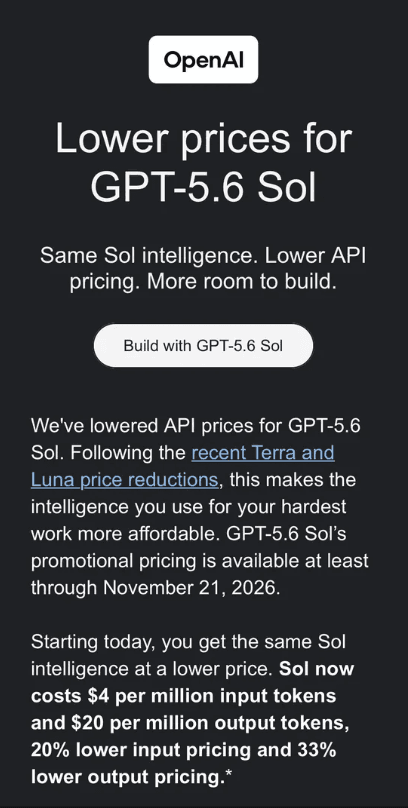
The claim arrives as OpenAI faces mounting pressure from Anthropic's Claude Code and Google's Gemini Code Assist. Anthropic's ARR hit $69B in July 2026, with daily revenue accelerating to $550M [as previously reported]. Google has added background execution and MCP support to Gemini API Managed Agents [as previously reported]. OpenAI itself launched GPT-5.6 in July 2026 with three tiered models (Luna, Terra, Sol) alongside a multi-agent API, but the new model mentioned by Altman appears to be a separate, specialized coding variant—possibly a distillation or a fine-tune optimized for agentic workflows.
Skepticism warranted
OpenAI has a recent track record of pulling benchmark endorsements. In July 2026, the company withdrew its support for SWE-Bench Pro after finding ~30% of tasks were broken [as previously reported]. Without a named model, a public benchmark submission, or a technical paper, the 54% figure remains a vendor claim. OpenAI did not disclose the model's name, architecture, or release date, making independent verification impossible.
What to watch
Watch for OpenAI to release a technical paper or benchmark submission that substantiates the 54% figure. The next earnings call from Microsoft (OpenAI's primary compute provider) may also reveal inference cost trends. If no evidence emerges within 30 days, treat the claim as marketing.
Source: news.google.com