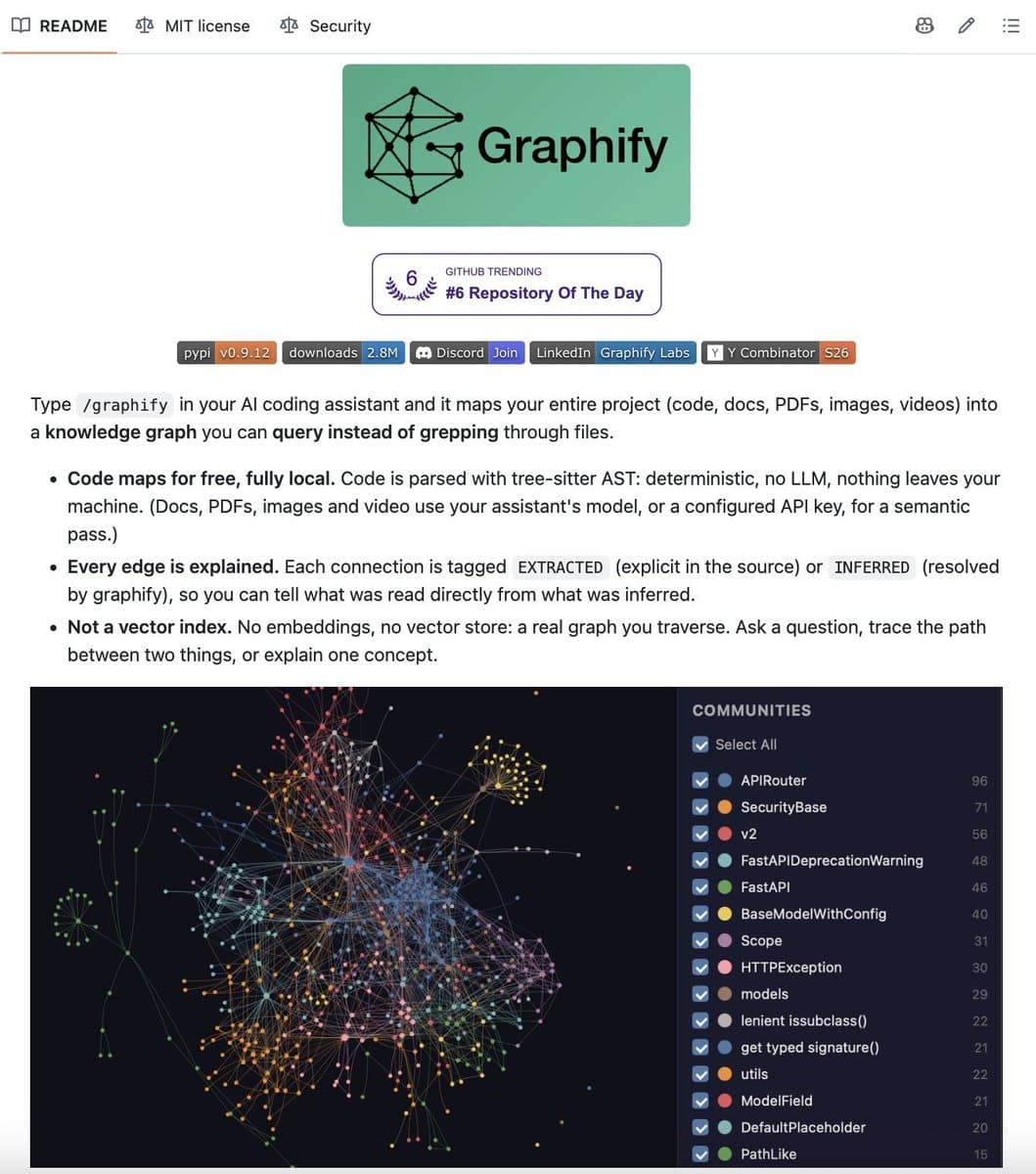
Graphify maps any folder into a local knowledge graph using tree-sitter AST parsing, with zero LLM calls. The tool, now at 82k+ GitHub stars, traverses code, docs, PDFs, images, and videos without vector stores or embeddings.
Key facts
- 82k+ GitHub stars as of announcement
- 40+ languages supported via tree-sitter grammars
- 30 seconds to generate graph.json, graph.html, GRAPH_REPORT.md
- Zero LLM calls, no vector store needed
- Supports 20+ AI coding assistants
Graphify, a tool announced by @_vmlops on X, transforms any folder into a queryable knowledge graph without relying on vector stores or embeddings. According to @_vmlops, it parses code locally using tree-sitter AST, requiring zero LLM calls and ensuring nothing leaves the machine.
The output includes graph.json, graph.html, and GRAPH_REPORT.md, generated in about 30 seconds. Every edge in the graph is tagged as EXTRACTED (explicit in source) or INFERRED (resolved by graphify). The tool supports 40+ languages via tree-sitter grammars and integrates with 20+ AI coding assistants including Claude Code, Cursor, Codex, Gemini CLI, and Copilot.
How it works
Users invoke /graphify . inside their AI assistant. Graphify maps the folder — code, docs, PDFs, images, videos — into a graph that supports query, path, and explain commands directly against graph.json. Unlike RAG pipelines that chunk and embed text into a vector database, Graphify builds a structured graph from the codebase's AST, preserving relationships like function calls, imports, and file dependencies.
The approach avoids the two main failure modes of vector-based code retrieval: semantic drift from embedding models and the lack of explicit relationship tracking. By tagging edges as EXTRACTED or INFERRED, users can audit the graph's provenance — a feature absent in most RAG systems.
Unique take
Graphify represents a contrarian bet against the prevailing RAG-and-vector-store consensus for code understanding. While most tools (GitHub Copilot Chat, Cursor's codebase indexing) rely on embedding models and vector databases to find relevant code, Graphify argues that for codebases, explicit AST relationships are more valuable than semantic similarity. The EXTRACTED vs. INFERRED edge tagging provides a transparency layer that vector stores can't offer — you can trace exactly why two pieces of code are connected.
This matters because code retrieval errors in vector-based systems often stem from embedding models missing structural relationships: a function call is not semantically similar to its callee, but the AST captures it directly. Graphify's approach may be more reliable for complex codebases where exact dependency chains matter more than fuzzy semantic matches.
Limitations
Graphify does not handle natural language queries that require semantic understanding beyond syntax — for example, "find the bug in the payment processing logic" would still need an LLM. The tool also doesn't index runtime behavior or data flow across network calls. The source did not disclose performance benchmarks on large monorepos or compare accuracy against RAG-based alternatives.
What to watch
Watch for Graphify to release benchmark results comparing its graph-based retrieval against vector-based approaches on standard code search tasks like SWE-Bench or CodeSearchNet. Also track whether the tool adds support for dynamic analysis (runtime call graphs) or integrates with CI/CD pipelines for automated documentation generation.
Key Takeaways
- Graphify maps codebases into local knowledge graphs using tree-sitter AST parsing, no LLMs or vector stores.
- At 82k+ stars, it supports 40+ languages and 20+ AI assistants.