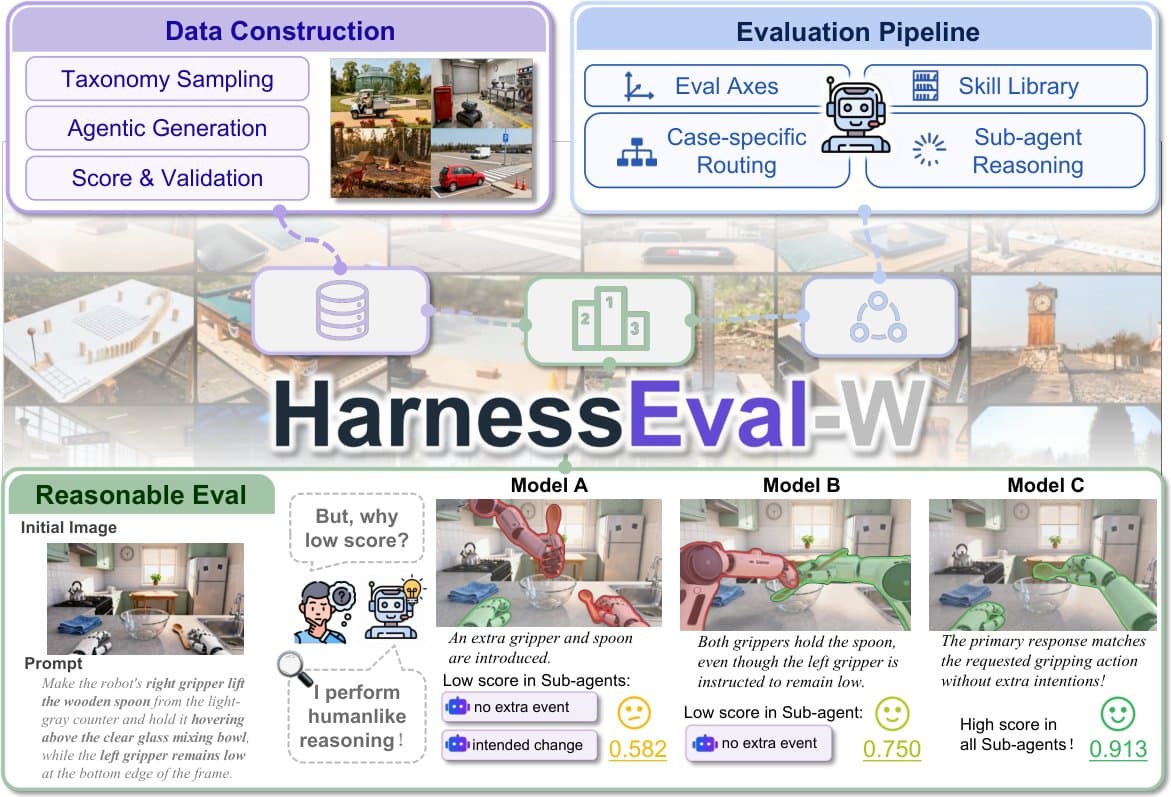
HarnessEval-W, announced via @HuggingPapers, applies the harness paradigm to world model evaluation. The benchmark uses specialized sub-agents to generate auditable reasoning chains behind every score.
Key facts
- HarnessEval-W announced via @HuggingPapers on X
- Applies harness paradigm to visual world model evaluation
- Uses specialized sub-agents for scoring
- Produces auditable reasoning chains per score
- Benchmark scores not disclosed in source
HarnessEval-W, announced via @HuggingPapers, applies the harness paradigm to world model evaluation. The benchmark uses specialized sub-agents to generate auditable reasoning chains behind every score, targeting visual world modeling tasks.
Why the harness matters
The harness paradigm, previously popularized in agentic coding benchmarks, shifts evaluation from a single opaque scalar to a transparent process. HarnessEval-W adapts this for world models, where scoring has historically been a black box. Instead of a final number, the benchmark produces a step-by-step reasoning chain that can be audited by a human or another model.
The core claim is auditable reasoning. Each score is accompanied by a transparent chain of sub-agent decisions, allowing researchers to trace exactly why a model received a particular rating. This is a structural departure from traditional benchmarks like VQA or video prediction metrics that output a single number without explanation [According to @HuggingPapers].
The source does not disclose specific benchmark scores, model rankings, or the exact number of sub-agents used. It does not name the visual world models evaluated or provide comparative results against prior art. The technical details of the sub-agent architecture, prompting strategy, and evaluation dataset size remain unspecified.
The shift in evaluation philosophy
HarnessEval-W represents a philosophical shift: the burden of proof moves from the model to the evaluation process. A world model no longer just needs to perform well; the evaluation must justify why it performed well. This could catch failure modes that aggregate metrics miss, such as a model that scores well on average but fails catastrophically on specific edge cases.
The approach is not without trade-offs. Transparent reasoning chains are more compute-intensive to produce and harder to compare across runs. A single scalar score, while opaque, is easy to rank. HarnessEval-W trades that simplicity for verifiability, a trade that may be worth it for safety-critical world model applications.
What to watch
Watch for the arXiv paper and code release, which should disclose the sub-agent architecture, dataset size, and baseline results. If HarnessEval-W publishes comparative scores against existing world model benchmarks, the delta will reveal whether auditable evaluation changes model rankings or merely confirms them.




