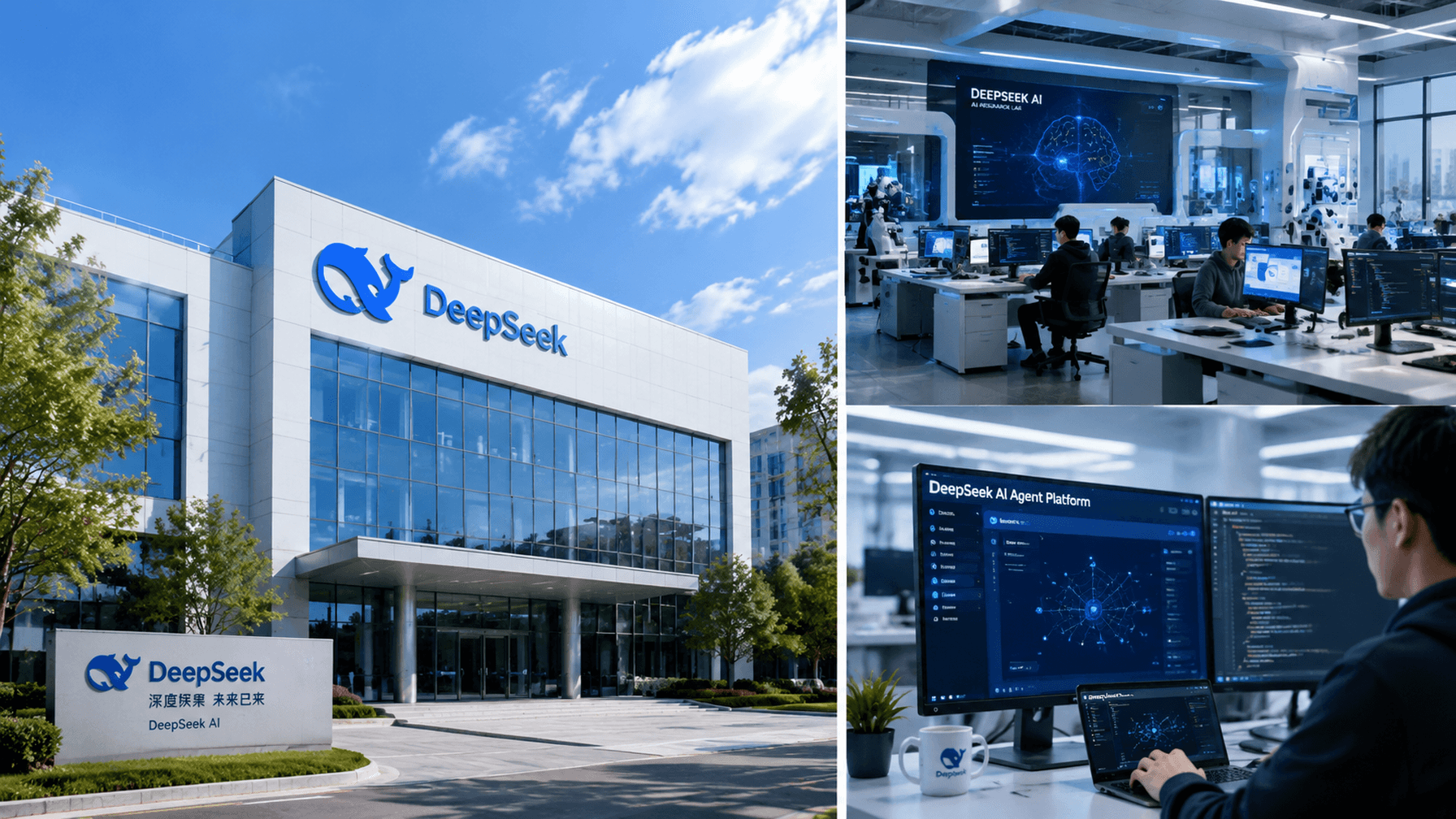
DeepSeek and Zhipu AI have begun developing custom inference chips, joining OpenAI and Anthropic in a vertical integration push. The move signals a structural shift: leading AI labs no longer see silicon as a commodity to be bought but as a strategic asset to be owned.
Key facts
- DeepSeek and Zhipu AI developing custom inference ASICs.
- China's domestic AI chip budget share hits 46% in July 2026.
- Joins OpenAI and Anthropic in custom silicon push.
- Custom inference chips can cut per-token costs by 3-5x.
- Zhipu raised over $1B from Alibaba, Tencent, state funds.
Key Takeaways
- DeepSeek and Zhipu AI are developing custom inference chips to cut GPU costs.
- China's domestic chip budget share hit 46% in July 2026.
The Chip Arms Race Goes Vertical

The two Chinese AI labs confirmed they are building custom inference ASICs, according to a report by Pandaily. DeepSeek, the Hangzhou-based lab behind the open-source DeepSeek-R1 reasoning model, and Zhipu AI, the Tsinghua University spin-off backed by Alibaba and Tencent, are both investing in in-house chip design teams.
China's domestic AI chip budget share rose to 46% in July 2026, driven by DeepSeek and Zhipu exploring custom silicon [per Pandaily]. This mirrors the playbook of Western labs: OpenAI has been hiring chip architects since 2023, and Anthropic has explored custom silicon for inference acceleration, though neither has disclosed a finished chip.
Why Inference Silicon Now
Inference costs remain the dominant operational expense for deployed models at scale. A single query on a frontier model can consume thousands of GPU-seconds. Custom chips optimized for transformer-based inference — specifically sparse attention, KV-cache management, and low-precision math — can cut per-token costs by 3-5x compared to general-purpose GPUs like Nvidia's H100 or B200.
For DeepSeek, which pioneered cost-efficient training with DeepSeek-V3 and R1, the chip move is a natural extension. The lab has already shown it can match frontier performance at a fraction of the compute budget. Owning the silicon lets it further compress the cost curve, potentially widening its margin advantage over closed-source competitors.
For Zhipu, the chip effort mirrors its broader ambition to control the full AI stack — from model architecture (the GLM series) to deployment infrastructure. Zhipu has raised over $1 billion from Chinese tech giants and state-linked funds, giving it the capital to sustain a multi-year chip development cycle.
The Structural Read
This is not merely about chip independence. It signals a maturing industry where model improvements alone no longer provide sufficient competitive differentiation. When every frontier lab can match GPT-4 or Claude-class performance, the moat shifts to cost per token, latency, and vertical integration.
Custom inference chips are the most direct path to a defensible cost advantage. The lab that can run its models at 1/5th the inference cost of its rivals can either undercut on price or reinvest the savings into more capable models. It's a flywheel that general-purpose GPU vendors cannot easily replicate.
The China Angle
The move also has geopolitical implications. U.S. export controls have restricted Chinese access to advanced Nvidia GPUs like the H100 and B200, creating a structural incentive for domestic chip development. China's domestic AI chip budget share rising to 46% is not just a market statistic — it reflects a forced decoupling that is reshaping the global AI supply chain.
DeepSeek and Zhipu are not the first Chinese AI labs to pursue custom chips. Baidu has its Kunlun chips, and Alibaba has the Hanguang 800. But the timing — mid-2026, with inference demand exploding — suggests these chips are being designed for the current generation of models, not the next one.
What's Not Known
Neither DeepSeek nor Zhipu disclosed chip specifications, timeline, or manufacturing partners. It is unclear whether these chips will be fabricated at domestic foundries (SMIC) or rely on TSMC, which faces its own export restrictions. The companies also did not reveal the size of their chip design teams or capital commitments.
What to watch
Watch for tape-out announcements or foundry partnerships from DeepSeek or Zhipu in Q3 2026. A TSMC 3nm or 5nm commitment would signal serious volume ambitions; an SMIC tie-up would indicate full supply-chain decoupling from the West.
Source: pandaily.com
[Updated 10 Jul via scmp_tech]
The shift toward custom chips coincides with a nuanced policy change: China's government now plans to let selected AI firms purchase Nvidia's H200 GPUs, previously restricted under Beijing's self-sufficiency drive [per SCMP]. This selective opening suggests the state is balancing domestic chip ambitions against immediate compute needs, potentially easing pressure on DeepSeek and Zhipu as they develop their own silicon.