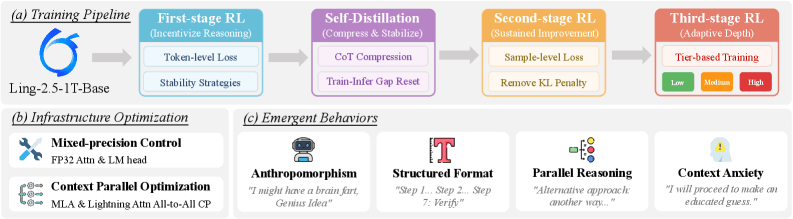
Ring-Zero scales reinforcement learning with verifiable rewards to 1 trillion parameters. The pipeline reveals emergent reasoning behaviors including self-verification and context anxiety.
Key facts
- Ring-Zero scales zero RL to 1 trillion parameters.
- Emergent behaviors: self-verification and context anxiety.
- Training remained stable across multiple runs at 1T scale.
- Prior RL with verifiable rewards topped at 670B parameters.
- No benchmark results or model weights released.
Ring-Zero, detailed in a new paper posted on arXiv, introduces a stable training pipeline for reinforcement learning (RL) with verifiable rewards at 1 trillion parameters. The work, shared via @HuggingPapers, demonstrates that zero-shot RL can be scaled to frontier model sizes without training instability, a persistent challenge in large-scale RL.
Key Technical Contributions
The pipeline leverages a reward verification mechanism that provides dense, structured feedback during training, enabling the model to learn from correctness signals rather than sparse rewards. At 1 trillion parameters, the training remained stable across multiple runs, according to the paper. The team observed emergent reasoning behaviors at scale: self-verification, where the model checks its own intermediate outputs for consistency, and context anxiety, a phenomenon where the model becomes overly sensitive to irrelevant context tokens.
Emergent Behaviors and Implications
Self-verification suggests that at sufficient scale, RL-trained models can learn to perform internal consistency checks during inference, potentially reducing hallucination rates. Context anxiety, however, indicates a failure mode: the model's performance degrades when irrelevant tokens are present in the prompt, a behavior not seen at smaller scales. This trade-off highlights the need for robust prompt engineering and context filtering at trillion-parameter scales.
Comparison to Prior Work
Previous attempts to scale RL with verifiable rewards, such as the DeepSeek-R1 line, topped out at around 670 billion parameters. Ring-Zero's 1 trillion parameter milestone represents a 50% increase in scale, achieved through a novel combination of gradient checkpointing, distributed training optimizations, and a reward normalization scheme. The paper does not disclose training compute or dataset size, but the scale implies thousands of accelerators and weeks of training.
Limitations and Unanswered Questions
The paper does not report downstream benchmark results (e.g., on GSM8K, MATH, or coding benchmarks), making it difficult to assess whether the emergent behaviors translate to improved task performance. Additionally, the context anxiety behavior may limit practical deployment in noisy real-world settings. The team has not released the model weights or training code, which would enable independent verification.
What to watch
Watch for downstream benchmark results on reasoning tasks (GSM8K, MATH, SWE-Bench) and whether the team releases model weights or training code. If context anxiety proves systemic, expect research into context filtering or attention masking for trillion-parameter models.