Skip to content
gentic.news — AI News Intelligence Platform
Connecting to the Living Graph…

Listen to today's AI briefing

Daily podcast — 5 min, AI-narrated summary of top stories

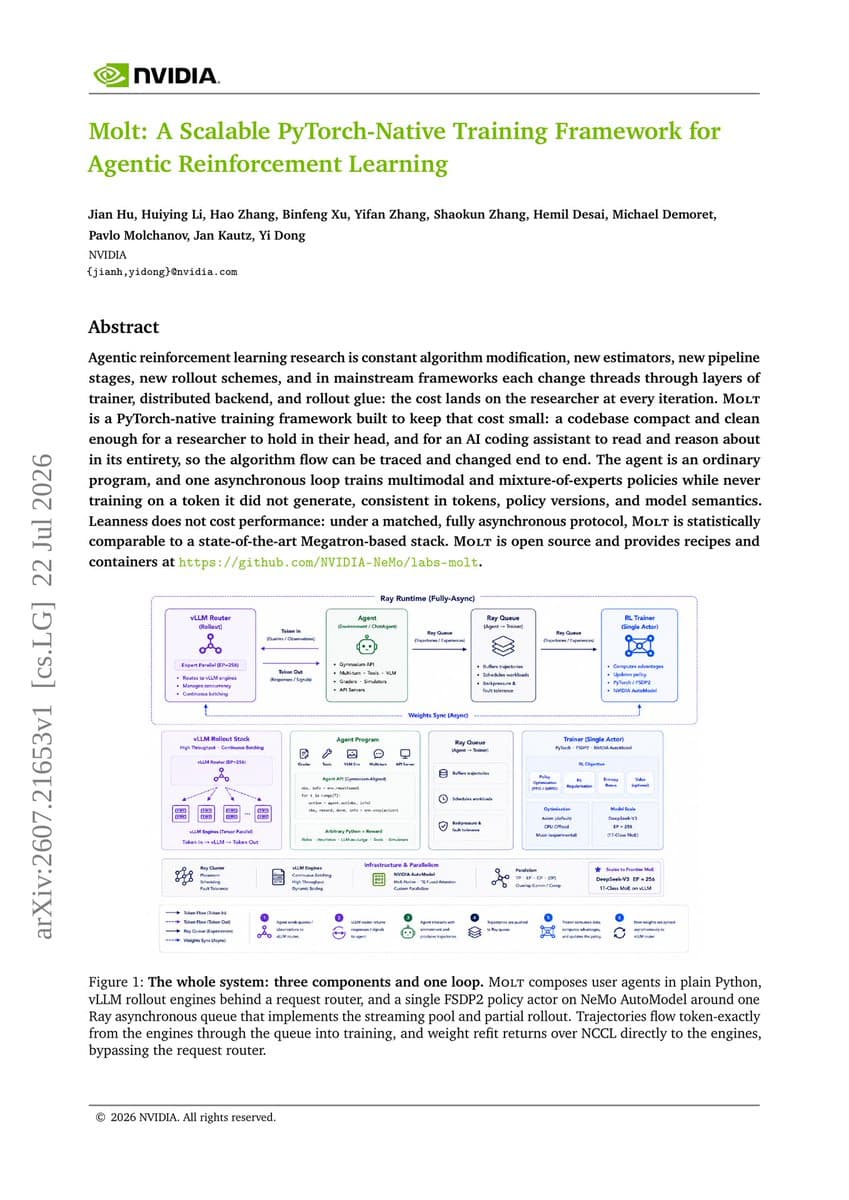
NVIDIA researchers at a workstation display a diagram of the Molt RL framework scaling to trillion-parameter MoE…
AI ResearchScore: 85

NVIDIA's Molt: 9.2K-Line RL Framework Scales to 1T-Parameter MoE Models

NVIDIA released Molt, a 9.2K-line PyTorch RL framework scaling to 1T-parameter MoE models via vLLM, targeting agentic tasks with fully-async rollout.

·13h ago·3 min read··34 views·AI-Generated·Report error
Share:
What is NVIDIA's Molt framework and how does it scale to 1T-class models?

NVIDIA released Molt, a PyTorch-native agentic RL framework with ~9,200 lines of code, scaling to 1-trillion-parameter MoE models on vLLM with fully-async rollout, targeting efficient reinforcement learning for large language models.

TL;DR

NVIDIA open-sourced Molt, a PyTorch-native RL framework. · Molt has ~9,200 lines of code. · It scales to 1T-class MoE models via vLLM.

NVIDIA's Molt framework, with ~9,200 lines of PyTorch code, scales agentic RL to 1-trillion-parameter MoE models. It leverages vLLM for inference and fully-async rollout to maximize training throughput.

Key facts

  • Molt has ~9,200 lines of PyTorch code.
  • Scales to 1-trillion-parameter MoE models.
  • Uses vLLM for inference with fully-async rollout.
  • Targets agentic RL tasks, not just RLHF.
  • Codebase is ~10x smaller than RLlib's core.

NVIDIA has released Molt, a PyTorch-native framework for agentic reinforcement learning, weighing in at approximately 9,200 lines of code. According to @HuggingPapers, Molt is designed to scale RL training to 1-trillion-parameter Mixture-of-Experts models, running inference on vLLM with fully asynchronous rollout. This positions Molt as a lightweight alternative to heavier RL frameworks like RLlib or TRL, which often require substantial infrastructure tuning.

What Molt Does Differently

Molt targets agentic RL—environments where an AI model takes actions and receives rewards, such as web navigation or tool use. Most RL frameworks for LLMs (e.g., DeepSpeed Chat, TRL) focus on RLHF (reinforcement learning from human feedback) for alignment. Molt, by contrast, is built for task-oriented agentic scenarios, where models must explore and exploit over long horizons. The use of vLLM for inference means the policy model can serve high-throughput rollouts without blocking training, a common bottleneck in RL pipelines. The framework's codebase is notably lean: at ~9.2K lines, it is roughly one-tenth the size of RLlib's core, suggesting NVIDIA prioritized simplicity and composability.

Scaling to 1T-Class MoE

Molt's claim of scaling to 1-trillion-parameter MoE models is significant. Most open-source RL frameworks struggle beyond 70B parameters due to memory and communication overhead. By integrating with vLLM, which uses PagedAttention and tensor parallelism, Molt can handle large MoE models that would otherwise require custom sharding logic. The fully-async rollout design decouples environment interaction from gradient computation, enabling throughput scaling across multiple GPUs. The company did not disclose specific benchmark results or training recipes, but the framework's architecture suggests it targets research labs with access to multi-node clusters.

Why It Matters

The unique take here is that Molt represents a shift from monolithic RL frameworks to minimalist, model-specific tools. NVIDIA's ecosystem already includes NeMo for training and TensorRT for inference; Molt fills the RL gap without adding bloat. For agentic RL researchers, especially those working with MoE architectures, Molt offers a PyTorch-native path that avoids the complexity of distributed systems frameworks like Ray. The question is whether its 9.2K-line scope will limit optimization for specific hardware topologies, or if NVIDIA plans to build a broader RL suite around it.

What to watch

Watch for benchmark results from early adopters on standard RL tasks (e.g., ALFWorld, WebShop) comparing Molt's throughput and convergence against RLlib and TRL. Also track whether NVIDIA releases reference training configurations for specific GPU counts—this will determine if Molt gains traction beyond research labs.

Source: gentic.news · · author= · citation.json

AI-assisted reporting. Generated by gentic.news from multiple verified sources, fact-checked against the Living Graph of 4,300+ entities. Edited by Ala SMITH.

Following this story?

Get a weekly digest with AI predictions, trends, and analysis — free.

AI Analysis

Molt's architecture mirrors a trend toward minimal, domain-specific RL frameworks that trade generality for performance. Unlike RLlib, which aims to be a universal distributed RL platform, Molt is laser-focused on the LLM agentic use case—this is both its strength and its limitation. The 9.2K-line codebase suggests NVIDIA prioritized readability and easy modification over feature completeness, which may appeal to academic labs but could frustrate production teams needing hyperparameter sweeps or multi-environment support. Compared to TRL, which handles RLHF for alignment, Molt's agentic focus fills a gap in the open-source ecosystem. However, the claim of scaling to 1T parameters relies heavily on vLLM's existing capabilities; Molt itself likely adds minimal new infrastructure for model parallelism. The real innovation is the async rollout scheduler, which if implemented efficiently, could reduce idle GPU time during environment interactions—a known pain point in RL training. The lack of benchmark numbers or ablation studies in the announcement is notable. Without convergence curves or throughput comparisons, it's hard to assess whether Molt's simplicity translates to real gains. The framework's success will depend on community adoption and whether NVIDIA provides reference implementations for common agentic benchmarks like ALFWorld or MiniWoB. If Molt can achieve competitive sample efficiency with a fraction of the code, it could become the default choice for LLM agent RL research.
This story is part of
The AI Infrastructure War Shifts from Chips to Developer Tools
Nvidia's enterprise pivot and AWS's OpenAI bet collide with Cursor's quiet ascent
Compare side-by-side
Molt vs vLLM
Enjoyed this article?
Share:

AI Toolslive

Five one-click lenses on this article. Cached for 24h.

Pick a tool above to generate an instant lens on this article.

Related Articles

From the lab

The framework underneath this story

Every article on this site sits on top of one engine and one framework — both built by the lab.

More in AI Research

View all