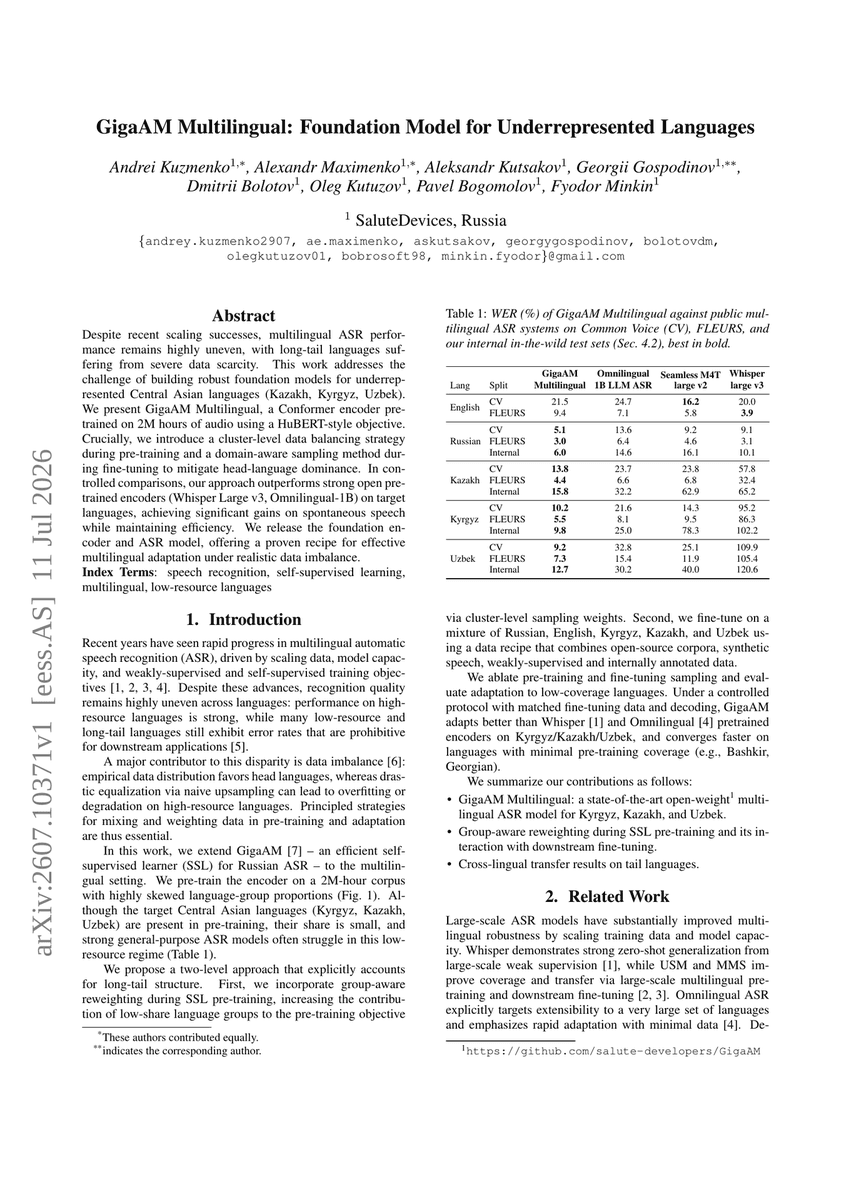
GigaAM Multilingual open-sources two Conformer encoders (220M / 600M params) that reduce WER by 32–86% relative to Whisper-large-v3 on Central Asian languages. The models, pre-trained on 2M hours across 70+ languages, target the severe underrepresentation of non-English speech in foundation models.
Key facts
- Two Conformer encoders: 220M and 600M parameters.
- Pre-trained on 2M hours of speech across 70+ languages.
- 32–86% relative WER reduction vs Whisper-large-v3.
- Open-source release includes model weights and inference code.
- Targets Central Asian languages: Kazakh, Uzbek, Kyrgyz.
The GigaAM Multilingual release, announced on X by @HuggingPapers, provides two Conformer-based speech encoders: a 220M-parameter variant and a 600M-parameter variant. Both were pre-trained on 2 million hours of multilingual speech data spanning over 70 languages, with a focus on Central Asian languages such as Kazakh, Uzbek, and Kyrgyz — languages poorly served by existing models like Whisper-large-v3 and Wav2Vec 2.0.
The key result: relative word error rate reductions of 32% to 86% compared to Whisper-large-v3 on Central Asian language benchmarks. The source tweet [@HuggingPapers] does not disclose the exact benchmark dataset, evaluation protocol, or whether the comparison uses Whisper's greedy decoding or beam search. Nonetheless, the delta is large enough to signal a structural improvement in encoder quality for low-resource languages.
Why the Conformer architecture matters
The Conformer architecture, introduced by Gulati et al. 2020, combines convolution and self-attention to model both local and global speech patterns. GigaAM's two-encoder strategy — 220M for efficiency, 600M for accuracy — mirrors the tiered approach used by OpenAI's Whisper (small through large) but with a different architectural backbone. The 600M model is roughly 40% the size of Whisper-large-v3's 1.5B parameters, yet achieves significantly lower WER on these languages, suggesting that Conformer encoders may be more parameter-efficient for multilingual speech representation than the encoder-decoder Transformer used in Whisper.
Open-source release and implications
Both models are released under an open-source license, enabling fine-tuning on downstream tasks like automatic speech recognition, language identification, and speech translation. The release includes model weights and inference code, though the source tweet does not specify a training recipe, dataset composition, or ablation studies. For researchers working on low-resource languages, GigaAM Multilingual offers a ready-to-use encoder that outperforms the previous state-of-the-art (Whisper-large-v3) by a wide margin without requiring massive compute for inference.
The biggest open question: how well does the 600M model generalize to languages outside Central Asia — e.g., African, Southeast Asian, or Indigenous languages? The source provides no zero-shot or cross-lingual transfer results. Until benchmarked on a broader set, the 32–86% WER reduction should be interpreted as a strong but narrow result.
What to watch

Watch for independent benchmark evaluations on a broader language set (e.g., Common Voice or FLEURS) to confirm whether the 32–86% WER reduction generalizes beyond Central Asian languages. Also track adoption in Kaggle or Hugging Face community fine-tuning projects as a signal of practical usability.