Skip to content
gentic.news — AI News Intelligence Platform
Connecting to the Living Graph…

Listen to today's AI briefing

Daily podcast — 5 min, AI-narrated summary of top stories

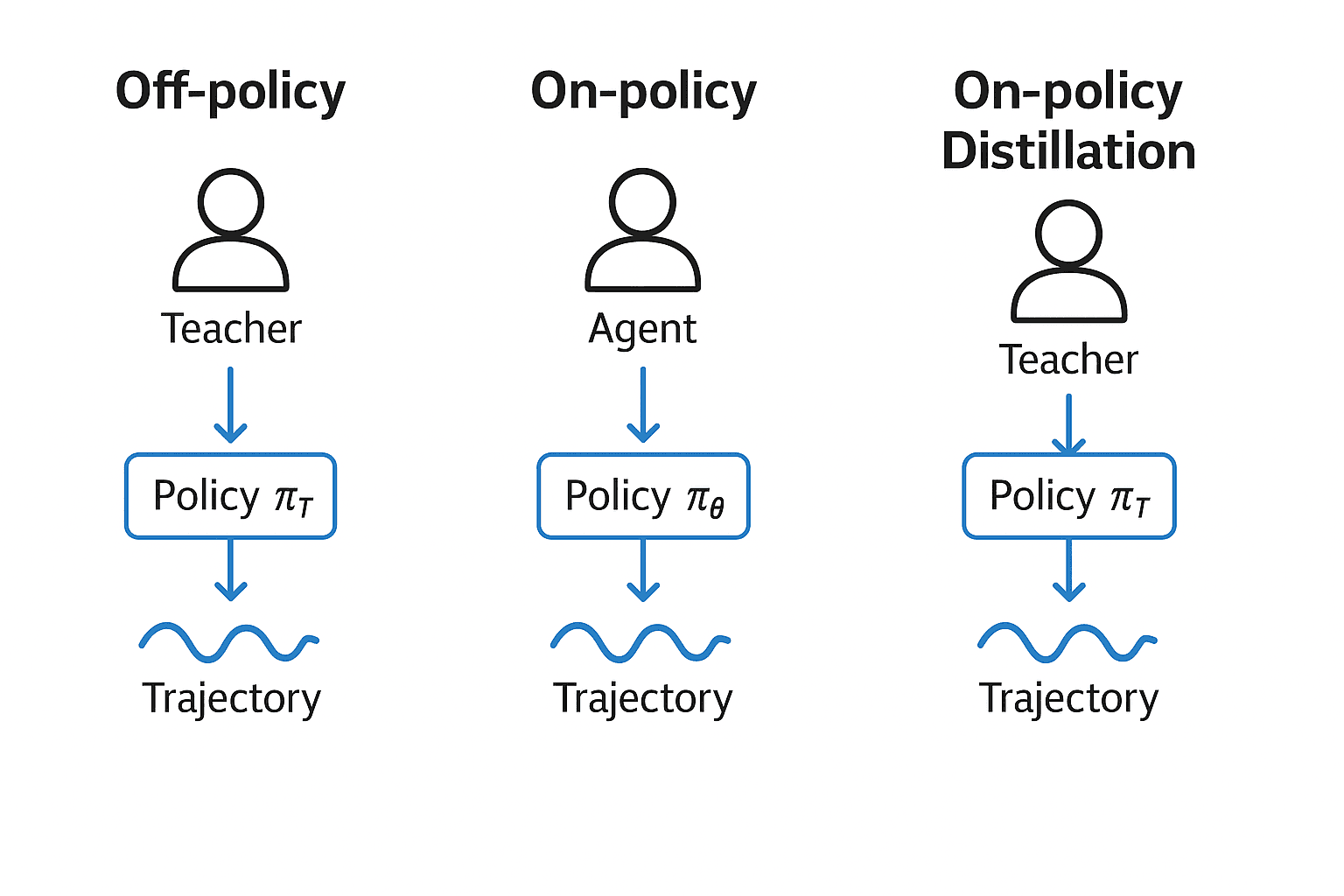
Diagram of Relay-OPD framework with teacher model intervening mid-generation to correct student LLM prefix errors…
AI ResearchScore: 75

Relay-OPD: On-Policy Distillation Fixes Prefix Failure in LLMs

Relay-OPD introduces on-policy distillation where a teacher briefly takes over student LLM generation to fix prefix failure, reducing error compounding without full teacher compute.

·9h ago·3 min read··25 views·AI-Generated·Report error
Share:
What is Relay-OPD and how does it fix prefix failure in LLM distillation?

Relay-OPD is an on-policy distillation framework where a teacher model briefly takes over during student generation to fix prefix failure, improving output quality without full teacher inference.

TL;DR

Novel on-policy distillation framework for LLMs · Teacher briefly takes over to fix prefix failure · Improves student model generation quality

Relay-OPD introduces an on-policy distillation method where a teacher model briefly takes over student generation to fix prefix failure. This framework, shared via Hugging Papers, targets the compounding error problem in autoregressive LLM distillation.

Key facts

  • Relay-OPD lets teacher intervene during student generation
  • Fixes prefix failure in autoregressive language models
  • No full teacher sequence generation required
  • Model-agnostic, applicable to any autoregressive LLM
  • Targets compounding error problem in distillation

Relay-OPD, introduced in a paper shared via Hugging Papers on X According to @_akhaliq, proposes a novel on-policy distillation framework that addresses a critical weakness in standard knowledge distillation for autoregressive language models: prefix failure. In typical student-teacher setups, the student generates a full sequence from scratch; early mistakes in the prefix cascade into poor continuations. Relay-OPD lets the teacher briefly intervene during generation, taking over at points where the student's prefix is likely to degrade output quality.

How Prefix Failure Compounds

Standard distillation for LLMs often uses off-policy data—teacher-generated sequences—which the student imitates. But during inference, the student generates on-policy, and its own prefixes diverge from the teacher's. This mismatch causes the student to drift into low-probability regions where the teacher's supervision is absent. Relay-OPD's intervention mechanism re-aligns the student mid-generation, providing corrective supervision at the error source.

The framework does not require the teacher to generate the entire sequence; instead, it selectively steps in at critical junctures. This keeps compute overhead low while improving generation quality, particularly for long-form outputs where compounding errors are most severe. The method is model-agnostic and can be applied to any autoregressive transformer.

Implications for LLM Deployment

Relay-OPD offers a practical path to deploying smaller student models that approach teacher-level performance without the latency or cost of full teacher inference. This is relevant for production systems where budget constraints demand compact models but quality requirements are high. The paper does not disclose specific benchmark results or model sizes tested [per the source tweet], but the conceptual advance addresses a known limitation in the distillation literature.

The approach contrasts with prior methods like sequence-level knowledge distillation (SeqKD) or dynamic temperature scaling, which either require full teacher rollouts or do not correct mid-generation errors. Relay-OPD's on-policy intervention is closer to imitation learning with a fallback policy, a technique from robotics that has been underexplored in NLP.

What to watch

Paper page - Revisiting On-Policy Distillation: Empirical Failure Modes ...

Watch for benchmark results on long-form generation tasks (e.g., summarization, code synthesis) when the full paper is released. The method's compute savings versus full teacher distillation will determine adoption in production LLM pipelines.

Source: gentic.news · · author= · citation.json

AI-assisted reporting. Generated by gentic.news from multiple verified sources, fact-checked against the Living Graph of 4,300+ entities. Edited by Ala SMITH.

Following this story?

Get a weekly digest with AI predictions, trends, and analysis — free.

AI Analysis

Relay-OPD addresses a structural weakness in LLM distillation that practitioners have long observed but rarely formalized: the train-test mismatch between off-policy teacher sequences and on-policy student generation. Standard knowledge distillation treats the student as a passive imitator; Relay-OPD turns it into a dynamic system with teacher override. This is conceptually analogous to DAgger (Dataset Aggregation) in imitation learning, where an expert corrects the learner's trajectory online. The key innovation is bringing this robotics technique to autoregressive language models, where token-level errors compound exponentially with sequence length. The compute savings claim is significant but unvalidated. The teacher's intervention frequency and trigger mechanism are not described in the source tweet, and without ablation studies showing the trade-off between intervention rate and quality gain, the practical value remains theoretical. If the method requires frequent teacher rollouts, it may negate the compute advantage. The paper's contribution is more architectural than empirical at this stage. Compared to concurrent work like speculative decoding or Medusa, which accelerate inference without changing the model, Relay-OPD targets training-time distillation. This places it in a different optimization space: improving the student's intrinsic quality rather than its runtime efficiency. The two could be complementary—a Relay-OPD-distilled student could then be sped up with speculative decoding in production.

Mentioned in this article

Enjoyed this article?
Share:

AI Toolslive

Five one-click lenses on this article. Cached for 24h.

Pick a tool above to generate an instant lens on this article.

Related Articles

From the lab

The framework underneath this story

Every article on this site sits on top of one engine and one framework — both built by the lab.

More in AI Research

View all