In a rare and specific disclosure during its Q2 2026 earnings call, Costco Wholesale Corporation provided a concrete dollar figure for the impact of its digital personalization initiatives. Executive Vice President and CFO Gary Millerchip stated that personalized product recommendation carousels drove more than $470 million in e-commerce sales during the quarter. This announcement moves the conversation about AI-driven personalization from theoretical benefits to quantified business impact for one of the world's largest retailers.
The Innovation — What Costco Reported
According to the earnings call coverage, Costco's digital strategy is built on two core pillars that are delivering measurable results:
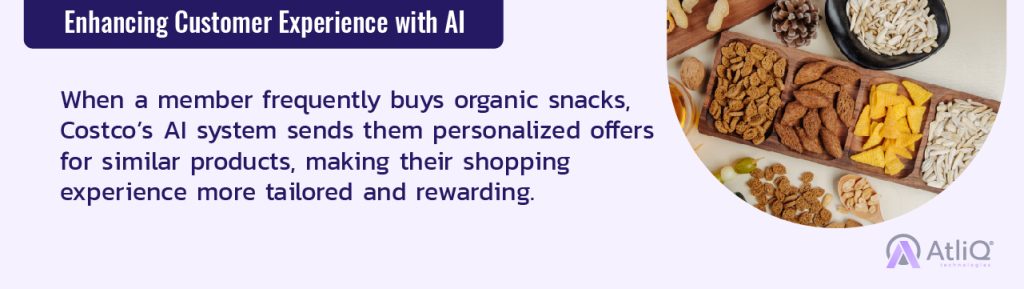
- Personalized Product Recommendation Carousels: These are AI-driven modules on Costco's website and app that suggest items to members based on their browsing history, purchase data, and likely broader behavioral patterns. Millerchip explicitly credited these carousels for the $470+ million in sales.
- Modernized Product Display Pages (PDPs): The retailer has overhauled its product pages to be more engaging and user-friendly, which executives cited as a driver of incremental online traffic.
Beyond e-commerce, Costco's leadership connected digital enhancements to broader operational efficiency. President and CEO Ron Vachris noted that these tools have helped the company manage significant increases in customer traffic without proportionally increasing staffing. Specific in-store digital tools mentioned include:
- A pharmacy app
- "Pay ahead" functionality in warehouses
- Digital wallet enhancements
- Employee pre-scan technology
Vachris stated these innovations led to "meaningful improvements" in checkout speed and employee productivity.
Why This Disclosure Matters for Retail & Luxury
For luxury and premium retail executives, Costco's announcement is significant for several reasons:

1. It Establishes a Benchmark for ROI. The $470M figure provides a rare, public benchmark for the potential scale of personalization ROI. While luxury average order values (AOVs) are far higher than Costco's, the proportional impact on sales conversion and customer lifetime value can be similarly transformative. It answers the boardroom question: "What's the tangible return on our AI/digital investment?"
2. It Highlights a Mature, Integrated Strategy. Costco isn't discussing a pilot or a siloed experiment. The personalization engine is a core, scaled component of its digital roadmap. Millerchip emphasized a "clear road map for future digital enhancements" to continue growing digital-enabled sales faster than overall sales. This reflects a strategic commitment common among leading retailers but now with publicly stated financial justification.
3. It Connects Digital to Physical Operations. Luxury retail is inherently omnichannel. Costco's story reinforces that digital investments (like a pharmacy app or pay-ahead features) directly improve the in-store experience—reducing friction, increasing throughput, and enhancing service. For luxury houses, analogous applications could include appointment scheduling, clienteling tool integration, or seamless click-and-collect experiences.
Business Impact & Implementation Approach
Quantified Impact:
- Direct Sales Lift: >$470M in a single quarter attributed to recommendation carousels.
- Traffic Growth: Modernized PDPs drove incremental online traffic.
- Operational Efficiency: Improved checkout speed and employee productivity, allowing handling of higher volume with stable staffing.
Technical & Strategic Implementation:
Costco's success likely stems from a foundational, integrated approach:
- Data Foundation: Effective personalization requires a unified view of the member (or customer). Costco's membership model provides a strong first-party data advantage, tracking purchases across channels. Luxury brands must similarly integrate data from POS, CRM, e-commerce, and clienteling apps.
- Algorithmic Maturity: Moving beyond "customers who bought X also bought Y" to true contextual and behavioral personalization. This involves machine learning models trained on vast datasets to predict intent and affinity.
- Seamless Experience Integration: The recommendations aren't a standalone feature; they are woven into the browsing journey via carousels on the homepage, category pages, and cart pages.
- Omnichannel Mindset: The digital roadmap supports the physical warehouse experience, viewing technology as a service layer across all touchpoints.
Governance, Risk, and Strategic Considerations
For luxury brands considering or scaling similar initiatives, Costco's example highlights key considerations:

Privacy & Data Ethics: Costco leverages its membership data within a clear value-exchange context. Luxury brands, often dealing with ultra-high-net-worth individuals, must be even more meticulous. Personalization must be executed with explicit trust, transparency, and control. The goal is to feel like a curated, knowledgeable service, not surveillance.
The "Cold Start" Problem (Context from Additional Coverage): A related article on recommendation systems points out the "billion-dollar bottleneck": the "cold start" problem for new users or products with little data. Luxury brands launching new lines or acquiring new clients face this acutely. Solutions involve using rich metadata (product attributes, designer, season, style), leveraging broader trend data, and employing hybrid models until sufficient behavioral data is accumulated.
Brand Alignment & Curation: For luxury, the risk of a poorly calibrated algorithm is brand dilution. Recommendations must uphold brand aesthetics, exclusivity, and price integrity. The AI should act as a digital vendeur, suggesting complementary pieces that elevate an outfit, not just maximize basket size. This requires careful training data selection and business rule overlays.
Maturity Assessment: Costco's results indicate a late-stage, optimized program. Luxury brands should assess their maturity on a spectrum: from basic segmentation (Stage 1) to real-time, individual-level personalization across channels (Stage 4, where Costco appears to be). Investment should align with current data infrastructure and readiness.
Conclusion
Costco's earnings call disclosure is a watershed moment for retail AI. It provides a powerful, quantifiable case study that senior executives can reference when advocating for investment in intelligent personalization systems. For the luxury sector, the lesson isn't to replicate Costco's model directly, but to recognize the proven potential of a sophisticated, data-driven, and omnichannel personalization strategy. The challenge—and opportunity—lies in executing this with the nuance, privacy, and elevated sensibility that defines luxury, turning AI from a utility into a tool for unparalleled client service and business growth.