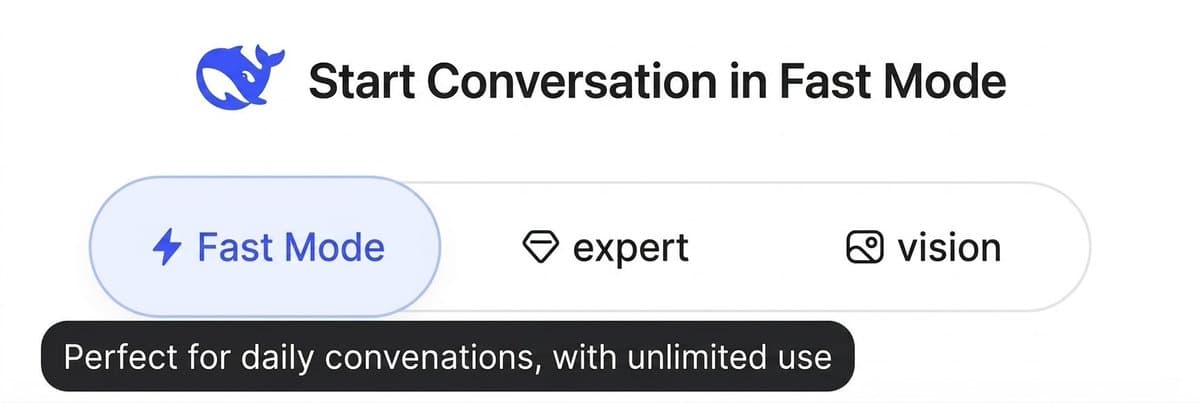
A new interface for the anticipated DeepSeek V4 model has been spotted in limited gray-scale testing, revealing a significant shift in how users might access the model's capabilities. The rollout, reported by the X account @intheworldofai, shows a clear move towards a tiered system of access modes, a strategy recently popularized by other major AI labs.
What's New: A Tiered Interface Emerges
The leaked interface indicates three distinct operational modes for DeepSeek V4:
- Fast Mode: Set as the default, this mode is described as having "unlimited for daily use." This suggests a free or base-tier experience designed for general, lower-complexity queries.
- Expert Mode: A separate, presumably higher-performance tier. The naming implies capabilities suited for more complex reasoning, coding, or technical tasks.
- Vision Mode: A dedicated multimodal tier for processing and reasoning about image inputs.
The structure is explicitly noted as being "similar to Kimi’s tiered system," referring to the Chinese AI company Moonshot AI's Kimi Chat, which employs a similar model-gating strategy. This design strongly implies that the higher-performance Expert and Vision modes will likely come with usage restrictions or rate limits, while Fast Mode serves as an unlimited gateway.
Context: The Strategic Shift to Tiered Access
This development marks a potential strategic pivot for DeepSeek. Historically, DeepSeek has gained attention for offering powerful, open-source models like DeepSeek-Coder and DeepSeek-VL with relatively generous access. The move to a clearly segmented interface suggests the company is formalizing a product strategy that balances widespread accessibility with the high computational cost of running its most capable models.
The "gray-scale testing" phase indicates this is an early, controlled release to a subset of users, likely to gather performance data, test infrastructure load, and refine the user experience before a broader launch. The core question, as noted in the source, is why the rate limits would be applied to the higher tiers. The most probable answers are economic: controlling inference costs for computationally intensive reasoning and vision tasks, and potentially creating a pathway for future premium subscriptions.
What to Watch: Benchmarks, Pricing, and API Access
While the interface leak reveals the product direction, critical details remain unknown:
- Performance Delta: How significant is the capability gap between "Fast" and "Expert" modes? Benchmarks on coding (LiveCodeBench, SWE-Bench), reasoning (GPQA, MATH), and vision (MMMU, ChartQA) will be essential.
- Rate Limits: What will the actual quotas for Expert and Vision modes be? Will they be daily, hourly, or per-session?
- Monetization: Is this tiering a prelude to a freemium model, or will it remain entirely free with limits? DeepSeek's parent company, DeepSeek (深度求索), has not previously charged for API access.
- API Consistency: Will this three-mode structure be reflected in the API offering, allowing developers to choose (and pay for) different capability tiers per request?
gentic.news Analysis
This limited rollout of DeepSeek V4's interface is a concrete step in the ongoing industry-wide normalization of tiered AI access. It follows Moonshot AI's successful implementation with Kimi Chat and aligns with a broader trend we've covered, where leading labs segment their offerings not just by model size (e.g., GPT-4o Mini vs. GPT-4o), but by performance profile within a single model family. This is a more nuanced approach than simply offering a "small" and "large" model.
The move is particularly notable for DeepSeek, a company that has built considerable developer goodwill through its open-source releases and competitive, free API. Implementing rate-limited expert tiers is a logical, if delicate, next step for sustainability. It mirrors the path taken by other formerly free-to-use platforms as model inference costs remain stubbornly high. The key to maintaining its community support will be transparency: clearly communicating the performance benefits of Expert Mode and ensuring Fast Mode remains genuinely useful for a wide range of tasks.
This development also intensifies the competitive dynamics in the Chinese AI landscape, where Kimi, DeepSeek, and Baidu's Ernie series are in close competition. By adopting a similar interface strategy, DeepSeek is signaling it will compete on the same product-ux playing field while hoping its underlying model performance—when V4 benchmarks are finally released—will be the ultimate differentiator.
Frequently Asked Questions
What is DeepSeek V4?
DeepSeek V4 is the anticipated next-generation large language model from Chinese AI lab DeepSeek (深度求索). While full specifications and benchmarks are not yet public, it is expected to be a significant upgrade over previous models like DeepSeek-V3 and DeepSeek-Coder, likely featuring enhanced reasoning and multimodal capabilities.
Is DeepSeek V4 free to use?
Based on the leaked interface, a "Fast Mode" will be available with unlimited daily use, suggesting a free tier will remain. However, the higher-performance "Expert" and "Vision" modes are expected to have usage limits. The company has not announced any pricing, so it is unclear if these limited tiers will remain free or transition to a paid model.
How does DeepSeek's new system compare to ChatGPT or Claude?
The tiered mode system is conceptually different. While OpenAI and Anthropic offer different model families (e.g., GPT-4o vs. GPT-4o Mini, Claude 3.5 Sonnet vs. Haiku), they typically do not offer multiple performance profiles from a single model name. DeepSeek's approach is more similar to Moonshot AI's Kimi Chat, which lets users switch between "Fast" and "Precise" modes within the same Kimi model.
When will DeepSeek V4 be widely available?
There is no official launch date. The model is currently in "limited gray-scale testing," which is a phased rollout to a small percentage of users. A broader public release typically follows after stability and performance are verified during this testing phase, which could take weeks or months.