Dexter: An Autonomous AI Agent for Deep Financial Research, Open-Sourced on GitHub

Dexter: An Autonomous AI Agent for Deep Financial Research, Open-Sourced on GitHub

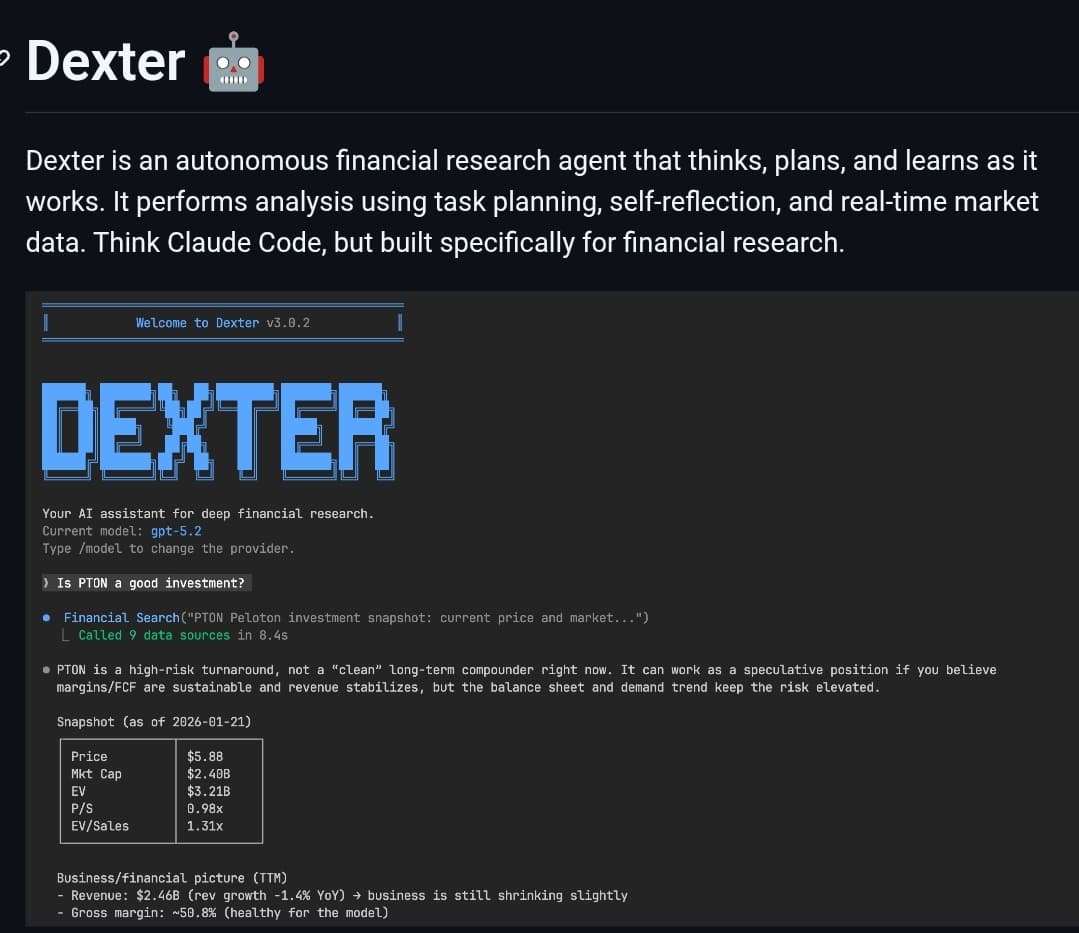
An open-source AI agent named Dexter autonomously conducts deep financial research, pulling real-time data, self-checking analysis, and iterating until confident. Described as 'Claude Code, but for finance,' it breaks down complex financial questions.

9h ago·2 min read·5 views·via @_vmlops
Share:

What Happened

An autonomous AI agent named Dexter has been open-sourced on GitHub. The project, highlighted by the X account @_vmlops, is described as an agent that performs deep financial research autonomously.

According to the brief announcement, Dexter's stated capabilities include:

  • Breaking down complex financial questions.
  • Pulling real-time financial data.
  • Self-checking its own analysis.
  • Iterating on its research process until it reaches a confident conclusion.

The post draws a direct analogy to a known coding agent, framing it as: "Basically: Claude Code, but for finance."

Context

The release of Dexter fits into the rapidly growing category of specialized autonomous AI agents. While general-purpose coding assistants (like the referenced Claude Code) are common, agents tailored for specific, data-intensive domains like finance are less prevalent. The core promise is automating the research workflow—data gathering, synthesis, and analysis—which is typically manual and time-consuming.

Key open questions not addressed in the source material include the specific AI models powering the agent (e.g., GPT-4, Claude 3, open-source LLMs), the exact sources of its "real-time financial data," and its architecture for "self-checking" and iterative reasoning. The GitHub repository linked in the tweet would be the primary source for these technical details.

For practitioners, the significance lies in the open-source availability of a domain-specific agent blueprint, which could be adapted or studied for building similar systems in other verticals like legal research, market analysis, or scientific literature review.

AI Analysis

The Dexter announcement points to two significant, ongoing trends in applied AI. First, it represents the **verticalization of AI agents**. Moving beyond generalist chatbots, developers are building agents with baked-in domain knowledge (finance) and tool integrations (data APIs) to perform complete, multi-step workflows. The value isn't just in answering a question, but in autonomously executing the process a human analyst would follow: query formulation, data retrieval, cross-referencing, validation, and report synthesis. Second, the mention of "self-checks" and iteration touches on the critical challenge of **reliability and hallucination mitigation** in autonomous systems. A financial agent making incorrect inferences based on poor data or flawed logic has real-world consequences. The approach of building in self-critique loops—where the agent evaluates its own intermediate conclusions—is a recognized technique (e.g., Reflexion, AlphaCodium) to improve output robustness. The implementation details here would be key; a simple prompt-based check is different from a structured verification pipeline using separate classifiers or consistency checks. Practitioners should examine the Dexter repo for its **orchestration framework** (likely LangChain or LlamaIndex), its **tooling design** (how it interfaces with data providers like Bloomberg, SEC EDGAR, or Yahoo Finance), and its **reasoning mechanism** (whether it uses Chain-of-Thought, Tree-of-Thought, or a custom planner). Its performance will hinge on the quality of these components as much as the underlying LLM.
Original sourcex.com

Trending Now

More in Products & Launches

View all