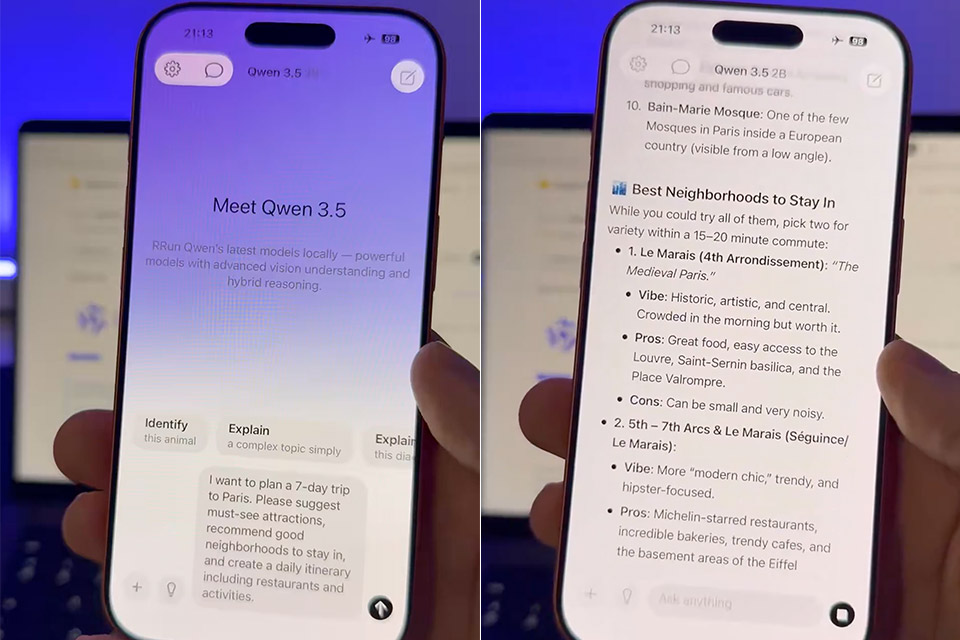
In a development that signals a new era for on-device artificial intelligence, Alibaba's Qwen3.5 2B language model has been successfully deployed to run locally on iPhone 17 Pro devices. This achievement represents what industry observers are calling "the breakthrough that was needed for local models running on the edge" - bringing sophisticated AI capabilities directly to mobile hardware without cloud dependency.
The Technical Milestone
The Qwen3.5 2B model represents a significant advancement in efficient AI architecture. With 2 billion parameters, it strikes a crucial balance between capability and efficiency that makes local deployment feasible on mobile hardware. The iPhone 17 Pro's enhanced neural engine and memory architecture have proven capable of handling this sophisticated model, enabling real-time inference without constant internet connectivity.
This development follows years of incremental progress in model compression, quantization techniques, and hardware optimization. Previous attempts at running large language models locally on mobile devices typically required significant compromises in model size or performance, but the Qwen3.5 2B implementation appears to maintain robust capabilities while operating within mobile hardware constraints.
Why This Matters for Mobile Computing
The implications of this breakthrough extend far beyond technical novelty. Local AI execution fundamentally changes the relationship between users and intelligent systems:
Privacy Revolution: With AI processing occurring entirely on-device, sensitive conversations, documents, and personal data never leave the user's phone. This addresses growing concerns about data privacy and corporate surveillance that have plagued cloud-based AI services.
Latency Elimination: By removing the round-trip to cloud servers, local AI provides instantaneous responses for language tasks, translation, content generation, and analysis. This creates a more natural, responsive user experience that feels integrated rather than mediated.
Offline Capability: Users in areas with poor connectivity or those traveling internationally can access sophisticated AI assistance without internet access, democratizing access to advanced AI tools regardless of infrastructure limitations.
Industry Context and Competitive Landscape
This development arrives at a critical juncture in the AI industry's evolution. Major players including Apple, Google, and Samsung have been racing to develop on-device AI capabilities, recognizing that the future of consumer AI lies in seamless, integrated experiences rather than cloud-dependent services.
Apple's recent focus on neural engine development across its product line suggests the company anticipated this shift toward local AI processing. The iPhone 17 Pro's hardware appears specifically optimized for such workloads, potentially giving Apple an early advantage in the edge AI space.
Meanwhile, Alibaba's decision to optimize Qwen3.5 for mobile deployment represents a strategic move to capture market share in the rapidly evolving edge computing landscape. By making their model compatible with popular consumer hardware, they position themselves as infrastructure providers for the next generation of AI applications.
Practical Applications and Use Cases
The ability to run sophisticated language models locally opens numerous practical applications:
Enhanced Siri and Voice Assistants: Apple's voice assistant could leverage local Qwen3.5 capabilities for more sophisticated conversations, better context retention, and improved task completion without compromising user privacy.
Real-time Translation: Travelers could use their phones for seamless, private conversations across language barriers without relying on cloud services.
Content Creation Tools: Writers, students, and professionals could access AI-assisted writing, editing, and brainstorming tools that work with sensitive documents without uploading them to external servers.
Accessibility Features: Enhanced local AI could power more sophisticated accessibility tools for users with disabilities, providing real-time assistance without connectivity requirements.
Technical Challenges Overcome
Running a 2-billion parameter model on mobile hardware required overcoming significant technical hurdles:
Memory Optimization: The model had to be compressed and optimized to fit within the iPhone's available memory while maintaining performance.
Power Efficiency: Mobile deployment demands exceptional power efficiency to avoid draining battery life during AI operations.
Thermal Management: Sustained AI inference generates heat that must be managed within the constraints of mobile device cooling systems.
Inference Speed: The model must provide responses quickly enough to feel instantaneous to users, requiring careful optimization of inference pipelines.
Future Implications and Development Trajectory
This breakthrough likely represents just the beginning of edge AI advancement. Several developments seem probable:
Model Specialization: We may see models specifically designed and trained for edge deployment, optimized for the unique constraints and opportunities of mobile hardware.
Hardware-AI Co-design: Future mobile processors will likely be designed with specific AI workloads in mind, creating a virtuous cycle of hardware and software optimization.
Decentralized AI Ecosystems: Local AI capabilities could enable new forms of decentralized applications and services that don't rely on centralized cloud infrastructure.
Privacy-First AI Services: Companies may compete on privacy-preserving features, with local execution becoming a key differentiator in AI service offerings.
Challenges and Considerations
Despite the excitement surrounding this development, several challenges remain:
Model Updates: Keeping locally deployed models current without constant cloud connectivity presents logistical challenges.
Hardware Fragmentation: Optimizing models for diverse hardware configurations across different devices and manufacturers complicates widespread deployment.
Security Considerations: While local execution enhances privacy, it also creates new attack surfaces that must be secured.
Developer Adoption: Widespread implementation will require robust tools and frameworks that make it easy for developers to leverage local AI capabilities in their applications.
Conclusion
The successful deployment of Qwen3.5 2B on iPhone 17 Pro devices marks a watershed moment in artificial intelligence development. By bringing sophisticated language models directly to mobile hardware, this breakthrough addresses fundamental concerns about privacy, latency, and accessibility that have limited cloud-based AI adoption.
As noted by industry observer @kimmonismus, this appears to be "the breakthrough that was needed for local models running on the edge" - potentially catalyzing a shift toward more distributed, user-controlled AI systems. The implications extend beyond technical achievement to touch on fundamental questions about data sovereignty, digital autonomy, and the future relationship between humans and intelligent systems.
What emerges most clearly from this development is that the future of AI may not be in massive cloud data centers, but in the devices we carry with us every day - processing our requests, protecting our privacy, and extending our capabilities wherever we go.
Source: @kimmonismus via X/Twitter (https://x.com/kimmonismus/status/2028602520302399701)