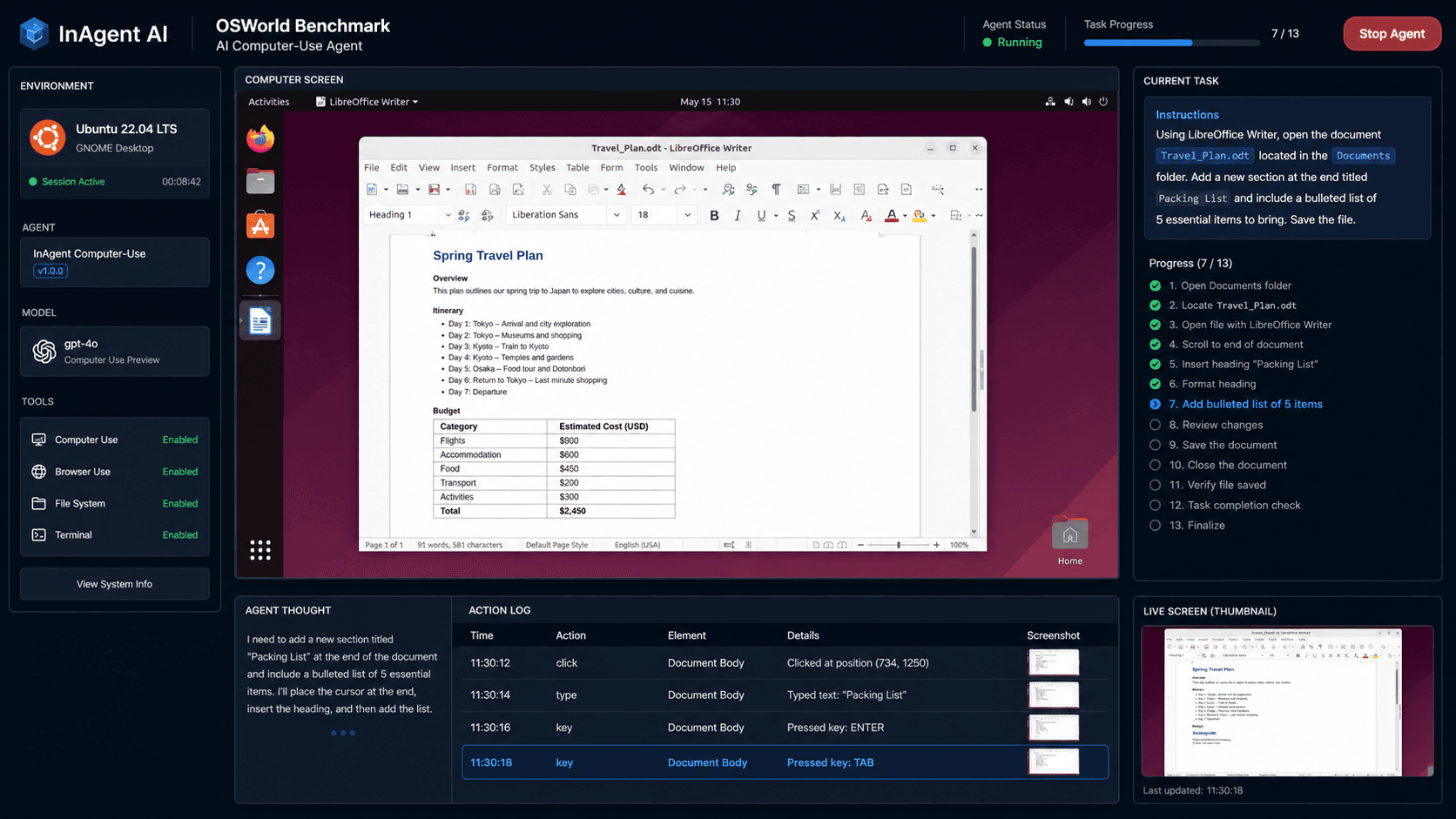
A recent report from InfoQ, titled "Evaluating AI Agents in Practice: Benchmarks, Frameworks, and Lessons Learned," provides a critical examination of the state of AI agent evaluation. As the industry anticipates a potential breakthrough year for AI agents in 2026, this analysis arrives at a crucial juncture, highlighting the gap between theoretical benchmarks and the practical demands of deploying autonomous systems in production environments.
What the Report Covers
The report synthesizes lessons from early adopters and researchers, focusing on the multifaceted challenge of assessing AI agent performance. It argues that traditional LLM benchmarks, which measure accuracy on static datasets, are insufficient for evaluating agents that must perceive dynamic environments, make sequential decisions, and execute actions over time.
Key themes from the report include:
- The Need for Multi-Dimensional Evaluation: Success metrics must extend beyond task completion rates to include reliability, safety, cost-efficiency, and user satisfaction. An agent that completes a task 95% of the time but makes a catastrophic error 5% of the time is not viable.
- Simulated vs. Real-World Testing: While sandboxed simulations are essential for initial development and stress-testing, they cannot fully capture the complexity and unpredictability of live systems. The report emphasizes the importance of phased rollouts and canary testing in real user environments.
- Emerging Frameworks and Protocols: The industry is actively developing new tools for agent evaluation. This includes the movement towards standardizing agent communication, as seen with initiatives like Google's reported development of an Agent2Agent protocol. Such standards aim to create interoperable testing environments and clearer evaluation criteria.
- The Critical Reliability Threshold: The report's context aligns with a significant industry narrative: that AI agents have recently crossed a critical threshold in reliability, particularly for programming and automation tasks. This shift makes rigorous, practical evaluation more urgent than ever, as these systems move from prototypes to core operational components.
The Core Challenge: Defining "Success" for an Agent
Evaluating a chatbot's response quality is challenging but bounded. Evaluating an AI agent is fundamentally different. Consider an agent tasked with managing a digital advertising campaign. Its "actions" might include adjusting bids, pausing underperforming ad sets, and generating new creative variants. A simple benchmark could check if it made the API calls correctly. A practical evaluation must answer:
- Did the campaign's ROI improve?
- Did the agent avoid budget overspend?
- Did it make explainable decisions?
- How did it handle unexpected events, like a sudden change in website traffic?
The report suggests that effective evaluation frameworks are therefore scenario-based, combining automated checks (e.g., "agent did not violate safety guardrail X") with business outcome analysis (e.g., "customer service resolution time decreased by 15%").
Technical and Operational Lessons
Practitioners contributing to the report highlighted several key lessons:
- Instrument Everything: Comprehensive logging of the agent's reasoning trace, tool calls, and environmental state is non-negotiable for debugging and evaluation.
- Build a Feedback Loop: Human-in-the-loop review of a subset of agent actions is crucial for continuous improvement and for catching edge cases that automated tests miss.
- Cost is a Primary Metric: Agentic systems can make numerous LLM calls and API requests. Evaluation must include the cost-per-task and compare it meaningfully to the value generated or the cost of the human alternative.
- Safety and Robustness are First-Class Concerns: Evaluation must proactively test for failure modes, such as prompt injection, tool misuse, or getting stuck in loops, not just measure success rates.
Retail & Luxury Implications
For retail and luxury AI leaders, this report is a vital playbook for moving beyond the hype. The potential applications of AI agents in this sector are vast and directly align with core business functions:
- Personal Shopping & Concierge Agents: Autonomous agents that browse catalogs, check inventory, compare products, and schedule appointments for high-value clients.
- Supply Chain & Inventory Agents: Systems that monitor global stock levels, predict shortages, and autonomously place replenishment orders with vendors.
- Dynamic Pricing & Promotion Agents: Agents that analyze competitor pricing, demand signals, and inventory lifespan to adjust prices or launch micro-promotions in real-time.
- Creative & Content Operations: Agents that manage the end-to-end production of marketing assets, from brief generation to copywriting, translation, and scheduling across platforms.
The central takeaway for retail is that the evaluation strategy must be designed in tandem with the agent's use case. The safety criteria for an agent handling million-dollar inventory purchases are vastly different from those for a social media copywriting agent. A luxury brand's agent interacting directly with top-tier clients requires evaluation focused on brand voice consistency, discretion, and error-free service, where a single misstep could damage a decades-long relationship.
Success in 2026 and beyond will not belong to the brands that build the most agents, but to those that establish the most rigorous, business-aligned frameworks for ensuring their agents are reliable, safe, and valuable.