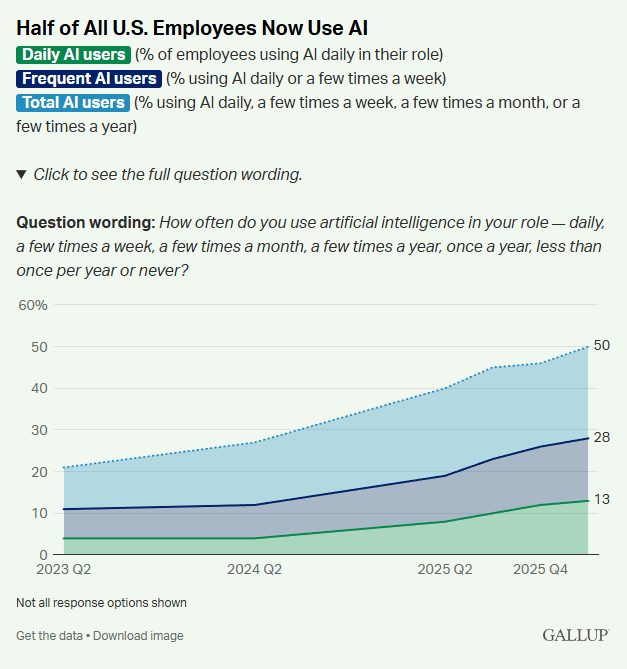
A new Gallup survey has captured a quiet but definitive turning point in the American labor market: for the first time, a majority of employed Americans—50%—report using artificial intelligence in their work. The data, drawn from a Q1 2026 survey of nearly 24,000 workers, shows adoption has more than doubled since 2023, when only 21% reported any AI use.
This milestone signals that AI tools have moved beyond early adopters and tech workers into the daily workflows of the general workforce. The three-year doubling rate suggests a rapid, S-curve style adoption, typical of transformative general-purpose technologies like the personal computer or the internet.
Key Takeaways
- A Gallup survey of nearly 24,000 US workers in Q1 2026 shows 50% now use AI at work, up from just 21% in 2023.
- This marks a critical mass for enterprise AI tools and signals a shift from experimentation to operational integration.
The Data: A Rapid Ascent to Majority Adoption
The core finding is stark: 50% of employed Americans now use AI at work. This figure represents a seismic shift from the landscape just three years prior.
Key Numbers from the Gallup Survey:
Workers Using AI 21% 50% +29 percentage points Approximate User Base ~34 million* ~81 million* +~47 million users *Estimates based on a U.S. employed civilian labor force of ~162 million.The growth represents an addition of roughly 47 million AI-using workers in three years. This surge aligns with the commercial rollout of powerful, accessible generative AI tools beginning in late 2022 and their subsequent integration into enterprise software suites throughout 2024 and 2025.
What "Using AI" Means in Practice
While the Gallup survey measures any AI use, the nature of that use has evolved dramatically since 2023. Early adoption was likely dominated by:
- Knowledge Workers: Using ChatGPT, Claude, or Copilot for drafting, summarizing, and brainstorming.
- Developers: Leveraging GitHub Copilot and similar code-completion tools.
By 2026, use cases have almost certainly broadened and deepened, embedding into core business functions:
- Integrated Copilots: Microsoft 365 Copilot, Google Duet AI, and Salesforce Einstein are now standard in office productivity and CRM software.
- Specialized Tools: AI for marketing copy, legal document review, financial analysis, and customer support automation.
- Low-Code/No-Code Platforms: Employees building simple automations and data apps using AI-assisted platforms like Zapier or Retool.
The 50% figure likely encompasses a spectrum from daily, intensive use to occasional assistance with specific tasks.
The Business and Economic Context

This data point is a leading indicator for several macroeconomic and business trends:
- Enterprise Software ROI: The mass adoption validates the massive investments made by companies like Microsoft, Google, and Salesforce in building AI into their core products. User uptake is necessary to justify licensing fees and demonstrate productivity gains.
- Skills & Training Gap: With half the workforce using these tools, the pressure on companies to provide effective AI training and establish governance policies (around accuracy, security, and ethics) is immense.
- Productivity Metrics: Economists and executives will be scrutinizing 2025-2026 productivity data more closely than ever, looking for the "AI productivity bump" that this level of adoption should theoretically enable.
gentic.news Analysis
This Gallup data point is the statistical confirmation of a trend our reporting has tracked since the launch of GPT-4. The jump from 21% to 50% in three years is explosive, but it follows the predictable diffusion pattern of a general-purpose technology. It contextualizes the frantic enterprise platform wars we covered throughout 2024, where Microsoft, Google, and Amazon aggressively bundled AI assistants into their cloud and productivity suites. Their strategy was clearly to capture this exact wave of adoption.
The 50% threshold is psychologically and practically significant. It moves AI from an optional skill to a core workplace competency. For HR departments and corporate trainers, the mandate is now clear: AI literacy is no longer a niche concern but a baseline requirement for half the workforce. This also raises urgent questions about the other 50%. Is this a divide between knowledge and non-knowledge work, or a lag in adoption that will close in the next survey cycle? The data will pressure companies to accelerate rollouts to avoid creating a two-tier workforce.
Furthermore, this mass adoption creates a massive, real-world feedback loop for model developers. Unlike a controlled research environment, 80 million daily users generate endless edge cases, prompt patterns, and failure modes. This operational data is arguably as valuable as the next training run for improving the robustness, safety, and utility of the underlying models. The era of AI as a research project is conclusively over; it is now an operational technology.
Frequently Asked Questions
What counts as "using AI at work" in the Gallup survey?
The Gallup survey question likely captured any use of artificial intelligence tools to assist with job tasks. This ranges from using a chatbot like ChatGPT or Claude for research and writing, to using an AI-powered feature within software like Microsoft Excel's formula generator or Adobe Photoshop's Generative Fill, to relying on an AI coding assistant like GitHub Copilot. It is a broad measure of exposure, not necessarily intensive or daily use.
Does this mean AI is replacing jobs?
Not necessarily. The survey measures use of AI, not displacement. Historical data on technology adoption suggests that widespread tool adoption often changes the nature of jobs rather than eliminating them outright in the short term. AI is currently functioning more as a productivity augmenter—automating specific tasks within a role (drafting emails, generating code, analyzing data)—which can free up workers for higher-value activities. However, some roles centered entirely on automatable tasks are at risk of being consolidated.
Who are the 50% not using AI at work?
This group likely includes many workers in hands-on, manual, or highly interpersonal roles where current AI tools have less obvious immediate application—think construction, manufacturing line work, nursing, or skilled trades. It may also include workers in companies that have been slow to adopt or provide access to new technologies due to cost, regulation, or cultural resistance. The divide highlights that AI's workplace impact remains uneven across industries and functions.
How does this compare to global AI adoption?
The Gallup survey is specific to the United States. Global adoption rates vary significantly based on factors like digital infrastructure, regulatory environment, and economic development. Regions with strong tech sectors and early corporate investment, like parts of Europe and Asia, may show similar trends. However, the U.S., as a leader in both developing and deploying AI technology and home to many of the leading AI companies, is likely at or near the forefront of this adoption curve.