ByteDance researchers have introduced PersonaVLM, a framework designed to transform standard multimodal large language models (MLLMs) into long-term personalized assistants. Presented as a highlight at CVPR 2026, the work addresses a core limitation of current models: their inability to maintain a consistent, evolving understanding of an individual user across multiple interactions.
The core innovation is the addition of a persistent, updatable user persona module that allows the model to remember past conversations, preferences, and visual contexts. This moves beyond single-session personalization toward a model that learns and adapts over time, much like a human assistant would.
Key Takeaways
- ByteDance researchers unveiled PersonaVLM, a framework that transforms multimodal LLMs into personalized assistants with memory.
- It improves baseline performance by 22.4% and surpasses GPT-4o by 5.2% on personalized benchmarks.
What the Researchers Built

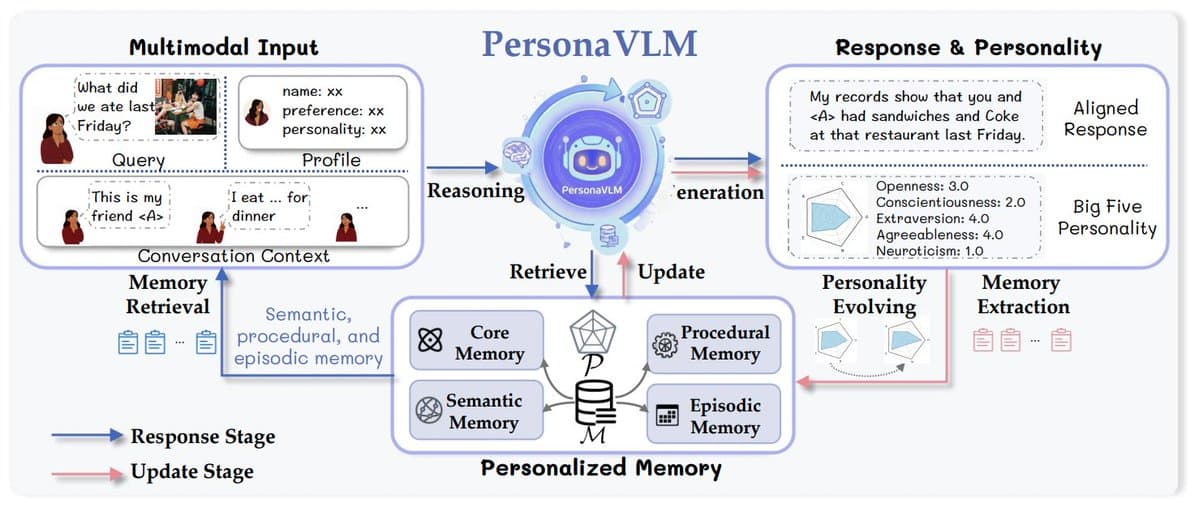
PersonaVLM is not a single new model, but a framework and training methodology that can be applied to existing MLLM architectures. The system consists of three key components:
- Persona Memory Bank: A structured, external memory store that records user-specific information extracted from past dialogues (both text and visual references).
- Persona Reasoning Engine: A module that retrieves and reasons over relevant memories from the bank to inform the current response.
- Personality-Aligned Training: A training regime that fine-tunes the base MLLM to not only use the persona data but to align its response style with a user's indicated preferences (e.g., formal vs. casual, detailed vs. concise).
Key Results
The paper reports significant gains on personalized multimodal benchmarks. According to the tweet summary from HuggingPapers, PersonaVLM delivers a 22.4% improvement over its own baseline (presumably the same base MLLM without the persona framework). More notably, it outperforms OpenAI's GPT-4o by 5.2% on these specialized tasks.
While the full paper details the benchmarks, this result is significant because it shows a specialized architecture for personalization can surpass a general-purpose frontier model like GPT-4o on its targeted problem. The implication is that adding dedicated memory and reasoning for long-term context is more effective than simply scaling up a model's parameter count for this use case.
How It Works: Memory, Retrieval, and Alignment
The technical approach involves several stages:
1. Persona Acquisition: During conversations, the model extracts and summarizes key personal facts, preferences, and visual object associations (e.g., "user prefers minimalist design," "user's dog is a golden retriever named Max"). These are encoded and stored in the memory bank with temporal tags.
2. Contextual Retrieval: For a new query, the reasoning engine performs a similarity search over the memory bank to find the most relevant past entries. It doesn't just retrieve raw facts; it performs inference to combine memories (e.g., connecting a past mention of a vacation photo to a current question about travel preferences).
3. Integrated Generation: The retrieved and reasoned persona context is fused with the current input (image + text) and fed into the base MLLM, which has been fine-tuned to leverage this extra information seamlessly. The training uses a combination of supervised fine-tuning and preference optimization to ensure responses are both accurate and stylistically aligned.
Why It Matters: From Tools to Assistants

Current MLLMs are powerful tools, but they reset with every new conversation. PersonaVLM represents a concrete step toward persistent AI agents that build relationships with users. The 5.2% margin over GPT-4o is a clear signal that this architectural direction has merit.
For developers, the framework suggests that external, structured memory is a viable path forward for personalization, potentially more efficient than attempting to cram all user history into a model's context window. This aligns with a broader industry trend of augmenting LLMs with specialized databases and retrieval systems.
The work is particularly relevant for applications in personalized education, companion AI, and long-term creative collaboration, where understanding a user's history and evolving tastes is critical.
gentic.news Analysis
This development from ByteDance's research arm fits directly into the intensifying competition to build truly persistent AI agents. As we covered in our analysis of Meta's Project CAIRaoke and Google's Astra, the frontier is shifting from raw capability to contextual awareness and memory. PersonaVLM provides a specific, benchmarked blueprint for the "memory" component, an area where many agent frameworks remain theoretical.
The choice to benchmark against GPT-4o is strategically significant. It positions ByteDance's research not just as an academic exercise but as a direct challenge to OpenAI's dominance in general-purpose multimodal models. By showing a specialized architecture can win on a specific axis (long-term personalization), ByteDance is carving out a leadership claim in a high-value niche. This follows ByteDance's pattern of aggressive, applied AI research, as seen in their advancements with the Doubao model series and video generation tools.
Technically, the most compelling insight is the reported efficiency gain. A 22.4% lift over baseline suggests the persona framework adds substantial value without requiring a complete model rebuild. If the methodology is open-sourced or detailed thoroughly in the paper, it could be rapidly adopted by the open-source community, applying pressure on closed-source API providers like OpenAI and Anthropic to accelerate their own personalization features. The race is no longer just about who has the smartest model, but who can build the most attentive one.
Frequently Asked Questions
What is PersonaVLM?
PersonaVLM is a research framework from ByteDance that adds long-term memory and personality alignment capabilities to standard multimodal large language models (MLLMs). It allows an AI to remember details about a user across multiple conversations and tailor its responses accordingly.
How does PersonaVLM outperform GPT-4o?
According to the research, PersonaVLM outperforms GPT-4o by 5.2% on personalized multimodal benchmarks. It achieves this not by being a larger model, but by using a specialized architecture with an external memory bank and reasoning engine dedicated to maintaining and utilizing a persistent user persona, which GPT-4o lacks.
What are the practical applications of PersonaVLM?
The technology is designed for applications requiring long-term user understanding, such as personalized AI tutors that adapt to a student's learning history, companion AIs that remember personal preferences and stories, or creative co-pilots that learn an artist's style and preferences over time.
Is PersonaVLM available to use?
As a CVPR 2026 Highlight paper, it is currently a research framework. The model or code may be released publicly, but as of now, it is a demonstration of a method. The techniques described could influence future products from ByteDance (like their Doubao models) and the wider open-source MLLM community.