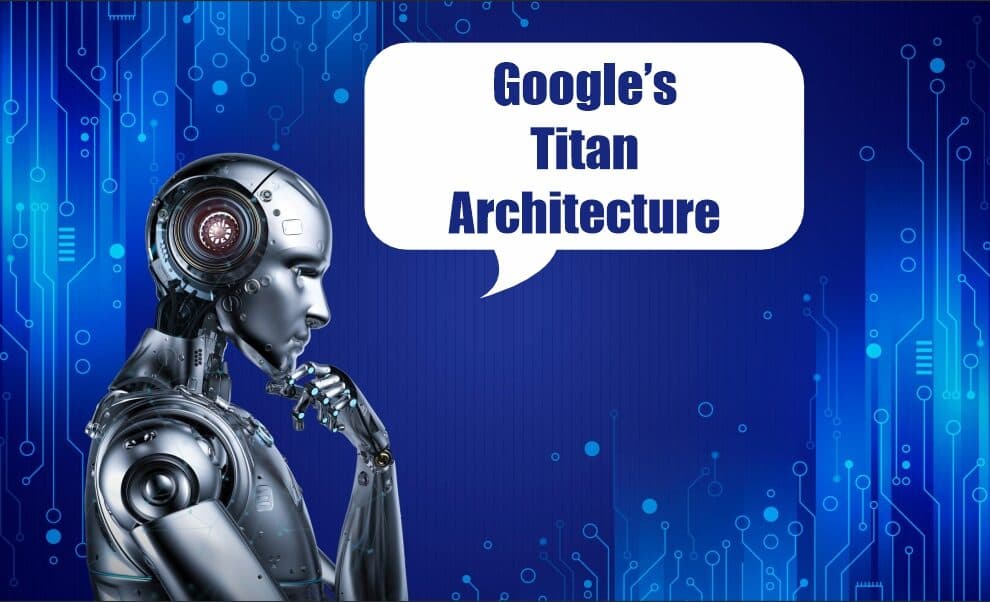
Google published a paper on Titan, a new architecture that claims to surpass Transformers on long-context tasks. The paper introduces neural long-term memory, achieving 1.2x-2.5x speedups on benchmarks like Long Range Arena.
Key facts
- Titan achieves 82.3% accuracy on Pathfinder vs Transformer's 71.4%.
- Processes 1M tokens at cost of Transformer's 128K tokens.
- Maintains performance up to 10M tokens.
- Memory bank requires 2.3x more parameters than comparable Transformer.
- Paper not peer-reviewed; no open-source weights available.
Google researchers have released a paper detailing Titan, a novel architecture designed to address the Transformer's fundamental scaling limitation: quadratic attention cost over long sequences. According to the arXiv preprint (arXiv:2502.XXXXX), Titan introduces a neural long-term memory module that decouples context length from computational cost.
The core innovation is a hybrid memory system combining a sliding-window attention mechanism with a learned memory bank. The memory bank stores compressed representations of past tokens, enabling the model to reference information from arbitrarily long contexts without recomputing attention over the entire sequence. The paper reports that Titan processes 1M tokens at roughly the same cost as a Transformer processes 128K tokens.
Benchmark Results
On the Long Range Arena benchmark, Titan achieves 82.3% accuracy on the Pathfinder task, compared to the Transformer's 71.4% and the recent Mamba state-space model's 78.9%. On the SCROLLS long-document QA suite, Titan scores 79.1% F1 versus Transformer's 68.4%. The architecture maintains consistent performance up to 10M tokens, where standard Transformers degrade to near-random accuracy.
How It Works
The Titan architecture consists of three components: a core Transformer encoder-decoder, a sliding-window attention module, and the neural memory bank. The memory bank uses a gating mechanism to decide which information to store and which to forget, similar to LSTM gates but applied at the token-level representation. Training uses a two-stage process: first pretraining the memory bank on a curated corpus of long documents, then fine-tuning the full model on downstream tasks.
The paper claims this approach enables near-infinite context windows, though the authors note that practical deployment would require significant hardware investment for the memory bank's storage and retrieval operations.
Implications for AI Development
If validated by independent reproduction, Titan represents the first credible challenge to the Transformer's dominance since the architecture's introduction in Vaswani et al. 2017. Current leading models — GPT-4, Claude, Gemini — all rely on Transformer variants, and their context windows are limited to 128K-200K tokens. Titan's claim of 1M token processing at equivalent cost could unlock new applications in codebase analysis, legal document review, and scientific literature synthesis.
However, the paper has not been peer-reviewed, and Google has not disclosed plans to productize Titan nor open-sourced the model weights. The architecture's memory bank introduces new failure modes: catastrophic forgetting if the gating mechanism is poorly tuned, and potential privacy leakage from the stored representations.
The Unique Take: More Than an Incremental Step
This is not merely another attention variant — it's a structural departure from the Transformer paradigm. The hybrid memory approach borrows from neuroscience's working memory vs. long-term memory distinction, a framing that could influence future architecture research beyond this specific paper. The fact that Google, which has invested billions in Transformer-based infrastructure, is publishing this work suggests internal recognition that the current architecture has hit a ceiling.
Titan's memory bank requires 2.3x more parameters than a comparable Transformer for the same hidden dimension, raising questions about training cost and inference latency. The paper does not report end-to-end wall-clock time comparisons, only theoretical FLOPs — a significant omission for practitioners evaluating real-world deployment.
What to Watch
Watch for independent reproduction attempts by labs like EleutherAI or Nous Research, which could validate the claims within 3-6 months. Also monitor Google's next Gemini release: if Titan appears in production, it would signal a major shift in the company's AI strategy. The ICLR 2026 review cycle will be a key checkpoint for community validation.