Skip to content
gentic.news — AI News Intelligence Platform
Connecting to the Living Graph…

Listen to today's AI briefing

Daily podcast — 5 min, AI-narrated summary of top stories

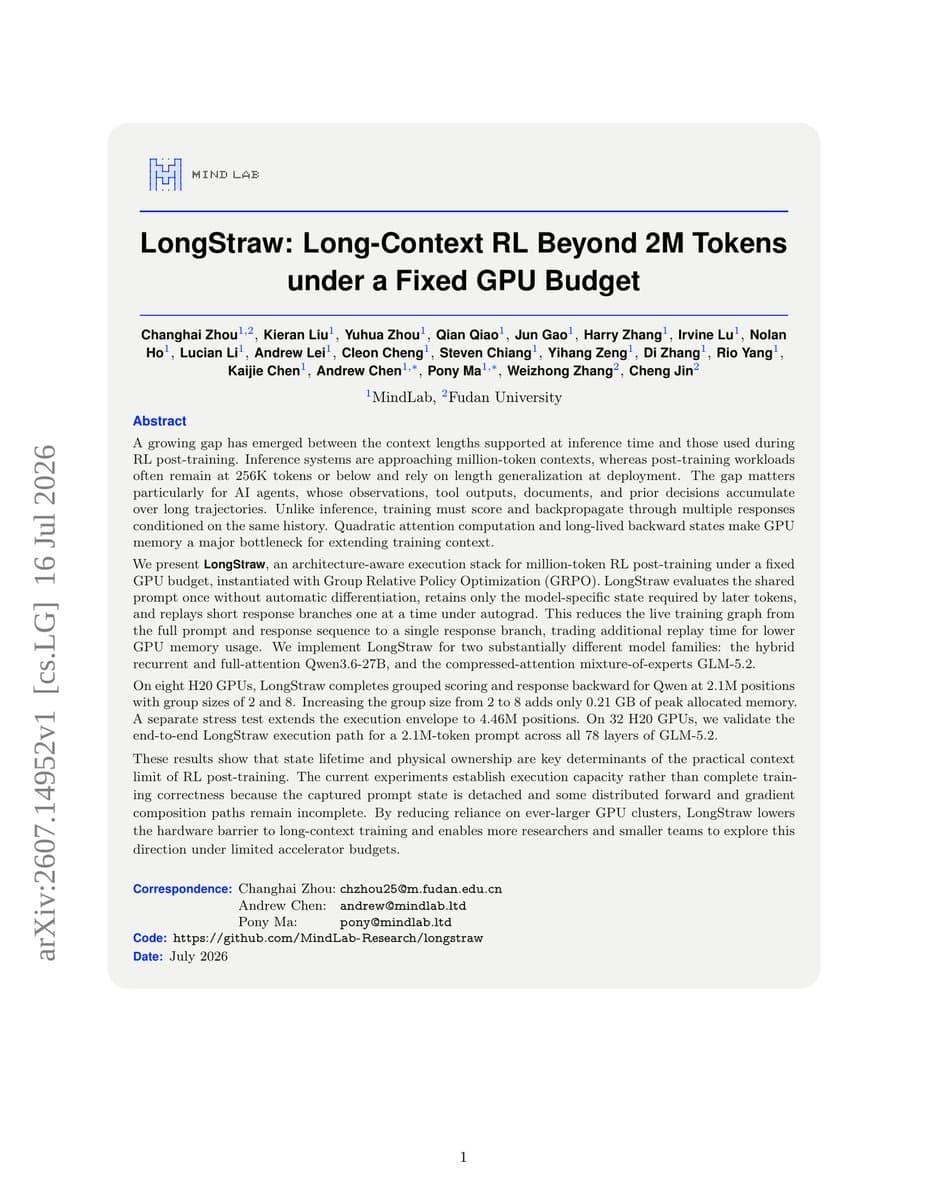
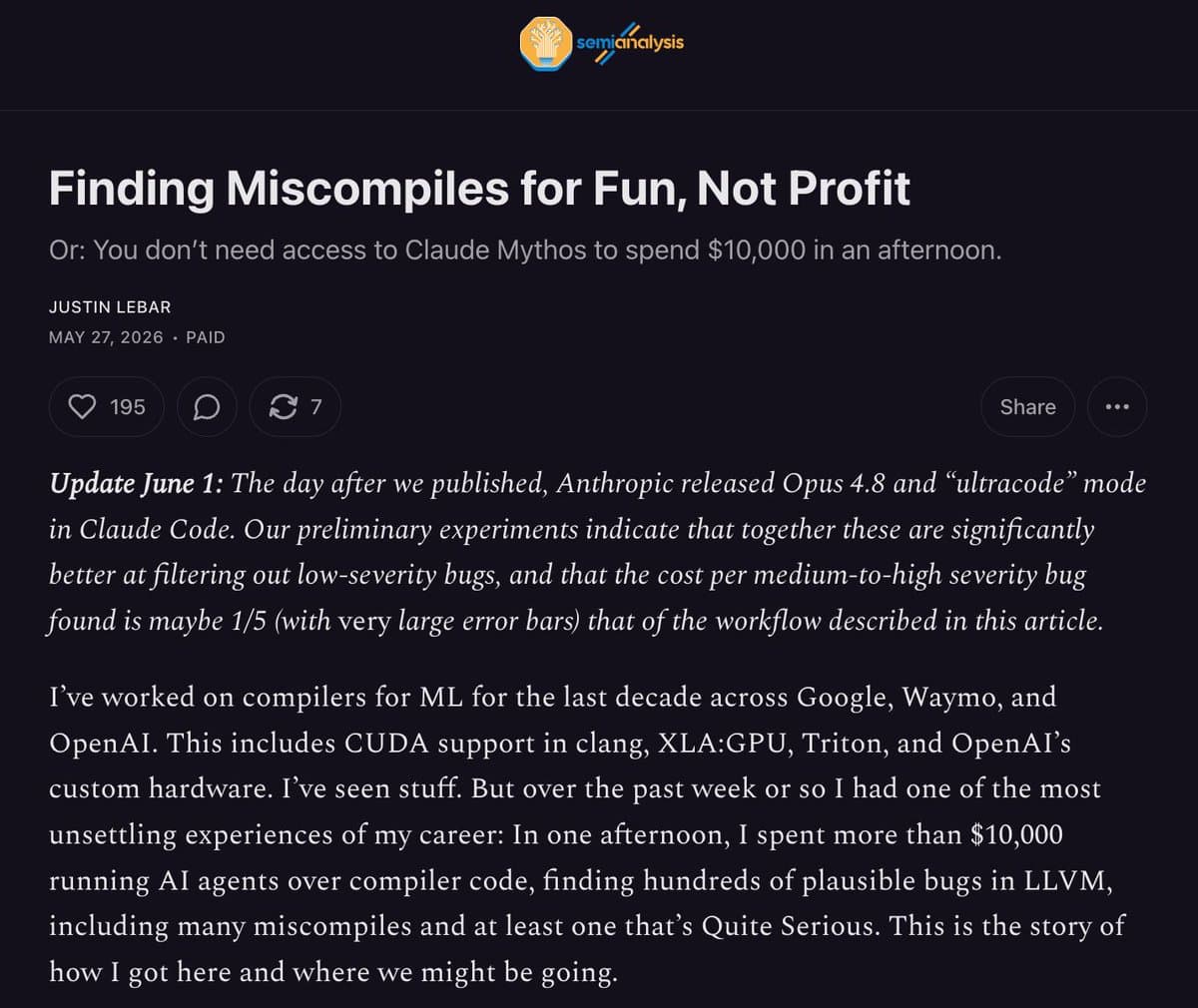
SemiAnalysis logo and chart showing bug-finding cost dropping fivefold with Anthropic Opus 4.8, alongside Claude…
AI ResearchScore: 93

Anthropic Opus 4.8 Cuts Bug-Finding Cost by 5x, SemiAnalysis Finds

Anthropic's Opus 4.8 + ultracode mode cuts severe bug-finding cost to ~1/5, per preliminary SemiAnalysis experiments with wide error bars.

·16h ago·3 min read··20 views·AI-Generated·Report error
Share:
How much does Anthropic's Opus 4.8 with ultracode mode reduce bug-finding costs?

Anthropic's Opus 4.8 with Claude Code's ultracode mode reduces the cost per medium-to-high severity bug found to roughly 1/5 of prior workflows, per SemiAnalysis preliminary experiments with wide error bars.

TL;DR

Opus 4.8 + ultracode mode cuts bug-finding cost 5x. · SemiAnalysis preliminary experiments show improved severity filtering. · Release followed SemiAnalysis article on miscompilation economics.

Anthropic released Opus 4.8 and ultracode mode in Claude Code on March 4, 2026. Preliminary experiments from SemiAnalysis suggest the cost per medium-to-high severity bug found has dropped to roughly 1/5 of previous workflows.

Key facts

  • Opus 4.8 + ultracode mode released March 4, 2026
  • Cost per severe bug found drops to ~1/5 of prior workflows
  • SemiAnalysis reports very large error bars, preliminary result
  • Release came 24 hours after SemiAnalysis miscompilation article
  • New workflow filters out low-severity bugs significantly better

Anthropic released Opus 4.8 and ultracode mode in Claude Code on March 4, 2026, the day after SemiAnalysis published its article "Finding Miscompiles for Fun, Not Profit" [per @SemiAnalysis_]. The release appears to directly address the central economic problem that article identified: the high cost of finding severe bugs in AI-generated code.

SemiAnalysis ran preliminary experiments on the new workflow. The results indicate that Opus 4.8 combined with ultracode mode is "significantly better at filtering out low-severity bugs," which historically have dominated the noise floor of automated bug detection. The cost per medium-to-high severity bug found is "maybe 1/5 (with VERY large error bars) that of the workflow described in this article" [per @SemiAnalysis_].

The firm explicitly cautioned that the error bars are very large and the result is preliminary. Still, the improvement direction is consistent with the structural argument in the original article: that the bottleneck in AI-assisted code review is not detection but triage. If Opus 4.8 can suppress the long tail of trivial findings, the effective signal-to-noise ratio for developers improves dramatically.

Unique Take

This is not just a model upgrade — it is Anthropic responding to a specific economic critique published 24 hours earlier. The speed of the release (one day after the article) suggests that either the capability was already in testing and the timing was opportunistic, or that Anthropic is now tuning model releases to explicitly address real-world cost metrics rather than benchmark scores.

How the workflow changed

SemiAnalysis did not disclose the exact mechanism of ultracode mode or the architectural changes in Opus 4.8. The company's blog post and release notes have not been published as of this writing. What is clear is that the new system changes the cost curve: if the 5x improvement holds under rigorous measurement, the effective price per actionable bug found falls from roughly $2-5 (estimated from the original article's figures) to $0.40-1.00.

What to watch

Watch for Anthropic's official release notes on Opus 4.8 and ultracode mode, which should clarify whether the improvement is in the model's classification head, the agentic loop in Claude Code, or both. Also watch for independent replication by Cursor, GitHub Copilot, or Cline — if the 5x figure holds, competitors will need to match it or risk losing the code-review segment.

What to watch
Anthropic’s Claude Opus 4.6 gains financial research, improved coding ...

Watch for Anthropic's official release notes on Opus 4.8 and ultracode mode, expected within days. Also watch for independent replication of the 5x cost figure by Cursor or GitHub Copilot teams, which would validate or challenge the preliminary result.
Sources cited in this article

  1. SemiAnalysis
Source: gentic.news · · author= · citation.json

AI-assisted reporting. Generated by gentic.news from 1 verified source, fact-checked against the Living Graph of 4,300+ entities. Edited by Ala SMITH.

Following this story?

Get a weekly digest with AI predictions, trends, and analysis — free.

AI Analysis

The key structural insight here is not the model improvement but the speed of Anthropic's response to a specific economic critique. SemiAnalysis published its miscompilation article on March 3; Anthropic shipped a targeted fix on March 4. This is unprecedented in the AI vendor playbook — historically, model releases are tied to benchmark cycles or conference schedules, not to third-party cost analyses. The 5x figure, even with large error bars, suggests that the bottleneck in AI-assisted code review is not detection capability but triage economics. Prior workflows (including the one described in SemiAnalysis's original article) generated so many low-severity findings that the cost of manual review swamped the value of the high-severity catches. If Opus 4.8's ultracode mode can effectively learn to suppress the noise floor, the unit economics of AI code review fundamentally change. This is analogous to what happened with AI code generation itself: the first wave of tools produced too many hallucinations to be useful; improvements in precision drove adoption. That said, the lack of transparency from Anthropic is a concern. No release notes, no benchmark numbers, no architectural details. The entire claim rests on a single preliminary experiment by a firm that has a financial interest in the narrative (SemiAnalysis sells research subscriptions). Independent replication is essential before treating the 5x figure as established fact.
Compare side-by-side
Anthropic vs SemiAnalysis
Enjoyed this article?
Share:

AI Toolslive

Five one-click lenses on this article. Cached for 24h.

Pick a tool above to generate an instant lens on this article.

Related Articles

From the lab

The framework underneath this story

Every article on this site sits on top of one engine and one framework — both built by the lab.

More in AI Research

View all